

Tulu Accorded Additional Official Language Status in Karnataka
Context: The Karnataka Cabinet accorded Tulu the status of second additional administrative language in Dakshina Kannada and Udupi districts.
More on the News
- The status will apply to administrative matters in Dakshina Kannada and Udupi, with the respective district administrations as implementing agencies.
- The decision implements the recommendations of a committee headed by educationist M. Mohan Alva, appointed to study Tulu language and culture.
About Tulu
- Tulu is one of the five Dravidian languages, spoken mainly in Dakshina Kannada, Udupi and parts of northern Kerala, with around 1.8–2 million native speakers.
- It has a strong oral tradition and rich folklore, with cultural practices such as Yakshagana and Bhoota Kola.
- Though it historically had its own script, it is now largely written using the Kannada script.
- Tulu-speaking communities have sought official recognition for decades, with the demand repeatedly raised in the Karnataka Legislature and through social-media campaigns.
- Article 345 empowers a State Legislature to adopt a language in use in the State as an official language for administrative purposes.
Significance
- Administrative inclusion: Government notifications and communication can now be issued in Tulu in the two districts.
- Cultural preservation: It can promote Tulu language, literature and coastal Karnataka’s cultural heritage.
- Language promotion: Dedicated funding for translation and training can facilitate the practical use of Tulu.
- Constitutional recognition: Article 347 provides for recognition of a language in a State or a part of it when a substantial proportion of the population demands it.
- Recognition gap: Tulu remains outside the Eighth Schedule, which currently recognises 22 languages, despite long-standing demands for its inclusion.
KAVACH Version 4.0
Context: Indian Railways has commissioned KAVACH Version 4.0 for the first time on South Central Railway (SCR), upgrading the system from Version 3.2 to Version 4.0 across 108 route kilometres on the Malkajgiri–Kamareddi section of Hyderabad Division.
About KAVACH
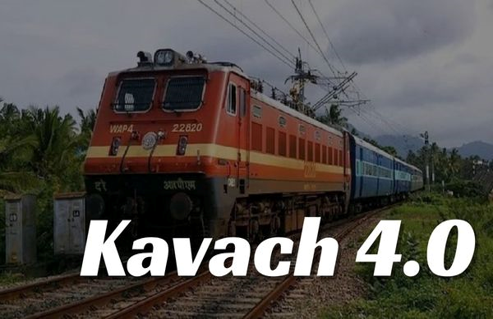
- KAVACH is an indigenously developed Automatic Train Protection (ATP) system designed to enhance operational safety.
- It assists the loco pilot in maintaining prescribed speed limits and can automatically apply brakes when required if the loco pilot fails to do so.
- It helps prevent Signal Passing at Danger (SPAD), control train speed in critical situations and reduce the risk of collisions.
- KAVACH has evolved through successive versions, including Versions 1.0, 2.0, 3.0/3.2 and 4.0, with technological improvements based on operational experience and the requirements of Indian Railways.
- Version 3.2 had been deployed over 1,465 route kilometres on SCR, providing experience for further improvements.
- KAVACH requires the highest safety certification, Safety Integrity Level-4 (SIL-4).
About KAVACH Version 4.0
- KAVACH 4.0 incorporates technological improvements to cater to the diverse operational and technological requirements of Indian Railways.
- Increased location accuracy enables more precise train positioning.
- Improved information on signal aspects in larger yards strengthens situational awareness.
- A station-to-station KAVACH interface through Optical Fibre Cable (OFC) enables enhanced communication and system integration.
- Direct interfacing with existing Electronic Interlocking Systems improves integration with railway signalling infrastructure.
Need and Significance
- Enhanced Safety: Strengthens automatic protection against unsafe train movement.
- Better Situational Awareness: More accurate positioning and signal information support safer operations.
- Improved Reliability: Upgrades address diverse operational and technological requirements.
- Indigenous Capability: Strengthens India’s indigenous railway safety technology.
- Network-Wide Deployment: Provides a technological foundation for the planned large-scale deployment of KAVACH across Indian Railways.
Nauru Reclaims Its Traditional Name as Naoero
Context: At the United Nations General Assembly, President David Adeang announced that the South Pacific island nation formerly known as Nauru is restoring its traditional name, Naoero, as an affirmation of its heritage, language and national identity.
About Naoero (Formerly Nauru)
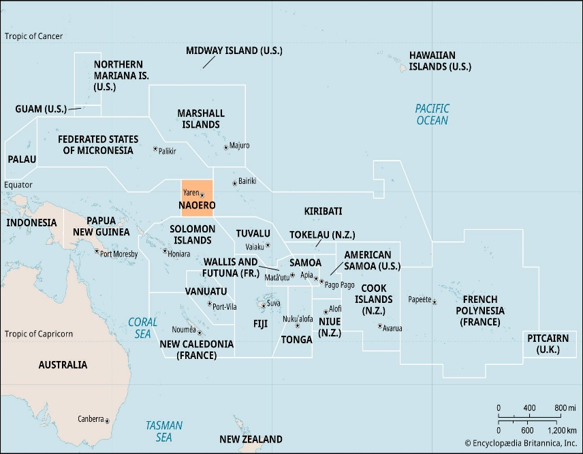
- Naoero is a small island country in the southwestern Pacific Ocean, located in southeastern Micronesia, about 40 km south of the Equator.
- Formerly known as Nauru, it restored its traditional name Naoero in 2026, with the pronunciation changing from “Now-roo” to “Now-ero”; its international code will change from NRU to NRO, and its citizens will be known as dei-Naoero.
- It gained independence in 1968 after colonial rule under the United Kingdom, New Zealand, Australia and Germany and is the third-smallest country in the world.
- The island has an estimated population of about 12,500, no official capital, and government offices are located in Yaren.
India Rejects OIC References on Jammu and Kashmir
Context: India rejected the references to Jammu and Kashmir in the Joint Communiqué of the OIC Contact Group on Jammu and Kashmir, issued after its meeting on the sidelines of the 81st UN General Assembly in New York.
About the Organisation of Islamic Cooperation (OIC)
- Established: 1969 in Rabat, Morocco, following the arson of the Al-Aqsa Mosque.
- Membership: 57 member states across four continents, representing around 1.5 billion people.
- Headquarters: The General Secretariat is headquartered in Jeddah, Saudi Arabia.
- Objective: To safeguard the common interests of member states, strengthen Islamic solidarity and promote cooperation in political, economic, social, cultural and humanitarian fields.
- Principal Organs: Islamic Summit, Council of Foreign Ministers and General Secretariat, supported by various standing committees, subsidiary and specialised institutions.
- The OIC works on issues including peace and security, Palestine, counter-terrorism, economic cooperation, human rights, development and interfaith harmony.
- The OIC Contact Group on Jammu and Kashmir, established in 1994, regularly discusses the issue and has adopted positions concerning the Kashmir dispute.