
SYLLABUS
GS-3: Indian Economy and issues relating to planning, mobilization of resources, growth, development and employment.
Context: As Make in India completes 12 years on 25 September 2026, India’s manufacturing landscape has expanded across key industries, components, machinery, strategic materials and advanced technologies.
About Make in India
- Make in India was launched on 25 September 2014 to position India as a global hub for manufacturing, design and innovation by facilitating investment, fostering innovation and developing world-class infrastructure.
- Guided by “Minimum Government, Maximum Governance”, it also focuses on modernising processes and policies.
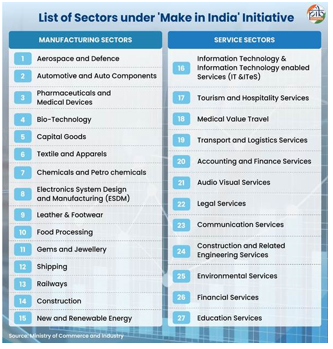
- Under Make in India 2.0, the initiative now covers 27 sectors, including 15 manufacturing and 12 services sectors, with 24 sub-sectors identified based on industrial strengths, import-substitution potential, export potential and employment opportunities.
Achievements of Make in India
- Growth of Manufacturing and Key Industries: Manufacturing GVA recorded a 10.88% CAGR between 2022-23 and 2025-26, while manufacturing IIP increased by 7% during April-July 2026.
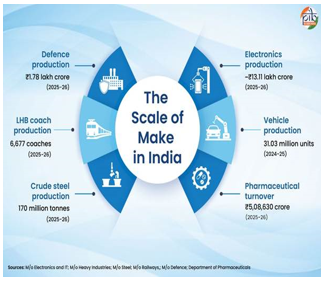
- Electronics production rose nearly seven-fold, mobile-phone production increased to around ₹6.3 lakh crore, and vehicle production reached 31.03 million units in 2024-25.
- Expansion of Pharmaceuticals, Steel, Railways and Defence: India ranks third globally in pharmaceutical volume and 11th by value, while crude steel production increased from 81.7 million tonnes in 2014-15 to 170 million tonnes in 2025-26.
- Indigenous defence production rose from ₹46,429 crore to ₹1.78 lakh crore during the same period.
- Deepening Indigenous Technology and Strategic Capabilities: India has expanded manufacturing beyond final products into space microprocessors, rare-earth permanent magnets, solar cells and modules, electric-vehicle drive systems, aircraft, railway components and nuclear components, strengthening domestic technological and strategic capabilities.
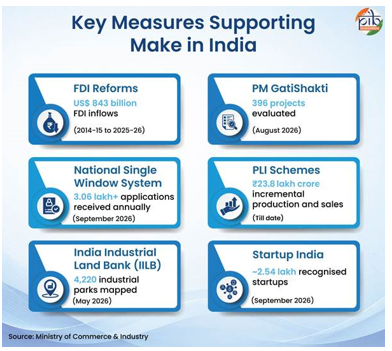
- Investment and Infrastructure Support: Cumulative FDI reached USD 843 billion during 2014-15 to 2025-26, while the National Single Window System provides access to over 327 Central and 3,452 State approvals.
- The India Industrial Land Bank had mapped 4,220 industrial parks, and PM GatiShakti had evaluated 396 projects worth around ₹18.66 lakh crore.
- PLI and New Strategic Manufacturing Initiatives: PLI schemes covering 14 sectors had attracted around ₹2.6 lakh crore investment, generated ₹23.8 lakh crore in production and sales, supported over ₹15.5 lakh crore in exports and created around 14.6 lakh jobs
- New initiatives such as Semicon 2.0, BHAVYA, the Mobile Phone Manufacturing Scheme and the Rare Earth Permanent Magnets Scheme seek to deepen strategic manufacturing.
Need and Significance
- Strengthening Domestic Manufacturing: A strong manufacturing base is essential for higher economic growth, domestic value addition and a deeper industrial ecosystem.
- Employment Generation: Manufacturing expansion can create employment for India’s large labour force and generate opportunities across industrial supply chains.
- Reducing Import Dependence: Developing domestic capabilities in components, machinery, electronics and strategic materials can reduce import dependence and strengthen supply-chain resilience.
- Promoting Exports: Higher production and domestic value addition can help India increase manufacturing exports and integrate more deeply with global value chains.
- Strategic and Technological Self-Reliance: Domestic capabilities in semiconductors, defence, space, rare-earth magnets and advanced pharmaceuticals can strengthen technological and strategic self-reliance.
Gaps / Challenges
- Limited Rise in Manufacturing Share: Despite higher output, manufacturing’s share in overall GVA under the new series increased only marginally from 14.6% in 2022-23 to 15.6% in 2025-26.
- Limited Employment Impact: Manufacturing employment increased from around 5.1 crore in 2016-17 to 5.3 crore in 2025-26, while its share in total employment remained broadly similar.
- Concentration of PLI Benefits: PLI benefits remain concentrated, with the top five sectors accounting for nearly 83% of total PLI investment, indicating limited spread across the wider manufacturing base.
- Weak Private Investment: Private-sector fixed investment remains subdued, while manufacturing capacity utilisation has remained below the 80% level generally associated with stronger incentives for fresh capacity creation.
- Global Competitiveness and Structural Constraints: India continues to face challenges related to import dependence, infrastructure and logistics costs, skill gaps, regulatory issues, production costs and competition from countries such as China, Vietnam and Indonesia.