
SYLLABUS
GS-2: Effect of Policies and Politics of Developed and Developing Countries on India’s interests, Indian Diaspora.
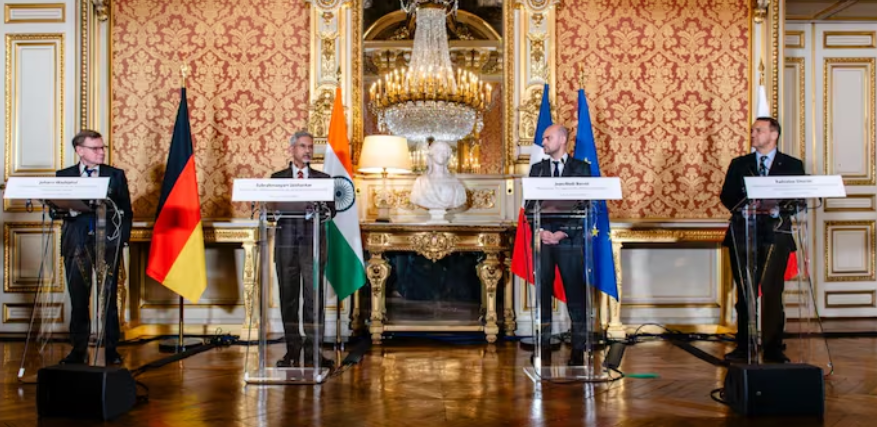
Context: The first V4+India Foreign Ministers’ Meeting was held on the margins of the 81st Session of the United Nations General Assembly in New York under the Slovak Presidency of the V4.
Key Highlights of the Meeting
- The meeting marked the first Foreign Ministers-level engagement between India and the Visegrad Group as a group.
- The Ministers agreed to closer political cooperation, including annual meetings of Foreign Ministers.
- They agreed to deepen economic cooperation, including an Annual Business Forum, to create greater interaction between businesses.
- Cooperation will be strengthened in areas such as:
- Trade and investment
- Technology and innovation
- Research and education
- Resilient supply chains
- Defence and security
- Connectivity
- Space
- Mobility and people-to-people exchanges
- Cultural cooperation
- The Ministers discussed possibilities for greater interaction between businesses, academic and research institutions and other stakeholders from India and the V4 member states.
- They exchanged perspectives on global and regional developments, peace and security, including the Ukraine conflict and developments in the Gulf.
- The countries discussed the need for reformed multilateralism and addressing contemporary global challenges, including those affecting the Global South.
- The four V4 countries expressed support for India’s inclusion as a permanent member of the United Nations Security Council. Slovakia’s Foreign Minister Juraj Blanar said that India “must be at the table” as a permanent member of the United Nations Security Council.
About the Visegrad Group (V4)
- The Visegrad Group (V4) is a cultural and political alliance comprising four Central European countries: Poland + Hungary + Slovakia + Czech Republic
- It aims to advance cooperation in military, economic, cultural and energy affairs.
- The V4+India group is a diplomatic dialogue format that brings together India and the Visegrad Group.
- India has longstanding and substantive bilateral relations with each of the four V4 countries.
- The V4+India format provides an additional platform for dialogue and cooperation, building upon India’s existing bilateral relations with Poland, Hungary, Slovakia and the Czech Republic.
Significance of V4 and the Meeting
- Strengthening Central European engagement: The format provides an additional platform for India to engage collectively with four Central European countries.
- Political cooperation: Annual Foreign Ministers’ meetings can provide regular political dialogue between India and the V4.
- Economic cooperation: The proposed Annual Business Forum can promote greater interaction between Indian and V4 businesses and strengthen trade and investment cooperation.
- Technology and innovation: The countries agreed to strengthen technology, innovation, research and education partnerships.
- Defence cooperation: India has a strong history of defence cooperation with all the V4 countries, and the meeting aims to reinvigorate defence cooperation.
- Connectivity and people-to-people ties: Cooperation in connectivity, mobility, cultural cooperation and people-to-people relations can further strengthen India–Central Europe engagement.
- Strategic cooperation: Discussions on peace and security, global and regional developments and multilateral cooperation provide an additional avenue for strategic engagement.
- Multilateralism: Cooperation on reformed multilateralism and contemporary global challenges, including issues affecting the Global South, strengthens coordination in multilateral forums.
- Support for UNSC reform: The support expressed by all four V4 countries for India’s permanent membership of the United Nations Security Council is significant for India’s efforts towards reform of the United Nations Security Council.
- Complementing India–European Union relations: The V4+India format can complement India’s bilateral relations with the four V4 countries as well as India’s deepening relationship with the European Union.