
SYLLABUS
GS-2: Appointment to various Constitutional Posts, Powers, Functions and Responsibilities of various Constitutional Bodies.
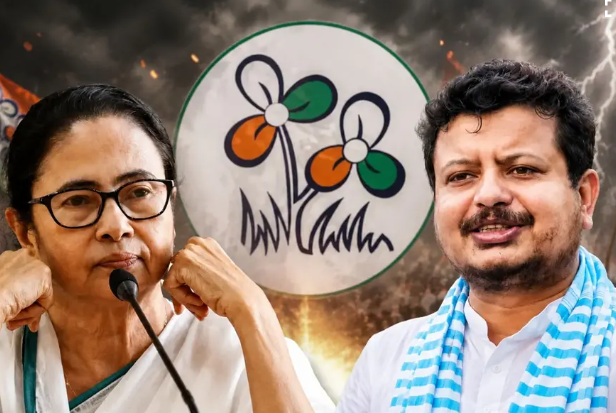
Context: The Election Commission of India has frozen the name and election symbol of the All India Trinamool Congress amid an organisational dispute between rival factions ahead of the West Bengal Assembly by-elections.
More on the News
- The Election Commission of India issued an interim order freezing the All India Trinamool Congress name and its ‘Flowers & Grass’ symbol under Paragraph 15 of the Election Symbols (Reservation and Allotment) Order, 1968.
- The Commission took this step after identifying two rival groups claiming to represent the party and observing that there was insufficient time to determine the dispute substantively before the upcoming by-elections.
- To place both factions on an “even keel” and protect their rights and interests, the ECI allotted temporary names and symbols to both groups.
- The interim order was subsequently challenged in the Supreme Court.
About Paragraph 15 of the Election Symbols Order, 1968
- Paragraph 15 empowers the Election Commission of India to resolve disputes between rival factions of a recognised political party when each faction claims the party’s original name and election symbol.
- The Commission may decide that one faction is the recognised political party or that neither faction is entitled to retain the original party identity.
- Its decision is binding on all rival factions involved in the dispute.
- The provision applies to disputes involving recognised national and State political parties.
- The Supreme Court upheld the validity of Paragraph 15 in Sadiq Ali and Another v. Election Commission of India (1971).
- When a dispute cannot be resolved before an election, the Commission may freeze the original party name and symbol and allow the rival factions to contest elections using separate names and symbols.
How Does the ECI Resolve Political Party Disputes?
- Although Paragraph 15 does not prescribe a fixed procedure, the Election Commission has generally considered a three-test principle to resolve such disputes:
- Party Constitution: The Commission examines whether the party’s organisational affairs have been conducted according to its constitution and democratic procedures.
- Aims and Objectives: The Commission examines which faction adheres to the aims and objectives of the party constitution.
- Majority Support: The Commission assesses the support enjoyed by rival factions in both the organisational and legislative wings of the party.
- For this purpose, the Election Commission examines the support of office-bearers, delegates, Members of Parliament and Members of Legislative Assemblies.
- However, the legislative majority is not the only or necessarily the primary test. The ECI may adopt an appropriate method depending on the facts and complexities of the dispute.
- When a clear majority supports one faction, it may receive the original party name and symbol.
- If the majority is unclear or the dispute cannot be resolved immediately, the Commission may freeze the original symbol and allot separate names and free symbols to the rival factions.
Significance
- Electoral Clarity: The interim order prevents both factions from using the same name and symbol during the by-elections, reducing potential confusion among voters.
- Fair Electoral Competition: Allotting separate names and symbols provides both groups with distinct identities while the organisational dispute remains unresolved.
- Importance of Party Organisation: The dispute highlights the significance of valid organisational structures and internal party procedures in determining control over a recognised political party.
- Judicial Scrutiny: The Supreme Court petition brings the ECI’s interim decision and its handling of the organisational dispute under judicial consideration.
Broader Issues
- Role of the ECI: The dispute raises questions about the Commission’s role in balancing electoral certainty with the need for a thorough examination of competing party claims.
- Internal Party Democracy: Disputes over office-bearers, organisational authority and legislative support highlight the importance of transparent internal party elections.
- Anti-Defection Law: The involvement of legislators facing disqualification proceedings raises questions about the relationship between legislative defections and claims to control a political party.
- Party Identity and Electoral Symbols: In India’s electoral system, party names and symbols are important tools of political recognition, making disputes over their ownership significant for both political organisations and voters.
Way Forward
- Time-Bound Dispute Resolution: The ECI should establish a clear timeline for resolving disputes under Paragraph 15, particularly when elections are approaching.
- Strengthening Internal Democracy: Political parties should conduct regular organisational elections and maintain updated records of office-bearers, delegates and party membership.
- Transparent Decision-Making: The ECI should clearly communicate the evidence and principles used to determine the legitimate faction while ensuring that both sides receive a fair hearing.
- Coordination with Constitutional Authorities: Disputes involving rebel legislators should be addressed in coordination with the relevant constitutional authorities, while maintaining the distinct roles of the ECI and the Speaker under the Tenth Schedule.