
SYLLABUS
GS-3: Achievements of Indians in science & technology; indigenization of technology and developing new technology; Awareness in the fields of IT, Space.
Context:Several employee associations of the Indian Space Research Organisation (ISRO) have raised concerns over the transfer of the space agency’s core processes to private players.
More on the News:
- Shift to Private Participation: Concerns arose after IN-SPACe Chairperson Pawan Goenka said ISRO would eventually stop manufacturing all launch vehicles and operating the spaceport under development.
- ISRO Chairman V. Narayanan clarified that transferring these activities to private entities aims to expand India’s space sector, not privatise ISRO.
- Core Role: ISRO will remain the principal institution for advanced space research, national and strategic missions, space science, exploration, and critical frontier capabilities.
- Indian Space Policy–2023: The development must be viewed in the context of Indian Space Policy–2023, which redefines the roles of ISRO, IN-SPACe, NSIL and private entities.
- Growing Space Economy: India’s space economy is presently estimated at around $8.4 billion, still a relatively small share of the rapidly expanding global space economy. India aims to increase its share of the global space market to $44 billion by 2033.
Indian Space Policy–2023: A New Space-Sector Framework
- After the space sector was opened to private participation and IN-SPACe was established in 2020, the Indian Space Policy–2023 was formulated to clearly define the roles of ISRO, IN-SPACe, NewSpace India Limited (NSIL), and private entities.
- ISRO: From Operational Manufacturing to Advanced Research
- Research-oriented role: Develop newer applications, systems and technologies; share technologies with industry; store/provide satellite data; and demonstrate human spaceflight capability for a sustained human presence in space.
- Manufacturing transition: Develop new technologies while transitioning out of manufacturing operational space systems.
- IN-SPACe: Opening the Space Ecosystem to Industry
- Promotion & Authorisation: Promote private space activities, hand-hold industries and create an enabling environment while authorising activities considering national security and international/foreign-policy obligations.
- NSIL: The Commercial Arm of ISRO
- Commercialisation: NewSpace India Limited (NSIL) , a Department of Space PSU and ISRO’s commercial arm, commercialises publicly developed space technologies and serves space-based needs.
- According to the Economic Survey 2025-26: NSIL revenues increased from ₹321.77 crore in FY 2021-22 to ₹3,246.09 crore in FY 2024-25.
- As of 31 January 2026, IN-SPACe had facilitated 71 ISRO technology transfers to industry and startups.
Key Technologies & Processes Being Transferred
- SSLV: Small Satellite Launch Vehicle(SSLV) was operationalised in 2024 after 3 development flights; designed for industry with 3-day assembly, 6 people and ₹30 crore cost, compared with PSLV’s 70 days, 60 people and ₹100 crore.
- PSLV: Became the first commercialised Indian launch vehicle in 2022; a contract for 5 PSLVs was awarded to the HAL–L&T consortium.
- A fresh EoI in 2026 proposes ISRO handholding for 36 months or until 2 vehicles are manufactured end-to-end.
- LVM3: ISRO began commercialising the LVM3 in 2024, but the bid was never awarded. Initially, NSIL planned two years of development support, after which industry would manufacture 4–6 LVM3 rockets annually for 12 years.
- New EoI (2026): A fresh EoI provides for ISRO support for 42 months or until at least two vehicles are realised. Thereafter, the industry will be able to create its own market.
- Satellite Launch Complex in Kulsekarapattinam: In 2026, IN-SPACe invited an EoI to operate the upcoming small-satellite launch spaceport at Kulsekarapattinam, Thoothukudi, Tamil Nadu, aligned with Government space-sector reforms and Indian Space Policy–2023.
Why Is India Moving Towards Private Participation?
- Expand India’s Space Economy: Opening the sector to private players aims to increase India’s less than 2% share of the global space economy.
- The target is to grow the sector from $9 billion in 2026 to $40–45 billion over the next decade, with private players handling routine services and providing reliable, cost-effective launch services to Indian and international customers.
- Private-space investment has already risen sixfold, from $100.5 million (2021–22) to $618.5 million by March 31, 2026.
- Balance Commercialisation with Strategic Capability: While commercialisation is focused largely on civilian space activities, ISRO needs to retain in-house expertise for strategic needs and major missions such as Chandrayaan-4 and 5, Gaganyaan and Bharatiya Antariksh Station.
- The private sector is still nascent and cannot yet compete with ISRO, making preservation of ISRO’s expertise important.
Key Concerns
- Need for In-house Expertise: The transition raises concerns about preserving ISRO’s critical in-house expertise, as the private space sector is still nascent and cannot currently match ISRO’s capabilities.
- Strategic & Scientific Needs: Retaining this expertise is essential for India’s strategic requirements, particularly when mission failures or delays demand specialised knowledge, as well as for major programmes such as Chandrayaan-4 and 5, Gaganyaan and Bharatiya Antariksh Station.
- Limited Commercial Scale: Despite strong technological capabilities and cost-effective launches, India has a limited presence in high-value downstream space activities and needs stronger global market access.
- Funding & Talent Gaps: Space start-ups face high capital requirements, technological and market risks, long gestation periods and limited patient capital, along with shortages of specialised space talent.
- Technology & Import Dependence: India has end-to-end mission capability but remains dependent on imports for critical technologies such as advanced electronics, sensors, specialised materials and high-end manufacturing equipment, creating supply-chain vulnerabilities.
- Launch Reliability & Operational Bottlenecks: Vehicle anomalies, payload failures, manufacturing and quality-assurance challenges can disrupt commercial launches, strategic deployments and overall execution capacity.
The Road Ahead
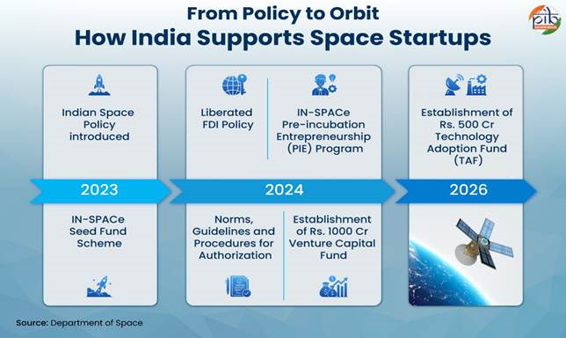
- Reforms & Ecosystem: Indian Space Policy–2023, liberalised FDI norms and dedicated funding initiatives have opened the entire space value chain to potential private players, fostering startups, indigenous innovation and expanding commercial activities.
- Patient Capital & Risk Financing: Expand credit guarantees, launch-failure insurance, viability-gap funding and blended finance suited to the capital-intensive, long-gestation nature of space technology.
- Indigenous Technology & Manufacturing: Promote domestic capabilities in space-grade semiconductors, sensors, atomic clocks, optical systems and advanced propulsion, while integrating Indian MSMEs into global supply chains.
- Domestic Demand & Skilled Talent: Create assured government demand through multi-year procurement and outcome-based contracts, while strengthening specialised education and ISRO–academia–industry linkages.