

SYLLABUS
GS-3: Science and Technology- Developments and their Applications and Effects in Everyday Life;Awareness in the fields of Bio-technology.
Context: Bhutan has become the first country in the WHO South-East Asia Region to achieve WHO validation for eliminating dog-transmitted human rabies as a public health problem.
More on the News:
- The achievement, validated by the WHO on 4 September 2026, reflects more than a decade of sustained investment in One Health, mass dog vaccination, dog population management, integrated surveillance and universal access to post-exposure prophylaxis (PEP).
- 2018 WHO Expert Consultation on Rabies established the criteria for validation of elimination of dog-mediated human rabies as a public health problem, requiring absence of human deaths for at least two years.
- The Global Strategic Plan to End Human Deaths from Dog-Mediated Rabies by 2030 (Zero by 30) is a joint initiative of WHO, WOAH and the Food and Agriculture Organization of the United Nations (FAO), in collaboration with the Global Alliance for Rabies Control (GARC).
About Rabies
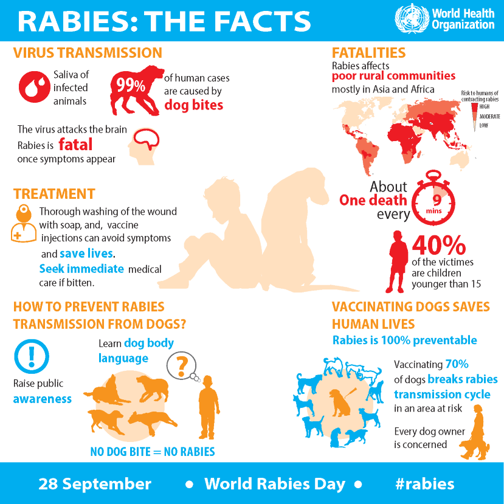
- Rabies is a zoonotic viral disease caused by the Rabies virus, a Ribonucleic Acid (RNA) virus of the Lyssavirus genus under the Rhabdoviridae family, and is transmitted through the saliva of infected animals such as dogs, cats and monkeys.
- Rabies is a neglected tropical disease and a serious public health problem in over 150 countries and territories, mainly in Asia and Africa, causing tens of thousands of deaths annually.
- Transmission: Rabies spreads through the saliva of infected animals, mainly through bites and scratches or contact with broken skin or mucous membranes.
- Symptoms and Incubation Period: Early symptoms include fever, pain, and unusual tingling, pricking or burning sensations (paraesthesia) at the wound site. In later stages, the virus spreads to the central nervous system, causing fatal inflammation of the brain and spinal cord. The incubation period ranges from 1 week to 1 year, typically 2–3 months.
- Furious Rabies: Furious rabies is characterized by hyperactivity, excitable behaviour, hydrophobia (fear of water) and sometimes aerophobia (fear of drafts or fresh air).
- Paralytic Rabies: Paralytic rabies accounts for about 20% of human cases and generally follows a less dramatic and longer course than the furious form.
- Rabies Prevention : Dog vaccination is the most cost-effective strategy; human vaccines are available for pre-exposure immunization.
- After a bite/scratch, wash and flush the wound with water for ~15 minutes, apply iodine-containing/antiviral medication, avoid irritants and dressings, and seek healthcare immediately.
- Safely confine and observe the animal for 10 days; WHO promotes dog-rabies elimination, bite prevention and intradermal PEP, reducing vaccine volume/cost by 60%–80%.
Indian Government Initiatives:
- National Rabies Control Programme (NRCP):
- Aim: Reduce human rabies mortality and progressively achieve the global target of “Zero deaths by 2030.”
- Objectives: Ensure prompt PEP for animal-bite victims; promote intradermal PEP and pre-exposure prophylaxis for high-risk categories; train healthcare professionals in animal-bite management and rabies PEP.
- Programme Components: The Programme had two components – Human and Animal Components.
- Human Component for roll out in the all States and UTs through nodal agency National Centre for Disease Control (NCDC), Ministry of Health & Family Welfare.
- Animal Health Component for pilot testing in Haryana and Chennai through nodal agency Animal Welfare Board of India (AWBI) under the aegis of MoEF&CC.
- NRCP Strategies: Ensure ARV & ARS availability at all health facilities.
- Capacity building for animal-bite management.
- Strengthen surveillance & rabies diagnostics.
- IEC for awareness and timely treatment of animal bites.
- National Action Plan For Dog Mediated Rabies Elimination:
- National Action Plan for Dog Mediated Rabies Elimination (NAPRE) by 2030 Jointly launched by the Ministry of Health & Family Welfare and Ministry of Fisheries, Animal Husbandry & Dairying; stray dog population control is the mandate of local bodies.
- Animal Birth Control (Dogs) Rules, 2023 Implemented by local authorities, focusing on anti-rabies vaccination and neutering of stray dogs for population stabilization.