

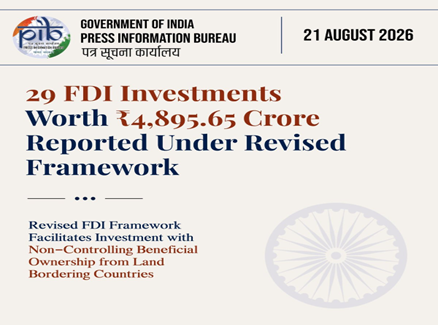
Context: The Union Government has received 29 FDI investments worth ₹4,895.65 crore under the revised framework governing investments involving countries sharing a land border with India (LBCs). The development follows the Union Cabinet’s March 2026 decision to modify the earlier FDI restrictions applicable to LBC investments.
Background
- India introduced Press Note 3 (2020) in the wake of the COVID-19 pandemic to prevent opportunistic takeovers and acquisitions of Indian companies. It mandated that investments from countries sharing a land border with India, or investments where the beneficial owner was situated in or was a citizen of such a country, would require approval through the Government route.
- However, the Government subsequently found that this framework could also affect investments by global funds such as private equity and venture capital funds, even where investors from land-bordering countries held only small, non-controlling interests.
Revised Framework
- In March 2026, the Union Cabinet approved changes to the FDI policy for investments from Land Bordering Countries (LBCs).
- The revised framework provides greater clarity on Beneficial Ownership (BO) by incorporating a definition and criteria based on the Prevention of Money Laundering Rules, 2005. The beneficial-ownership test is applied at the level of the investor entity.
- Importantly, investors having non-controlling beneficial ownership of up to 10% from an LBC are permitted to invest through the automatic route, subject to applicable sectoral caps, entry routes and other conditions. Relevant information is also required to be reported by the investee entity to DPIIT.
- The revised framework also provides an expedited 60-day timeline for processing LBC investment proposals in specified manufacturing activities, including capital goods, electronic capital goods, electronic components, polysilicon and ingot-wafer. In such cases, majority shareholding and control must remain with resident Indian citizens or resident Indian-controlled entities.
Significance
- The reform attempts to strike a balance between national security and investment facilitation. While retaining scrutiny over investments that may involve strategic or controlling interests from land-bordering countries, it reduces regulatory barriers for genuine non-controlling investments.
- It is expected to:
- improve Ease of Doing Business;
- facilitate greater FDI inflows;
- support technology transfer and domestic value addition;
- strengthen India’s integration with global supply chains; and
- encourage investment in sectors such as electronics and advanced manufacturing
Kosi–Mechi Link Project and Other Key Infrastructure Initiatives
Context: Bihar Chief Minister Samrat Choudhary held discussions in New Delhi with Union Finance Minister Nirmala Sitharaman and External Affairs Minister S. Jaishankar on issues related to Bihar’s development. The discussions included the Kosi–Mechi Intra-State River Link Project, tourism infrastructure, the proposed Vikramshila University, and other development priorities.
Kosi–Mechi Intra-State Link Project
- The project aims to utilise a portion of the surplus water of the Kosi River and divert it towards the Mahananda basin through the remodelling and extension of the Eastern Kosi Main Canal (EKMC).
Tourism Infrastructure in Bihar
- The meeting also discussed tourism-related development, including the Mahabodhi Temple Corridor and Vishnupad Temple Corridor.
- Mahabodhi Temple
- Located at Bodh Gaya.
- It is an important Buddhist pilgrimage centre.
- The Union Budget 2024–25 announced support for developing the Mahabodhi Temple Corridor.

- Vishnupad Temple
- Located in Gaya.
- The Union Budget 2024–25 also proposed development of the Vishnupad Temple Corridor.
- The proposed corridors are intended to follow the broad development approach of the Kashi Vishwanath Temple Corridor, with the objective of developing these sites as world-class pilgrimage and tourism destinations.

Vikramshila University
- Another issue discussed was the restoration of Vikramshila University.
- The Bihar Government has identified the revival of Vikramshila as an important higher-education and heritage initiative.
- The Bihar Government stated in June 2026 that it intended to restore Vikramshila University within the following year.
- The historical Vikramshila centre was one of the major centres of learning of ancient India, alongside Nalanda and other renowned institutions. The Ministry of Education also recognises Vikramshila as an important example of India’s ancient multidisciplinary higher-education tradition.
National Teachers’ Awards 2026: Two Teachers from Bihar Selected
Context: The President of India, Droupadi Murmu, will confer the National Teachers’ Awards 2026 on 48 selected school teachers on the occasion of Teachers’ Day, 5 September 2026, at Vigyan Bhawan, New Delhi. Two teachers from Bihar—Khushboo Kumari and Pushpa Prasad—have been selected for the award.

Bihar Awardees
- Khushboo Kumari – Urdu Primary School, Bidaydih, Banka.
- Pushpa Prasad – Middle School, Kuchaikote Kanya, Gopalganj.
About the National Teachers’ Awards
- The National Teachers’ Awards were instituted in 1958 to recognise outstanding teachers and heads of schools for their contribution towards improving the quality of school education and enriching students’ learning experiences.
- The awards are administered under the overall supervision of the Ministry of Education, through the Department of School Education and Literacy. They recognise excellence, innovation and commitment in the field of school education.
Award Components
- Each award carries:
- Certificate of Merit
- Silver Medal
- Cash award of ₹50,000
- The awardees also get an opportunity to interact with the Prime Minister.