
SYLLABUS
GS-3: Indian Economy and issues relating to planning, mobilization of resources, growth, development and employment.
Context: The Ministry of Electronics and Information Technology (MeitY) has notified the Mobile Phone Manufacturing Scheme (MPMS) with a ₹62,500-crore outlay to sustain India’s mobile manufacturing growth, deepen domestic value addition and strengthen Indian mobile phone brands.
About the Mobile Phone Manufacturing Scheme (MPMS)
• Tenure: Five years, from FY 2026–27 to FY 2030–31, effective from April 1, 2026.
• Objective: To enhance the global competitiveness of Indian mobile manufacturing by increasing scale, deepening the domestic supply chain, raising Domestic Value Addition (DVA) and strengthening manufacturing capabilities.
• The scheme also seeks to promote Indian-owned mobile brands, domestic intellectual property, product design and research and development (R&D).
• It follows the Production Linked Incentive Scheme for Large Scale Electronics Manufacturing (PLI-LSEM), whose tenure ended on March 31, 2026.
• India is currently the world’s second-largest mobile phone manufacturer by volume, while 99.2% of mobile phones used in India are manufactured domestically.
• Smartphones emerged as India’s single-largest exported product category in 2025.
Key Features of the Scheme
• Two Target Segments: The scheme has Target Segment 1 (TS1) for mobile phone manufacturing and Target Segment 2 (TS2) for supporting Indian mobile phone brands.
- TS1 provides incentives of 2.25%–5%, while TS2 provides a 5% incentive for Indian brands.
• Eligibility under TS1: Mobile phone manufacturers, including Electronics Manufacturing Services (EMS) companies registered in India, require a minimum turnover of ₹10,000 crore in FY 2025–26.
- Existing brands must achieve incremental sales of ₹5,000 crore in FY27, rising by ₹5,000 crore annually up to ₹25,000 crore in FY31.
• TS1 Incentive Structure: The scheme introduces a moving baseline, with baseline sales equal to the previous financial year’s domestic sales plus 15%.
- Incentives are provided on eligible sales, with rates ranging from 2.75% to 2.25% for one portion and 5% to 4% for another portion over the scheme tenure.
• Support for Indian Brands: Under TS2, applicants require a minimum turnover of ₹1,000 crore in FY 2025–26 and must meet Indian-brand criteria.
- These include Indian incorporation, IP and trademarks held in India, management control by Indian citizens, more than 51% Indian ownership, and in-house R&D and design capabilities in India.
• Design and Domestic Sourcing Incentives: Indian brands receive an additional 3% incentive for Indian design and R&D, while both target segments can receive up to 1.5% for domestic sourcing of key components and sub-assemblies.
- The 1.5% comprises incentives for display modules (0.3%), camera modules (0.3%), enclosures (0.5%), batteries (0.2%) and USB cables/connectors (0.2%), subject to localisation for at least 25% of total mobile phone units in a financial year.
• Institutional and Non-Fiscal Support: The government may provide non-fiscal support to Indian brands, with an Empowered Committee evaluating applications and recommending support.
- The scheme will be implemented through a Project Management Agency (PMA), with incentive claims allowed quarterly.
Need and Significance of the Scheme
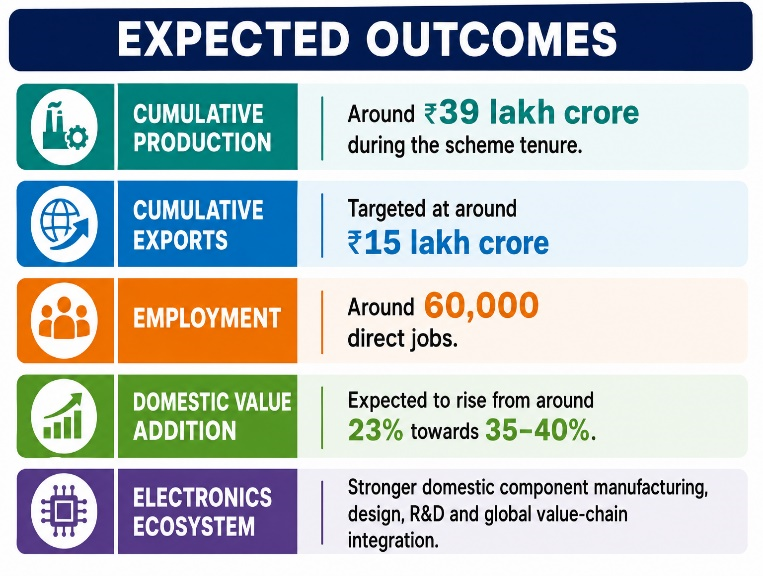
• Sustaining Manufacturing Momentum: PLI-LSEM helped mobile phone production reach ₹11.61 lakh crore against a ₹8.12 lakh crore target, while investment crossed ₹20,500 crore against ₹7,000 crore targeted, and MPMS provides continuity after PLI-LSEM ended in March 2026.
• Deepening Domestic Value Addition: Domestic value addition in mobile manufacturing has risen to around 23% from about 15%, while MPMS shifts greater focus towards localisation of components and sub-assemblies.
• Promoting Indian Technology and IP: The scheme supports Indian-owned brands, domestic IP, product design and R&D, helping India move from large-scale assembly towards greater technological sovereignty.
• Strengthening the Electronics Ecosystem: Mobile manufacturing can generate technology and skill spillovers into laptops, gaming consoles, drones, medical devices, tablets, smartwatches and other electronics-intensive sectors.
• Expanding India’s Global Role: Mobile phone exports grew 166 times between 2014 and 2025, while mobile phones accounted for about 61% of India’s electronics exports in FY26, and MPMS seeks to further strengthen India as a global electronics manufacturing hub.