
SYLLABUS
GS-2: Government Policies and Interventions for Development in various sectors and Issues arising out of their Design and Implementation.
GS-3: Science and Technology- Developments and their Applications and Effects in Everyday Life.
Context: The Ministry of Road Transport and Highways (MoRTH) has issued a draft notification proposing phased mandatory adoption of Vehicle-to-Vehicle (V2V) Communication Systems in specified motor vehicles from 1 October 2028.
Background
- The Ministry of Road Transport and Highways (MoRTH) had constituted a Task Force to develop a framework for Intelligent Transportation Systems (ITS) with a focus on Vehicle-to-Everything (V2X) communication for improving road safety.
- The Task Force recommended adoption of 3GPP-based Cellular Vehicle-to-Everything (C-V2X) technology, use of the 5.875–5.925 GHz (5.9 GHz) spectrum band, and an enabling regulatory framework for V2V deployment.
- Subsequently, the Telecom Regulatory Authority of India (TRAI) released a consultation paper on the regulatory framework for V2X communication, covering spectrum assignment, interoperability, licensing and cybersecurity.
- The present draft notification operationalises these policy initiatives by proposing the phased deployment of Vehicle-to-Vehicle (V2V) communication systems in motor vehicles.
Key Highlights of the Draft Notification
- Two-stage Implementation:
- From 1 October 2027: Newly manufactured L, M and N category vehicles if fitted with V2V communication systems must comply with AIS-230.
- From 1 October 2028: Newly manufactured L, M and N category vehicles must be equipped with AIS-230-compliant V2V communication systems.
- Under the Central Motor Vehicles Rules, L denotes two- and three-wheelers, M denotes passenger vehicles with at least four wheels, and N denotes goods vehicles.
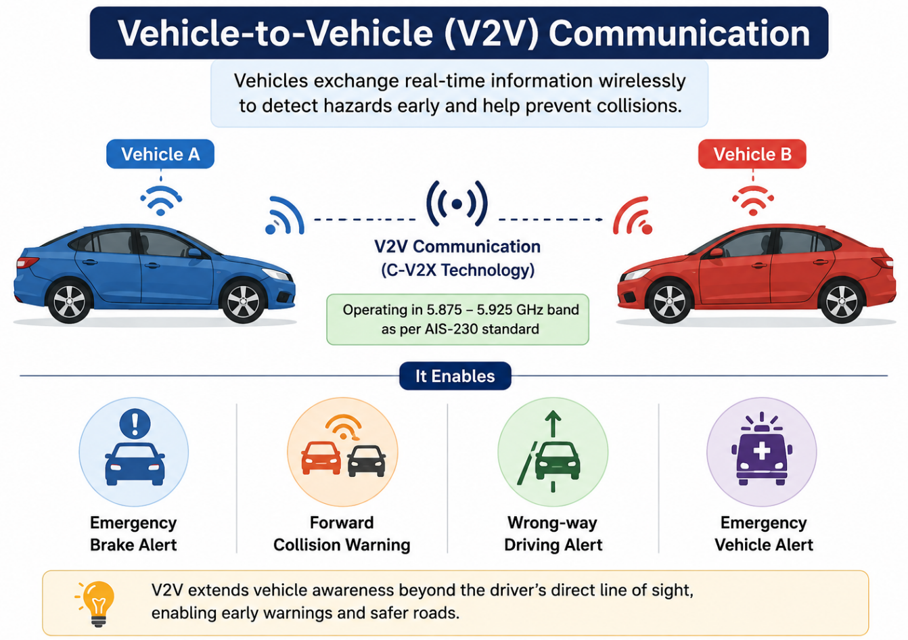
- Road Safety Objective: V2V systems will enable vehicles to exchange real-time safety information and provide advance warnings for situations such as Emergency Brake Alert, Forward Collision Warning, Wrong-way Driving and Emergency Vehicle Alert, thereby helping reduce road accidents.
- AIS-230 Standard: Specifies the minimum technical, functional, radio performance, environmental and cybersecurity requirements for factory-installed On-Board Units (OBUs) using Cellular Vehicle-to-Everything (C-V2X) technology in the 5.875–5.925 GHz frequency band.
- Enabling Regulatory Framework: The proposal follows the licence-exempt use of the 5.875–5.925 GHz frequency band for ITS/V2X applications and has been released for stakeholder consultation before final notification.
Understanding Vehicle-to-Vehicle (V2V) Communication
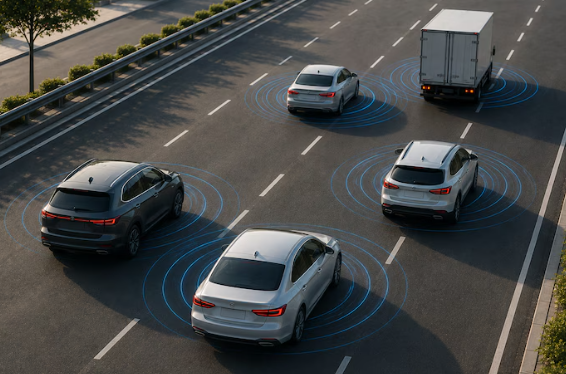
- Overview: Vehicle-to-Vehicle (V2V) Communication is a wireless technology that enables nearby vehicles to exchange real-time information such as position, speed, direction, acceleration and braking status, including safety information beyond the driver’s direct line of sight.
- Working Mechanism: Vehicles equipped with factory-installed On-Board Units (OBUs) continuously exchange real-time safety information using Cellular Vehicle-to-Everything (C-V2X) technology, enabling early detection of potential collision risks.
- Key Advantages:
- Extends situational awareness beyond the range of onboard sensors and the driver’s field of vision.
- Enables cooperative collision avoidance through timely exchange of safety information.
- Supports proactive accident prevention by complementing vehicle safety systems.
- Part of the V2X Ecosystem: V2V is one component of the broader Vehicle-to-Everything (V2X) ecosystem, which also includes Vehicle-to-Infrastructure (V2I), Vehicle-to-Pedestrian (V2P) and Vehicle-to-Network (V2N) communication, forming the foundation of Connected and Intelligent Transport Systems (C-ITS).
Significance of V2V Communication Systems
- Addresses India’s Road Safety Challenge: Enables cooperative collision avoidance by providing timely warnings of potential hazards, thereby helping reduce road accidents and fatalities.
- Complements Advanced Driver Assistance Systems (ADAS): Extends the capabilities of onboard sensors by providing information beyond the driver’s direct line of sight, supporting proactive accident prevention.
- Operationalises Connected Mobility: Represents India’s first major regulatory initiative towards deploying Connected and Intelligent Transport Systems (C-ITS) and establishing the communication backbone for future connected and autonomous mobility.
- Promotes Indigenous Automotive Innovation: Encourages domestic development of C-V2X technologies, automotive communication modules and intelligent mobility solutions, supporting Make in India and Atmanirbhar Bharat.
Challenges in Implementing V2V Communication Systems
- Standardisation & Interoperability: Ensuring seamless communication among vehicles from different manufacturers through harmonised technical standards and communication protocols.
- Cybersecurity & Data Privacy: Connected vehicles require robust safeguards against cyberattacks, spoofing, unauthorised access and misuse of vehicle-generated data.
- Deployment Readiness: Scaling V2V communication requires widespread availability of AIS-230-compliant hardware, testing and certification infrastructure, and industry-wide preparedness.
- Gradual Network Effect: The full safety benefits of V2V communication will be realised only as a significant proportion of vehicles become V2V-enabled, while legacy vehicles may initially limit its effectiveness.
Way Forward
- Ensure Phased Industry Readiness: Facilitate timely testing, certification and compliance with AIS-230 to enable smooth implementation of the phased mandate from October 2028.
- Develop the Complete V2X Ecosystem: Integrate V2V communication with Vehicle-to-Infrastructure (V2I) systems, intelligent traffic management and smart city infrastructure to maximise road safety benefits.
- Strengthen Cybersecurity Framework: Establish robust standards for encryption, authentication, secure software updates, data protection and liability management for connected vehicles.
- Promote Indigenous R&D and Manufacturing: Encourage domestic research, testing and manufacturing of On-Board Units (OBUs), communication modules and automotive electronics to build a globally competitive connected mobility ecosystem.