
SYLLABUS
GS-1: Indian culture will cover the salient aspects of Art Forms, Literature and Architecture from ancient to modern times.
Context: Archaeological excavations at Karivalamvanthanallur (Malayadipatti) on the banks of the Vaippar River in Tenkasi district, Tamil Nadu, are uncovering evidence of a settlement that appears to have survived and evolved from the Microlithic Period to the Sangam Age.
Key Findings
- Continuous Human Occupation: Evidence points to continuous occupation from the Microlithic Period through the Iron Age to the Early Historic and Historic periods, bypassing the Neolithic and Chalcolithic phases.
- This cultural sequence mirrors discoveries at Mangudi, Sivagalai and Adichanallur, unlike northern Tamil Nadu where a Microlithic–Neolithic–Iron Age sequence is evident.
- Organised Industrial Settlement: The discoveries suggest that the site was not merely a habitation site but an organised industrial settlement.
- Archaeologists have recovered hematite for iron extraction, iron implements, glass beads, terracotta figurines, graffiti-marked pottery, hopscotch pieces, and Black-and-Red Ware along with other Early Historic ceramics.
- Additional discoveries include shell bangles, terracotta spindle whorls, terracotta discs, coral beads, a gold bead, rectangular gaming pieces and copper coins.
- Structural evidence suggests the presence of iron tool-making, bead manufacturing, shell bangle production and weaving workshops during the Sangam period.
- Large Brick Structure: One of the excavation’s most significant discoveries is a large brick structure measuring about 8.7 m × 4.2 m, constructed using bricks measuring 40 × 20 × 7 cm.
- The structure, which includes descending steps, is believed to have served either as an underground granary, or a rainwater harvesting tank.
- Its design suggests sophisticated water management despite the settlement’s proximity to the Vaippar River.
- The brick dimensions resemble those found at Keeladi, Alagankulam and Poompuhar, suggesting an Early Historic/Sangam-period date.
- Soil analysis and carbon dating are being undertaken to determine the structure’s function and chronology.
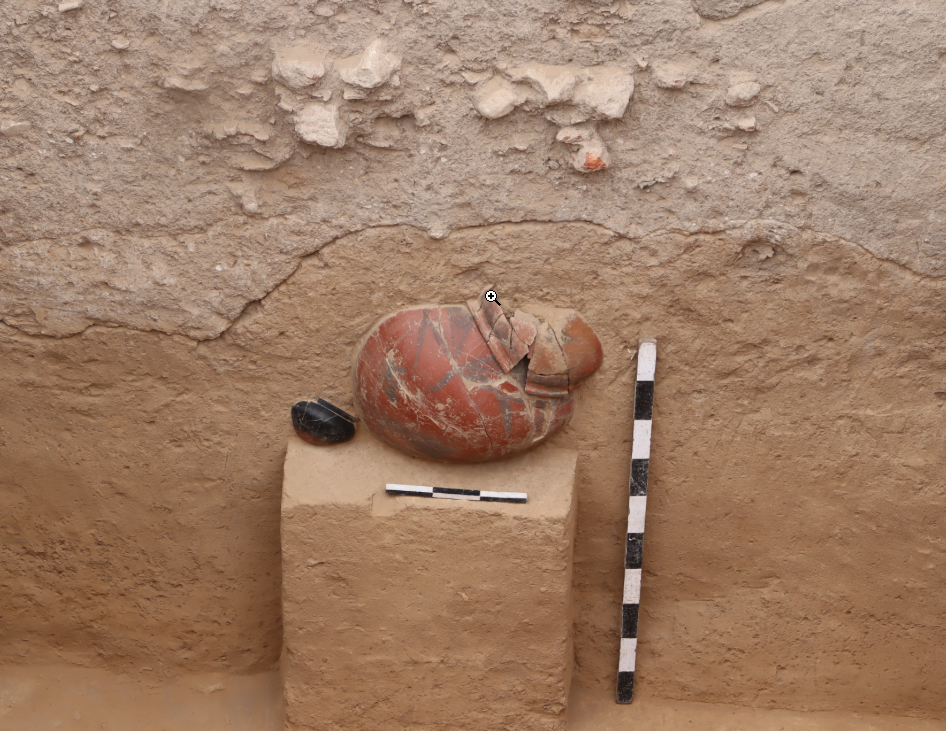
- Burial Evidence: Archaeologists unearthed a red-slipped burial pot decorated with painted peacocks.
- Molar and premolar teeth recovered outside the vessel, along with a black-and-red ware pot placed beneath it, suggest it functioned as a burial urn.
- Graffiti marks were also found on the vessel.
- Similar peacock-decorated burial vessels have previously been reported from Porunthal and in Harappan Cemetery-H, including Harappa, Hulas and Bhirrana, suggesting ritual significance.
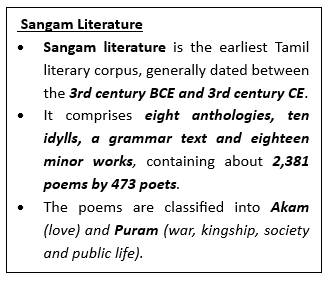
- Akananuru, a Sangam text, refers to decorating memorial stones with peacock feathers, providing literary resonance to the archaeological evidence.
Significance of the Findings
- Historically Significant Site: The site’s importance was first recognised after Roman coins were reported from the region, leading L. A. Cammiade to survey it, while the Madras Museum’s 1932–33 Annual Report documented glass beads and burial urns.
- Evidence of a Specialised Production Centre: The discoveries suggest the settlement functioned as a specialised production centre, with evidence of iron production, bead manufacturing, shell bangle production and weaving.
- Habitation, Manufacturing and Commerce: Located along an ancient east-west trade route, the settlement appears to have combined habitation, manufacturing and commerce, indicating its integration into wider trade networks.
- Bridges Archaeology and Sangam Literature: The peacock-decorated burial urn and references in Akananurustrengthen the link between archaeological evidence and Sangam literature.
- Distinct Cultural Sequence: The excavation suggests southern Tamil Nadu followed a Microlithic–Iron Age–Early Historic sequence, unlike the Microlithic–Neolithic–Iron Age sequence of northern Tamil Nadu.
- Strengthens Tamil Nadu’s Archaeological Record: Together with Keeladi, Sivagalai, Mangudi and Adichanallur, the findings strengthen Tamil Nadu’s archaeological record and may reveal Karivalamvanthanallur’s continuous evolution from the Stone Age to the Sangam Age.