
SYLLABUS
GS2: Amendments to Indian Constitution; Important Aspects of Governance, Transparency and Accountability.
Context: The Joint Parliamentary Committee (JPC) examining the Constitution (One Hundred and Thirtieth Amendment) Bill has deferred the adoption of its draft report to allow further deliberations on the proposed framework for the removal of the Prime Minister, Chief Ministers and Ministers.
Key Provisions of Constitution (130th Amendment) Bill, 2025
- Cover Constitutional Functionaries: Apply to the Prime Minister, Union Ministers, Chief Ministers and State Ministers.
- Complementary amendments have also been proposed to the Government of Union Territories Act, 1963 and the Jammu and Kashmir Reorganisation Act, 2019.
- Provide for Cessation of Office: A Prime Minister, Chief Minister or Minister shall cease to hold office upon completing 30 consecutive days of judicial custody for offences punishable with five years or more.
- Specify the Removal Process: Ministers would be removed by the President/Governor on the advice of the Prime Minister/Chief Minister, while the Prime Minister or Chief Minister would automatically cease to hold office after the prescribed period of detention.
- Provide an Opportunity to Seek Bail: The proposed framework effectively provides a 30-day window to obtain bail before the cessation provisions become operative.
- Allow Reappointment: A person ceasing to hold office may be reappointed after release from judicial custody, subject to the applicable constitutional and legal provisions.
- Amend Constitutional Provisions: Amend Articles 75, 164 and 239AA to establish the proposed constitutional framework.
Significance of the Proposed Bill
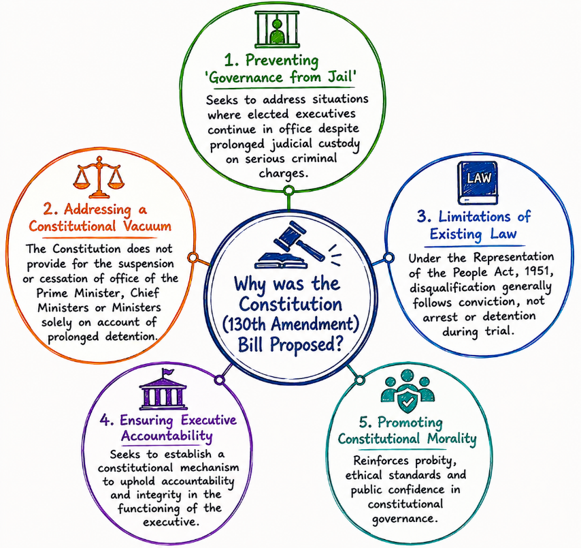
- Curbing Criminalisation of Politics: Prevents persons facing serious criminal charges from continuing in executive office during prolonged detention.
- Strengthening Constitutional Morality: Reinforces accountability, probity and ethical standards expected from holders of constitutional offices.
- Upholding Rule of Law: Affirms that high constitutional offices are subject to the same legal standards as other citizens.
- Enhancing Public Confidence: Promotes transparency and accountability, thereby strengthening citizens’ trust in democratic institutions.
Concerns & Challenges
- Presumption of Innocence: Cessation from office before conviction may conflict with the principle that an accused is innocent until proven guilty.
- Risk of Political Misuse: The provisions could be exploited through politically motivated arrests against elected executives.
- Democratic and Federal Concerns: Automatic cessation of office may disrupt governance and undermine the electoral mandate, particularly in States.
- Judicial Delays: Prolonged investigations and trials could unfairly affect constitutional functionaries before guilt is established.
Judicial Perspective
- B.R. Kapur v. State of Tamil Nadu (2001): Held that a person disqualified from being a legislator cannot be appointed as Chief Minister.
- Manoj Narula v. Union of India (2014): Declined to prohibit the appointment of persons with criminal charges as Ministers, while stressing constitutional morality in ministerial appointments.
- Public Interest Foundation v. Union of India (2018): Refused to disqualify candidates merely on pending criminal cases, holding that such reforms fall within Parliament’s domain, while directing greater disclosure of criminal antecedents by political parties.
JPC’s Draft Recommendations
- Suspend Instead of Remove: Replace automatic removal with temporary suspension after 30 consecutive days of judicial custody.
- Fast-track Adjudication: Cases involving suspended constitutional functionaries should be decided by designated fast-track courts within one year, wherever feasible.
- Revoke Suspension: Suspension should cease upon release from judicial custody, allowing the individual to resume office in accordance with the law.
- Define ‘Serious Criminal Offences’: Clearly define “serious criminal offences” as offences punishable with imprisonment of five years or more to ensure clarity and uniform application of the proposed law.