
SYLLABUS
GS-3: Infrastructure- Energy; Science and Technology- developments and their applications and effects in everyday life; Indigenization of technology and developing new technology.
Context: India and Australia have finalised the Administrative Arrangement under the India–Australia Civil Nuclear Cooperation Agreement during the Third India–Australia Annual Summit held in Melbourne.
About India–Australia Civil Nuclear Cooperation
- India and Australia signed the Civil Nuclear Cooperation Agreement in September 2014, which entered into force in November 2015.
- The Agreement provides the framework for civil nuclear cooperation and enables Australian companies to export uranium to India on a commercial basis.
- Key Features:
- Enables long-term exports of Australian uranium to India.
- Uranium will be used exclusively for peaceful civilian purposes.
- All supplies will remain under IAEA safeguards.
- Provides a stable long-term framework for cooperation between governments and industry.
- Under Australian policy, uranium exports are permitted only to countries having a Civil Nuclear Cooperation Agreement.
- Why Australia is Important
- Holds more than one-third of global uranium resources, the largest in the world.
- Offers India a reliable source of uranium for its expanding nuclear fleet.
- Diversifies India’s uranium imports, reducing dependence on limited domestic reserves.
- Australia reaffirmed support for India’s membership of the Nuclear Suppliers Group (NSG).
Significance
- Energy Security: Ensures assured long-term uranium supplies, strengthens fuel security, and diversifies uranium imports for long-term energy security.
- Supports Nuclear Energy Mission: Supports the 100 GW nuclear power target by 2047 by providing assured fuel for timely implementation of nuclear projects.
- Reinforces SHANTI Act: Complements the SHANTI Act, 2025 by enabling private participation and ensuring the fuel security needed to expand nuclear power.
- Clean Energy Transition: Provides reliable baseload power, supports manufacturing, industry, data centres, and advances Net Zero by 2070 and India’s NDCs.
- Strategic Importance: Reinforces India’s responsible nuclear credentials and strengthens the India–Australia Comprehensive Strategic Partnershipin clean energy and energy security.
India’s Status of Nuclear Energy
- India currently operates 24 nuclear power reactors across seven sites with a total installed capacity of 8.78 GW.
- The reactor fleet comprises:
- Pressurised Heavy Water Reactors (PHWRs)
- Boiling Water Reactors (BWRs)
- Light Water Reactors (LWRs)
- Most operational PHWRs use natural uranium as fuel while producing plutonium as a by-product.
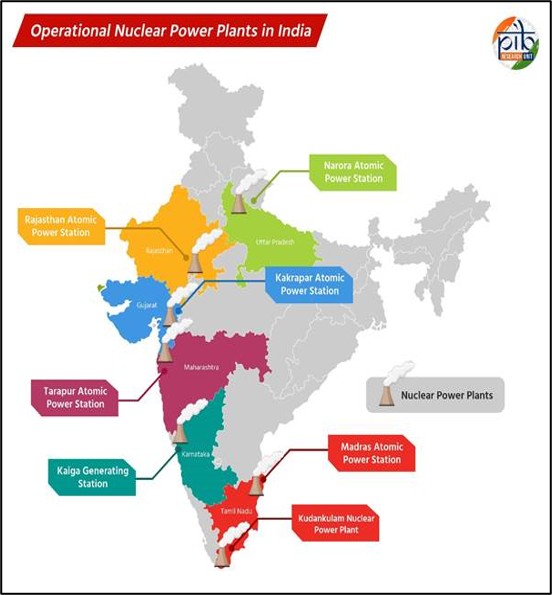
- Expansion Plans: 10 reactor units (8,000 MW) are under construction, and pre-project activities have commenced for 10 additional reactors.
- Nuclear Energy Mission: Announced in the Union Budget 2025–26, it targets 100 GW of nuclear power capacity by 2047and supports Net Zero emissions by 2070.
- SHANTI Act, 2025: The Sustainable Harnessing and Advancement of Nuclear Energy for Transforming India (SHANTI) Act, 2025 modernises India’s nuclear legal framework by enabling limited private participation under regulatory oversight.
- It also opens new avenues for collaboration and investment.
- Small Modular Reactors (SMRs): The Union Budget 2025–26 allocated ₹20,000 crore for indigenous SMRs (up to 300 MWe).
- Their advantages include factory-based manufacturing, faster construction, improved quality control and phased deployment, with a target of at least five operational SMRs by 2033.
- Prototype Fast Breeder Reactor (PFBR): India’s 500 MWe PFBR at Kalpakkam, developed by BHAVINI, attained first criticality on 6 April 2026, marking the second stage of India’s Three-Stage Nuclear Power Programme.
- It uses plutonium from spent PHWR fuel to breed more fuel and will eventually produce Uranium-233 from thorium, strengthening long-term fuel security and supporting Net Zero.
India’s Three-Stage Nuclear Programme
- Formulated by Dr. Homi J. Bhabha during the 1950s.
- Designed to utilise India’s limited uranium resources while harnessing its vast thorium reserves for long-term energy security and self-reliance.
- India possesses around 2% of the world’s uranium reserves but nearly 25% of global thorium reserves, primarily located in Kerala, Tamil Nadu, Andhra Pradesh and Odisha.
- Stage I; Pressurised Heavy Water Reactors (PHWRs): Use natural uranium as fuel and heavy water (D₂O) as both moderator and coolant.
- It generates electricity while producing Plutonium-239 from Uranium-238, and was chosen because it does not require uranium enrichment.
- Stage II; Fast Breeder Reactors (FBRs): Uses Mixed Oxide (MOX) fuel prepared from Plutonium-239 recovered from spent PHWR fuel and natural uranium.
- It produces more nuclear fuel than it consumes by converting Uranium-238 into Plutonium-239, while thorium can be used to produce Uranium-233; the Prototype Fast Breeder Reactor (PFBR) at Kalpakkammarks India’s entry into this stage.
- Stage III; Thorium-Based Reactors: Envisages thorium-fuelled breeder reactorsthat initially use a mixture of Uranium-233 and thorium.
- Thorium is progressively converted into Uranium-233, enabling large-scale use of India’s abundant thorium reserves and ensuring long-term energy independence.