
SYLLABUS
GS-2: Issues relating to development and management of Social Sector/Services relating to education.
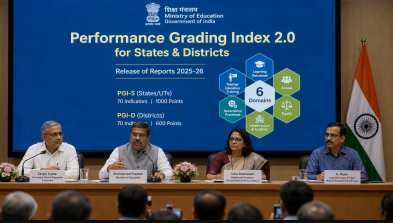
Context: The Union Ministry of Education released the Performance Grading Index 2.0 for States/UTs (PGI-S) and the Performance Grading Index for Districts (PGI-D) for 2025–26 to assess school education performance across States/UTs and districts.
About the Performance Grading Index 2.0 for States/UTs (PGI-S)
• The Department of School Education & Literacy, Ministry of Education, developed the PGI 2.0 to evaluate the performance of States and Union Territories in school education.
• It follows a grading system instead of ranking, allowing multiple States/UTs to be placed in the same performance band.
• PGI 2.0 is the revised version of the earlier Performance Grading Index framework.
• The framework carries a total weightage of 1,000 points across 70 indicators.
• The indicators are grouped under 2 categories: Outcome and Governance & Management.
• These cover 6 domains:
1. Learning Outcomes and Quality
2. Access
3. Infrastructure & Facilities
4. Equity
5. Governance Processes
6. Teachers Education & Training
• The framework is aligned with data from:
- Unified District Information System for Education Plus (UDISE+)
- PARAKH Rashtriya Sarvekshan 2024
- PM POSHAN Portal
- PRABAND Portal
- Vidyanjali Portal
Key Findings of PGI-S 2025–26
• No State/UT achieved the top three grades, Utkarsh, Uttam-1 or Uttam-2, indicating significant scope for improvement.
• Chandigarh was the only State/UT to attain Uttam-3 (761–820).
• Four States/UTs attained Prachesta-1: Dadra & Nagar Haveli and Daman & Diu, Punjab, Kerala and Delhi.
• Five States/UTs attained Prachesta-2: Lakshadweep, Himachal Pradesh, Goa, Maharashtra and Odisha.
• Thirteen States/UTs were placed in Prachesta-3, while another thirteen States/UTs were placed in Akanshi-1.
• No State/UT fell under Akanshi-2 or Akanshi-3.
About the Performance Grading Index for Districts (PGI-D) 2025–26
• The Department of School Education & Literacy, Ministry of Education extended the Performance Grading Index to the district level through PGI-D.
• PGI-D assesses districts on a common parameter, with greater emphasis on measuring the outcomes of educational policies.
• The framework has a total weightage of 600 points across 70 indicators.
• The indicators are grouped into 6 categories:
- Outcomes
- Effective Classroom Transaction
- Infrastructure Facilities & Student Entitlements
- School Safety & Child Protection
- Digital Learning
- Governance Process
• These are further divided into 11 domains:
1. Learning Outcomes and Quality (LOQ)
2. Access Outcomes (AO)
3. Teacher Availability and Professional Development Outcomes (TAPDO)
4. Learning Management (LM)
5. Learning Enrichment Activities (LEA)
6. Infrastructure, Facilities & Student Entitlements (IF&SE)
7. School Safety & Child Protection (SS&CP)
8. Digital Learning (DL)
9. Funds Convergence & Utilisation (FCU)
10. Attendance Monitoring Systems (AMS)
11. School Leadership Development (SLD)
• The framework uses data from:
- Unified District Information System for Education Plus (UDISE+)
- PARAKH Rashtriya Sarvekshan 2024
- PRABANDH Portal
Key Findings of PGI-D 2025–26
• No district attained the highest grades of Utkarsh or Uttam-1 in either 2024–25 or 2025–26.
• 19 districts reached Uttam-2 in 2025–26, compared with 16 districts in 2024–25.
• The number of districts in Uttam-3 increased from 75 to 97.
• Districts in Prachesta-1 decreased from 332 to 325, indicating improvement in overall performance.
• 473 districts improved their PGI score in 2025–26 compared with 2024–25.
• 89 districts achieved grade-level improvement.
• 664 districts remained in the same grade in both years.
• 29 districts slipped by one grade in 2025–26 compared with 2024–25.