
SYLLABUS
GS-2: Government policies and interventions for development in various sectors and issues arising out of their design and implementation.
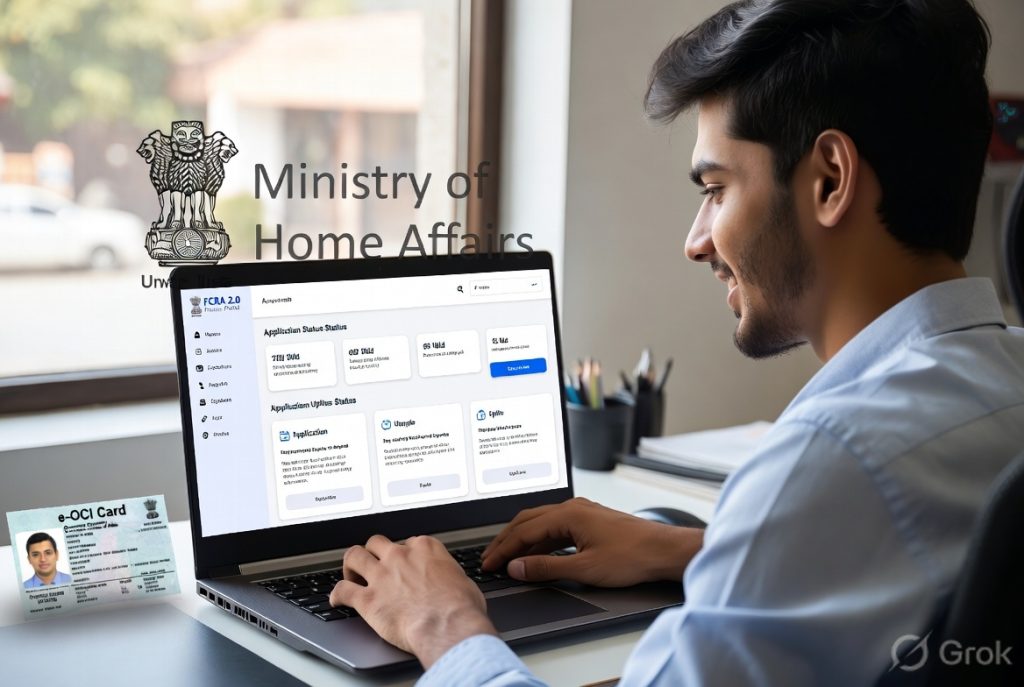
Context: Union Home Minister Amit Shah launched the Foreign Contribution (Regulation) Act (FCRA) 2.0 Portal and the Electronic Overseas Citizen of India (e-OCI) Cardto strengthen digital governance, simplify citizen services, and improve monitoring of foreign contributions.
More on the News
- The FCRA 2.0 Portal digitises the entire lifecycle of Foreign Contribution (Regulation) Act services—including registration, renewal, annual returns, and compliance—through an end-to-end online platform.
- The e-OCI Card introduces a fully digital OCI ecosystem, allowing applicants and existing OCI cardholders to access OCI services online while eliminating the need for repeated issuance of OCI booklets after passport renewal beyond the age of 20 years.
- The initiatives reflect the government’s principle of “Minimum Government, Maximum Governance“ by reducing paperwork, increasing transparency, and strengthening national security through technology.
About the FCRA 2.0 Portal
- The FCRA 2.0 Portal has been developed by the Ministry of Home Affairs to simplify compliance under the Foreign Contribution (Regulation) Act (FCRA) while strengthening monitoring and enforcement of foreign contributions.
- Key Features:
- Provides end-to-end digital processing of registration and renewal of FCRA certificates, filing of annual returns and other statutory approvals and services.
- Eliminates the need for physical submission of documents.
- Hosted on the MeghRaj (National Government Cloud) to enhance cybersecurity and reduce the risk of data theft.
- Incorporates provisions of the FCRA Amendment Rules, 2026.
- Features: Aadhaar-based authentication, e-Sign facility, OCR (Optical Character Recognition)-based document analysis, an integrated login-based dashboard, and API integration.
- Integrated Databases: The portal is integrated with PAN, Aadhaar, the OCI database, NGO Darpan, ICAI’s UDIN (Unique Document Identification Number) system, and banking systems.
- Current Coverage: Around 14,500 active FCRA-registered organisations operate across India, with 15,000–20,000 applications processed and nearly 17,000 annual returns filed each year.
- Upcoming Features: The portal will introduce an AI-powered chatbot, a mobile application, and a dedicated online dashboard for banks.
About the Electronic Overseas Citizen of India (e-OCI) Card
- The e-OCI Card is a citizen-centric digital initiative that transforms OCI services through a fully online platform for the global Indian diaspora.
- Key Features:
- The e-OCI platform enables end-to-end online services, including application submission, uploading supporting documents, digital approval, and downloading the electronically generated OCI Card.
- Existing OCI cardholders can obtain the digital card in most cases without a fresh application or physical verification.
- The requirement to re-issue the OCI booklet after obtaining a new passport beyond the age of 20 years has been removed.
- OCI holders only need to update passport details online whenever a new passport is issued.
- Enables real-time digital verification and faster immigration clearance.
- Coverage: Expected to benefit over 50 lakh OCI cardholders worldwide.
Significance
- Enhances Ease of Doing Compliance: Fully digital processing reduces paperwork, processing time, and compliance burden for FCRA-registered organisations.
- Strengthens National Security: Real-time monitoring, API-based verification, and integration with government databases improve oversight of foreign contributions and help detect misuse.
- Improves Citizen-Centric Services: e-OCI offers a seamless digital experience by eliminating physical documentation and simplifying OCI management.
- Promotes Digital Governance: Use of Aadhaar authentication, e-Sign, OCR technology, cloud hosting (MeghRaj), and future AI-enabled services reflects India’s push towards technology-driven governance.
- Improves Transparency and Efficiency: Faster verification, integrated dashboards, and centralized digital records strengthen accountability, reduce administrative costs, and improve public service delivery.
- Supports the Global Indian Diaspora: Digital OCI services provide greater convenience, secure identity verification, and easier international travel for millions of OCI cardholders.