
SYLLABUS
GS-3: Achievements of Indians in science & technology; indigenization of technology and developing new technology.
Context: The Defence Research and Development Organisation (DRDO) has handed over the Final Operational Clearance (FOC) of the indigenous Netra Airborne Early Warning and Control (AEW&C) system to the Indian Air Force (IAF).
More on the News
- The FOC certificate was handed over to the IAF, nearly nine years after the system received Initial Operational Clearance (IOC) in 2017, certifying the platform for full operational service.
- Developed jointly by DRDO, the IAF, certification agencies (CEMILAC and DGAQA), and Indian industry partners, the system has already demonstrated its operational reliability during the Balakot Air Strike (2019) and Operation Sindoor (2025).
- It strengthens India’s airborne surveillance, command-and-control capabilities, and the vision of Aatmanirbhar Bharat.
About the Netra Airborne Early Warning and Control (AEW&C) System
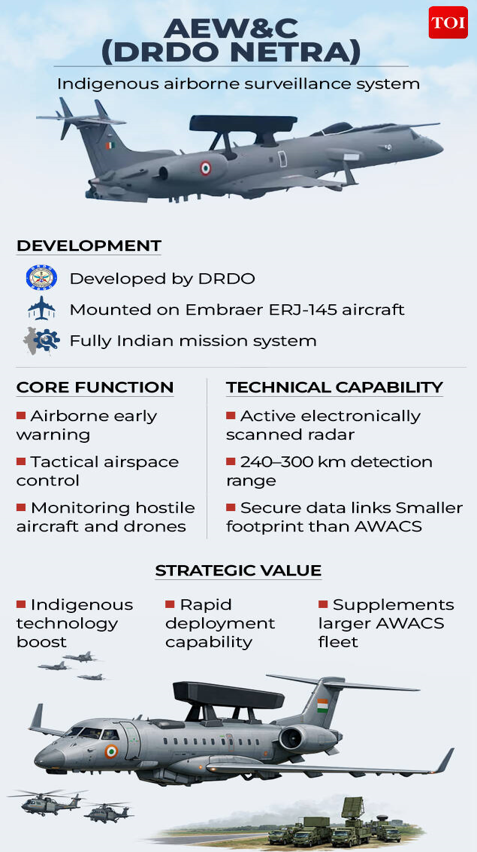
- Netra is India’s first indigenously developed Airborne Early Warning and Control (AEW&C) system, developed by DRDO’s Centre for Airborne Systems (CABS) in collaboration with the IAF and Indian industry.
- It is mounted on the Brazilian Embraer EMB-145 aircraft and functions as an airborne surveillance, battle management, and command-and-control platform—often referred to as an “Eye in the Sky.”
- The system is equipped with an indigenous Active Electronically Scanned Array (AESA) radar, providing 240° radar coverage and detecting low-flying aircraft, missiles, drones, and maritime targets up to about 375 km.
- It integrates advanced mission systems such as:
- Secondary Surveillance Radar (SSR)
- Identification Friend or Foe (IFF)
- Electronic Support Measures (ESM)
- Electronic Counter Measures (ECM)
- Secure communication systems
- Line-of-Sight (LOS) and Beyond-Line-of-Sight (BLOS) data links
- Mission computer and self-protection suite
- Air-to-air refuelling capability for extended endurance.
- Unlike ground-based radars, the airborne platform overcomes limitations posed by terrain and the Earth’s curvature, providing a real-time, integrated picture of the aerial battlespace.
- India currently operates three Netra AEW&C aircraft (No. 200 Squadron, Bhisiana, Punjab) and three Phalcon AWACS, while six upgraded Netra Mk-1A systems and six Airbus A321-based Netra Mk-2 AEW&C aircrafthave been approved to further enhance the IAF’s surveillance network.
Significance
- Force Multiplier: Provides early warning against aircraft, missiles, drones and maritime threats while directing fighter aircraft and air defence assets during combat.
- Network-Centric Warfare: Enhances real-time situational awareness, battle management and integration with the IAF’s Integrated Air Command and Control System (IACCS).
- Operational Validation: The FOC confirms that the platform has successfully completed all operational trials and is ready for full-scale deployment after proving its effectiveness during Balakot and Operation Sindoor.
- Strategic Self-Reliance: Reduces dependence on imported airborne surveillance platforms and showcases India’s indigenous capabilities in advanced radar, avionics, electronic warfare and mission software.
- Future-Ready Capability: The upcoming Netra Mk-1A and Netra Mk-2 programmes will provide longer-range surveillance, enhanced electronic warfare capabilities, greater endurance and improved coverage, strengthening India’s air defence architecture against evolving threats such as stealth aircraft, cruise missiles and unmanned aerial systems.