
SYLLABUS
GS-3: Infrastructure: Energy, Ports, Roads, Airports, Railways etc.
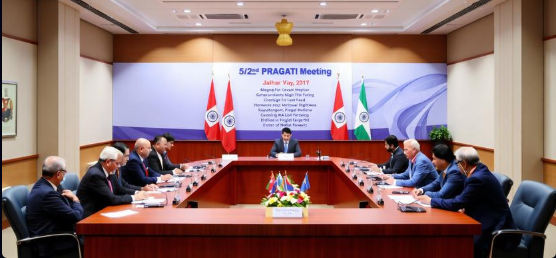
Context: Recently, thePrime Minister Narendra Modi chaired the 52nd meeting of PRAGATI (Pro-Active Governance and Timely Implementation) to review major infrastructure projects, TB Mukt Bharat Abhiyan, and measures to address cybercrime and digital fraud.
Key Highlights of the Meeting
- Infrastructure Project Review: Reviewed 4 critical infrastructure projects in the Road, Power, Industrial Corridor, and Metro Rail sectors across 4 States, involving an investment of around ₹30,000 crore.
- Focused on timelines, inter-agency coordination, issue resolution, and timely completion.
- Directed Ministries and State Governments to resolve bottlenecks in a mission-mode manner.
- Emphasised that project delays lead to cost escalation and deprive citizens and industries of timely benefits.
- PM GatiShakti-Based Planning: Stressed the effective use of the PM GatiShakti National Master Plan for integrated planning and implementation.
- Called for regular updating of project details, utilities, infrastructure layers, and clearances.
- Emphasised real-time data-driven decision-making to identify and address bottlenecks in advance.
- TB Mukt Bharat Abhiyan: Reviewed progress under the TB Mukt Bharat Abhiyan.
- Highlighted the use of Artificial Intelligence and digital technologies for TB surveillance and management.
- Suggested involving NCC cadets and MY Bharat volunteers for awareness generation, patient follow-up, and community mobilisation.
- Cyber Crime and Digital Arrest: Reviewed grievances related to cyber fraud and digital arrest scams.
- Directed agencies to ensure faster response, better coordination, and stronger public awareness.
- Emphasised strengthening prevention, reporting, investigation, and grievance redressal mechanisms.
- Urged States to implement e-Zero FIR mechanisms for quicker registration and response to cyber fraud complaints.
About PRAGATI (Pro-Active Governance and Timely Implementation)
- Launched in 2015, PRAGATI is an ICT-enabled multi-modal platform for monitoring projects, reviewing schemes, and addressing public grievances.
- Integrates the efforts of the Central Government and State Governments through technology-enabled governance.
- Serves as a platform for real-time review, coordination, and issue resolution under the direct supervision of the Prime Minister.
- Origin and Evolution: Inspired by SWAGAT (State Wide Attention on Grievances by Application of Technology), launched in Gujarat in 2003.
- Expanded the concept of technology-enabled grievance redressal to national-level project monitoring and programme implementation.
- Reflects the governance philosophy of “Minimum Government, Maximum Governance.”
- Key Features: Integrates digital data management, video conferencing, and geo-spatial technology.
- Brings together the Prime Minister, Chief Secretaries of States, and Secretaries of Central Ministries on a single platform.
- Integrates platforms such as PM GatiShakti, PARIVESH, and PM Ref Portal.
- Functions as a mechanism for resolving complex inter-ministerial and Centre–State issues.
- Structured Review Mechanism: Prime Minister chairs PRAGATI meetings with Chief Secretaries and Secretaries of Central Ministries.
- Infrastructure projects are monitored by the Cabinet Secretariat.
- Schemes and grievances are reviewed by concerned Ministries under PMO oversight.
- Critical issues are escalated from Ministries to PRAGATI for timely resolution.
- Achievements: Reviewed and monitored 382 major national projects.
- Fast-tracked projects worth over ₹85 lakh crore.
- Resolved 2,958 out of 3,187 identified issues.
- Enabled real-time coordination and accountability across multiple levels of government.
Significance of PRAGATI
- Economic Significance: Accelerates infrastructure delivery, reduces cost overruns, and enables faster realization of economic benefits through improved industrial growth, logistics efficiency, and regional connectivity.
- Cooperative Federalism: Institutionalises cooperative federalism by bringing Central Ministries and State Governments onto a common real-time decision-making platform, fostering shared ownership and accountability.
- Governance Significance: Strengthens transparency, accountability, and time-bound implementation while improving inter-ministerial coordination and promoting outcome-oriented governance reforms.
- Social Significance: Ensures faster delivery of infrastructure and public services, improving access to healthcare, education, markets, employment opportunities, and citizen-centric welfare schemes.
- Environmental Significance: Supports sustainable infrastructure planning through the PM GatiShakti GIS-based framework, enabling early environmental compliance and reducing delays, resource wastage, and emissions.
- Global Recognition: Recognised by Saïd Business School as a global best-practice model and a “Single Source of Truth” for real-time project monitoring, coordination, and efficient infrastructure delivery.