
SYLLABUS
GS-3: Indian Economy and issues relating to planning, mobilization of resources, growth, development and employment.
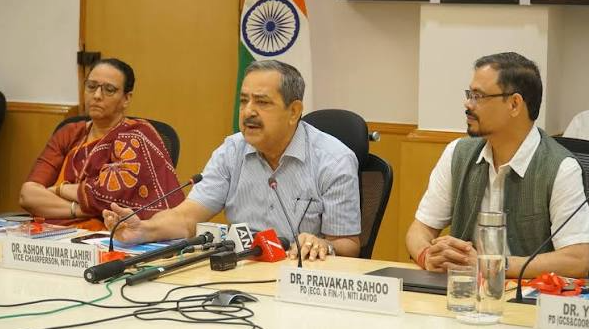
Context: NITI Aayog released the 8th edition of Trade Watch Quarterly (Q4 FY 2025–26), highlighting India’s resilient trade performance and examining opportunities and challenges in strengthening India’s pharmaceutical sector.
About Trade Watch Quarterly
• Trade Watch Quarterly is a flagship publication of the NITI Aayog that provides a data-driven assessment of global and domestic trade trends.
• Edition: Quarter 4 (January–March 2026), FY 2025–26.
• It evaluates India’s merchandise and services trade performance and offers policy recommendations to improve competitiveness.
• The thematic focus of this edition is India’s Pharmaceutical and Active Pharmaceutical Ingredients (API) Trade, assessing export opportunities, competitiveness, supply-chain vulnerabilities, and future growth prospects.
Key Findings
• India’s Overall Trade Performance: India’s total merchandise and services trade grew by 5.4% YoY in FY 2025–26, reaching $1.84 trillion.
- Exports increased by 4.2%, while imports grew by 6.5%.
- Merchandise exports declined by 2.8% in Q4 FY 2025–26, whereas imports increased by 11.9%.
- Services exports remained a major strength, growing by 9%, significantly outpacing services import growth of 4.1%.
• Rising Importance of Services Trade: India remained the world’s 8th-largest services exporter in 2025.
- Services exports recorded a 10.3% CAGR (2015–2025), exceeding the global average of 6.6%.
- India’s share in global services exports increased to 4.3%.
- Business Process Outsourcing (BPO) and support services accounted for 63.5% of software services exports.
- Europe’s share in India’s services exports rose to 33%, indicating greater market diversification.
• Global Pharmaceutical Market Opportunity: Global pharmaceutical and API demand reached approximately $1.3 trillion in 2025.
- Formulations accounted for $961.8 billion (75%), while APIs accounted for $261.2 billion.
- India exported pharmaceutical and API products worth $35.8 billion, but its global export share remained only 2.8%, indicating significant expansion potential.
• Strengths of India’s Pharmaceutical Sector: Contributes over 1.7% of GDP and 7.2% of manufacturing GVA.
- Supports around 27 lakh livelihoods.
- India is among the world’s largest suppliers of Generic medicines, vaccines, and Essential drugs.
- Retail medicaments and generic drugs (HS 3004) remain India’s strongest export segment, accounting for $22.6 billion exports and 4% share of global demand.
• Leading Pharmaceutical States:
| State | Key Strength |
| Telangana | Vaccine and life sciences hub |
| Gujarat | Strong chemical-pharmaceutical manufacturing and exports |
| Maharashtra | Large-scale manufacturing with strong R&D capabilities |
Emerging Challenges
• Limited Presence in High-Value Segments: India has a limited share in fast-growing segments such as biologics, biosimilars, immunologicals and advanced therapeutics, with exports of blood products, vaccines and immunologicals at only $2.2 billion (0.6% of global demand).
• Dependence on China: India remains highly dependent on China for APIs, Key Starting Materials (KSMs) and intermediates, with China supplying 66–86% of the top five API import categories.
• Low R&D Intensity: Despite patent filings rising from 440 (2013) to 3,576 (2023), Indian pharmaceutical firms spend only ~7% of sales on R&D, compared to 15–20% globally.
• Market Access Barriers: Indian exporters face hurdles such as lengthy registrations, duplicative inspections, stringent documentation requirements, limited regulatory recognition and increasing environmental compliance norms.
Recommendations
• Move Up the Pharmaceutical Value Chain: Shift from low-cost generic medicines towards biologics, biosimilars, advanced therapeutics and innovation-driven pharmaceutical products.
• Increase Research and Development and Innovation: Expand investments in research and development, strengthen industry-academia collaboration and promote commercialization of research and pharmaceutical startups.
• Reform Patent and Regulatory Systems: Improve regulatory transparency, introduce time-bound patent opposition and grant procedures, and enhance intellectual property certainty.
• Strengthen Domestic Active Pharmaceutical Ingredient Ecosystem: Expand domestic production of active pharmaceutical ingredients, key starting materials and biotechnology inputs while reducing dependence on Chinese imports through diversified sourcing.
• Improve Market Access Through Free Trade Agreements: Develop pharmaceutical provisions in future free trade agreements covering regulatory reliance, good manufacturing practice inspection cooperation, product registration, standards harmonization and dispute-resolution mechanisms.
• Promote Sustainable Manufacturing: Expand Bulk Drug Parks with common effluent treatment facilities, zero liquid discharge systems and solvent recovery infrastructure to reduce environmental compliance costs.
• Build World-Class Innovation Clusters: Develop integrated life-sciences ecosystems and pharmaceutical clusters to promote technology transfer, patent commercialization and advanced manufacturing capabilities.