
SYLLABUS
GS-2: Issues Relating to Development and Management of Social Sector/Services relating to Health, Education, Human Resources.
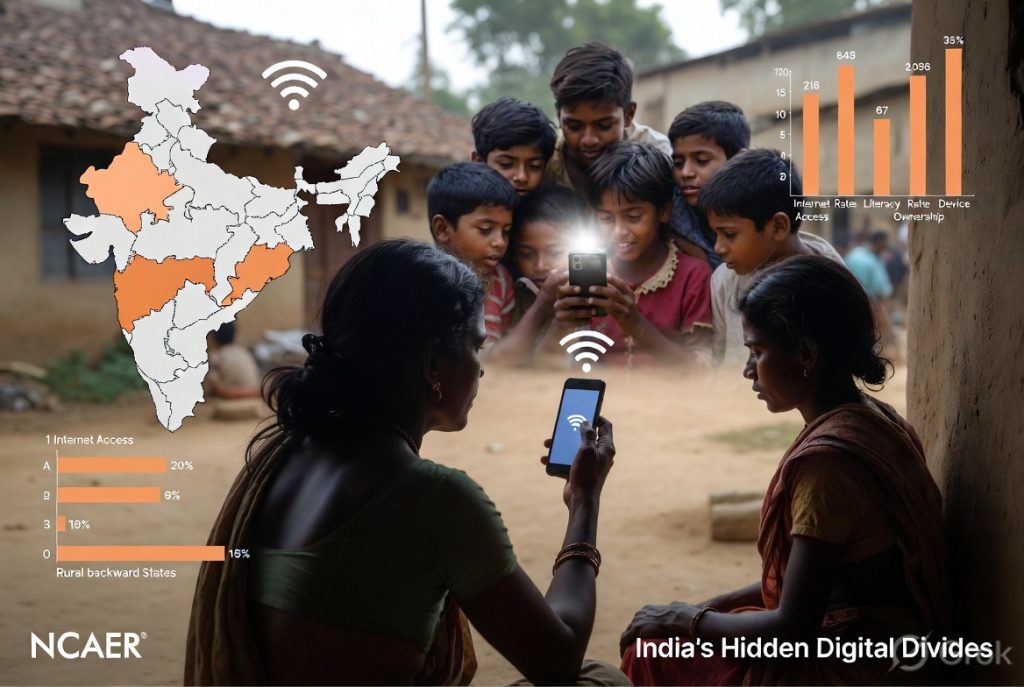
Context: Recently, the National Council of Applied Economic Research (NCAER) released a report highlighting that despite the rapid expansion of digital infrastructure and mobile penetration, significant hidden digital divides persist in access, skills, usage and outcomes of digital technologies across India.
Key Findings of the NCAER Report
- Access Divide: Mobile Penetration High, Advanced Device Ownership Low
- Mobile ownership has become nearly universal, with 95.1% of households owning a mobile device and 74.8% possessing a smartphone or internet-enabled device. However, only 8% of households own a computer/laptop, and merely 2.3% own a tablet, revealing significant disparities in access to advanced digital tools.
- Device ownership remains strongly linked to socio-economic status. Computer ownership ranges from 1.2% among the poorest households to 23.1% among the richest households, highlighting persistent inequalities in the quality of digital access.
- Connectivity Divide: Many Households Remain Offline
- India’s internet ecosystem remains overwhelmingly mobile-first, with 71.4% of households accessing the internet through mobile devices, while broadband and fixed-line internet remain limited.
- Despite widespread mobile penetration, 27.5% of households still lack internet access, including 32.2% of rural households and 17.2% of urban households. Connectivity gaps are most pronounced among economically disadvantaged households, where over half remain offline.
- Usage and Skills Divide: Connected but Not Empowered
- The report identifies a significant digital skills deficit. About 20.4% of households using digital services require assistance from someone outside the household, indicating that connectivity does not necessarily translate into digital empowerment.
- Computer literacy remains uneven, with only 21.9% of rural households reporting at least one computer-literate member compared to 43.6% in urban areas.
- Gender, Age and Social Inequalities
- Among working-age adults (15–59 years), 57.6% of men use the internet compared to only 35.6% of women, indicating a substantial gender gap that persists even with rising incomes.
- Digital exclusion is particularly severe among the elderly. Only 9.4% of individuals aged 60 years and above use the internet, raising concerns regarding access to increasingly digitalised public services and welfare schemes.
- Among children aged 13–16 years, 65.3% have access to a mobile device, but only 37.8% actively use the internet, suggesting that digital inequalities may be transmitted across generations.
Understanding India’s Hidden Digital Divide
The report conceptualises digital inequality as a three-layered challenge:
- First-Order Divide: Access
- Concerns ownership of devices and digital infrastructure. While mobile ownership is widespread, access to advanced devices such as computers and tablets remains highly unequal.
- Second-Order Divide: Connectivity
- Relates to internet access and quality of connectivity. A significant share of households remain offline despite living in a digitally connected economy.
- Third-Order Divide: Meaningful Outcomes
- Refers to the ability to convert digital access into educational, economic, financial and governance benefits. The report finds that internet use remains largely entertainment-driven, limiting transformative developmental outcomes.
Implications
- Challenge to Digital India: The findings indicate that digital transformation cannot be measured solely through connectivity indicators but must also consider usage quality and outcomes.
- Risk of Exclusion: Low digital literacy and internet usage among women, rural populations, and the elderly may restrict access to education, financial services, welfare delivery and employment opportunities.
- Human Capital Concerns: Limited use of digital technologies for education and skill development could constrain India’s long-term productivity and knowledge economy ambitions.
- Deepening Socio-Economic Inequalities: Without targeted interventions, digitalisation may reinforce existing social, gender and economic disparities rather than bridge them.
Way Forward
- Shift from Access to Meaningful Inclusion: Focus on ensuring that digital technologies translate into tangible benefits in education, livelihoods, finance and public service delivery, rather than merely expanding connectivity.
- Bridge the Digital Skills Gap: Strengthen digital literacy and computer-skilling initiatives, particularly among rural, less-educated and economically weaker households.
- Promote Productive Digital Usage: Encourage greater use of digital platforms for education, e-governance, financial services and skill development beyond entertainment-oriented consumption.
- Address Social and Gender Inequalities: Implement targeted measures for women, children, elderly citizens and other vulnerable groups to ensure equitable digital participation.
- Improve Quality of Digital Access: Expand access to computers, tablets and reliable broadband connectivity to deepen the quality of digital engagement beyond mobile-only access.