
SYLLABUS
GS-3: Indian Economy and issues relating to planning, mobilization of resources, growth, development and employment.
Context: The Reserve Bank of India (RBI) Monetary Policy Committee (MPC), in its June 2026 bi-monthly meeting, unanimously kept the repo rate unchanged at 5.25% and retained a neutral stance.
Key Highlights of the Meeting
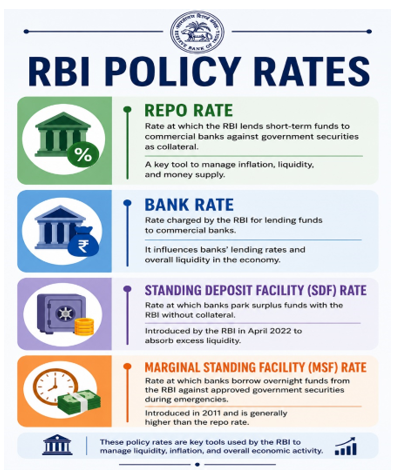
- The MPC unanimously kept the Repo Rate unchanged at 5.25%; consequently, the Standing Deposit Facility (SDF) Rate remains at 5.0%, while the Marginal Standing Facility (MSF) Rate and the Bank Rate remain at 5.5%.
- The committee retained its neutral policy stance, emphasizing flexibility and a data-driven approach amid evolving global and domestic conditions.
- This is the third consecutive MPC meeting (February, April and June 2026) in which policy rates have remained unchanged.
- The RBI revised its FY27 Real GDP Growth projection downward to 6.6% from 6.9%.
- Quarterly GDP Growth projections for FY27 are Q1: 6.6%, Q2: 6.3%, Q3: 6.5% and Q4: 6.8%.
- The RBI revised its FY27 CPI Inflation forecast upward to 5.1% from 4.6%.
- Quarterly CPI Inflation projections for FY27 are Q1: 4.2%, Q2: 5.1%, Q3: 5.9% and Q4: 5.4%.
- The MPC highlighted upside risks to inflation and downside risks to growth arising from geopolitical tensions, elevated energy prices and supply-side disruptions.
- The RBI announced measures to attract dollar inflows and strengthen external sector resilience, including:
- Expansion of the Fully Accessible Route (FAR);
- Concessional forex swap facility till September 30, 2026;
- Support for fresh Foreign Currency Non-Resident (Bank) deposits of 3–5 years till September 30, 2026;
- Incentives for External Commercial Borrowings (ECBs) by Public Sector Undertakings (PSUs).
- The RBI restored the timeline for the realization of export proceeds to nine months.
Factors Influencing the Decision
- West Asia Conflict and Global Uncertainty: Continuing geopolitical tensions have disrupted trade routes and supply chains, increased market volatility and weakened business sentiment.
- Energy Prices and Supply Chain Disruptions: Elevated crude oil and energy prices, along with disruptions in global logistics networks, are weighing on economic activity and growth prospects.
- Inflation Risks: Higher energy prices, food inflation uncertainties, forecasts of a subnormal southwest monsoon and possible El Niño conditions pose upside risks to inflation.
- Growth Concerns: High-frequency indicators suggest moderation in some sectors, while external shocks and supply disruptions present downside risks to growth.
- India’s Macroeconomic Resilience: The MPC noted that India entered the current phase of global turbulence with stronger fundamentals than in previous episodes and remains relatively well-positioned to absorb external shocks.
About the Monetary Policy Committee (MPC)
- It was established in September 2016, under Section 45ZB (1) of the Reserve Bank of India Act, 1934 (RBI Act).
- The Urijit Patel Committee had recommended the setting up of the MPC
- The MPC’s primary role is to set the Policy Rate required to achieve the inflation target.
- According to Section 42B (2) of the RBI Act, the MPC consists of:
- The Governor of RBI, who serves as the Chairperson, ex officio.
- The Deputy Governor of RBI is responsible for Monetary Policy, as a member, ex officio.
- One RBI officer nominated by the Central Board, as a member, ex officio.
- (Three individuals appointed by the Central Government, as Members.
- Members appointed by the Central Government hold their positions for a term of four years or until further orders, whichever is earlier.
- According to Section 45ZA of the RBI Act, the inflation target is set at 4%, with an upper tolerance level of 6% and a lower tolerance level of 2%.
- If inflation exceeds 6% or drops below 2% for three consecutive quarters, it is deemed a failure to meet the target.