
SYLLABUS
GS-2: Government Policies and Interventions for Development in various sectors and Issues arising out of their Design and Implementation; Issues Relating to Development and Management of Social Sector/Services relating to Health, Education, Human Resources.
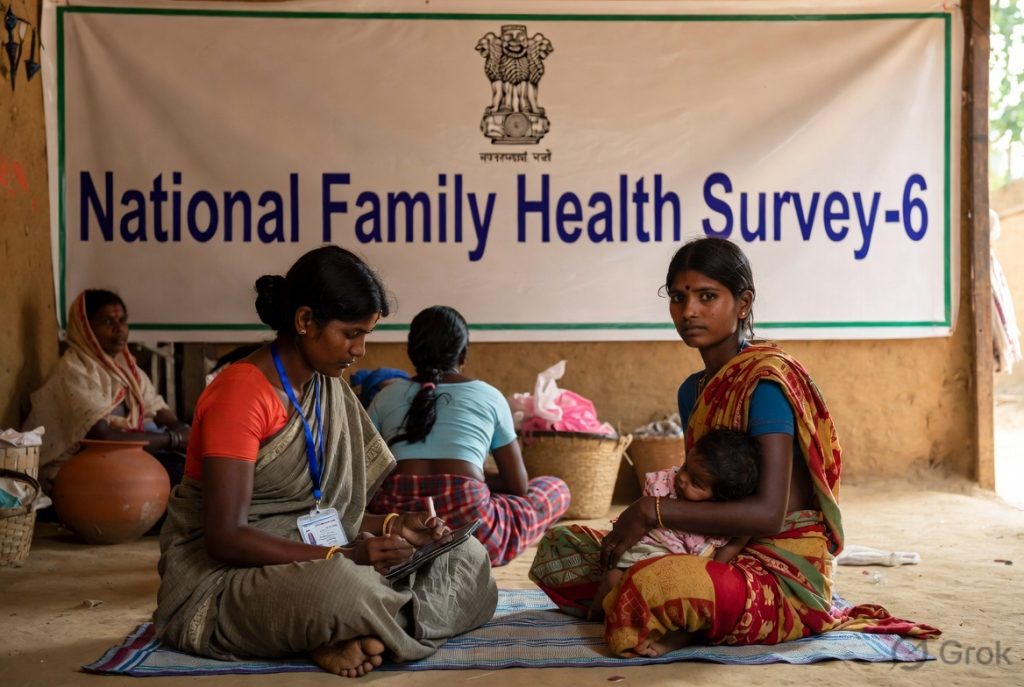
Context: The Union Ministry of Health and Family Welfare recently released the National Family Health Survey-6 (NFHS-6), providing comprehensive data on population, health, nutrition, emerging lifestyle diseases, and family welfare indicators in India.
More on the News
- NFHS-6 was conducted during 2023-24 by the Ministry of Health and Family Welfare (MoHFW) with the International Institute for Population Sciences (IIPS), Mumbai, as the nodal agency.
- The survey covered nearly 6.79 lakh households across 715 districts of all States and Union Territories and collected information from households, women, men, and children across a wide range of demographic and health indicators.
- The findings are significant for monitoring progress towards Sustainable Development Goals (SDGs), Universal Health Coverage (UHC), National Health Policy targets, and India’s demographic transition.
Key Findings of NFHS-6
Safe Motherhood and Maternal Healthcare
- Maternal healthcare indicators registered a significant improvement:
- 95.9% of pregnant women received antenatal care (ANC), up from 92.6% in NFHS-5.
- Mothers receiving ANC in the first trimester increased from 70.0% to 76.2%.
- Maternal nutrition outcomes also improved:
- Women consuming Iron-Folic Acid (IFA) supplements for 100 days or more during pregnancy increased from 44.1% to 54.9%.
- Women consuming IFA supplements for 180 days or more increased from 26.0% to 37.8%.
Institutional Deliveries and Newborn Care
- Institutional deliveries increased from 88.6% to 90.6%, moving India closer towards universal institutional delivery coverage.
- Births attended by skilled health personnel improved from 89.4% to 91.3%.
- Newborns receiving postnatal care within two days of delivery from trained health personnel increased from 79.1% to 85.3%.
Family Planning Indicators
- India’s Total Fertility Rate (TFR) remained stable at 2.0, indicating that the country is nearing replacement-level fertility (2.1).
- The Contraceptive Prevalence Rate (CPR) increased from 66.7% to 69.1%, reflecting improved access to family planning services.
Child Immunisation and Child Health
- Full vaccination coverage among children aged 12–23 months increased from 83.8% to 87.1%.
- 95.6% of children received most vaccinations through public health facilities, underscoring continued trust in the public healthcare system.
- Coverage of any vaccination among children aged 12–23 months remained consistently high at above 96%.
- Rotavirus vaccination coverage more than doubled from 36.4% to 85.4%.
- Child health outcomes also improved:
- Prevalence of Acute Respiratory Infection (ARI) symptoms among children declined from 2.8% to 1.9%, while prevalence of severe diarrhoea declined to 0.5%.
Child Nutrition and Feeding Practices
- NFHS-6 recorded encouraging improvements in child nutrition:
- Stunting (low height for age) among children under five declined from 35.5% to 29.3%.
- Severe wasting (too thin for one’s height) declined sharply from 7.7% to 5.2%.
- Underweight prevalence among children under five declined marginally from 32.1% to 31.8%.
- Infant and young child feeding practices improved:
- 95.6% of children below six months were breastfed during the survey period.
- Children breastfed within one hour of birth increased from 41.8% to 50.1%.
Expansion of Health Protection Coverage
- Households with at least one member covered under a health insurance/financing scheme increased substantially from 41.0% to 60.2%.
- The expansion reflects the growing reach of initiatives such as Ayushman Bharat–Pradhan Mantri Jan Arogya Yojana (AB-PMJAY) and other public health protection programmes.
Women’s Empowerment and Financial Inclusion
- Women’s digital and financial inclusion witnessed significant progress:
- Women who had ever used the internet nearly doubled from 33.3% to 64.3%.
- Women having a bank or savings account that they themselves use increased from 78.6% to 89.0%.
- Use of hygienic menstrual protection methods among women aged 15–24 years increased from 77.6% to 79.2%, supported by initiatives such as the Menstrual Hygiene Scheme (MHS) within the Rashtriya Kishor Swasthya Karyakram (RKSK) and the affordable sanitary products under the Pradhan Mantri Bhartiya Janaushadhi Pariyojana.
About the National Family Health Survey (NFHS)
- The National Family Health Survey (NFHS) is a large-scale, nationally representative household survey that provides data on population, health, nutrition, fertility, family planning, maternal and child health, and other socio-economic indicators in India.
- Conducted under the Ministry of Health and Family Welfare (MoHFW) with the International Institute for Population Sciences (IIPS), Mumbai as the nodal agency, the survey was first launched in 1992–93 (NFHS-1).
- NFHS provides estimates at the national, State/UT, and district levels, making it a key source of evidence for policy formulation, programme implementation, and monitoring of health and development outcomes.
- It plays an important role in tracking progress towards Sustainable Development Goals (SDGs), Universal Health Coverage (UHC), and various flagship health, nutrition, and social welfare programmes.