

SYLLABUS
GS-3: Achievements of Indians in science & technology; indigenization of technology and developing new technology
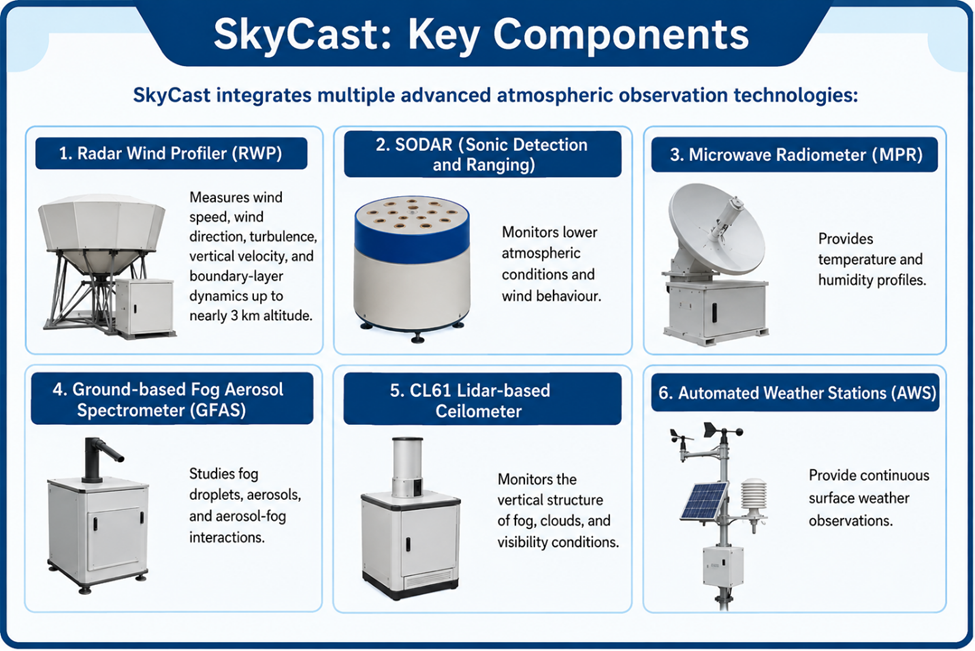
Context: India inaugurated its first “SkyCast” Aviation Weather Monitoring System at Indira Gandhi International Airport under Mission Mausam, making India the 19th country in the world to deploy an integrated aviation weather intelligence system.
About the SkyCast Aviation Weather Monitoring System
- SkyCast is an advanced integrated atmospheric remote sensing and aviation weather monitoring system developed under Mission Mausam.
- It provides real-time weather intelligence to pilots, airlines, airport operators, and air traffic management agencies.
- The system is designed to reduce flight disruptions caused by fog, turbulence, wind shear, poor visibility, and adverse weather conditions.
- It supports nowcasting and early warning services, enabling safer take-offs and landings.
- After Delhi’s IGI Airport, the next SkyCast facility will be established at Noida International Airport.
- The system is based on findings from the Winter Fog Experiment (WiFEX) launched jointly by India Meteorological Department and Indian Institute of Tropical Meteorology at IGI Airport in 2015.
- WiFEX improved understanding of fog formation, aerosol-cloud interactions, visibility reduction, and urban boundary-layer processes.
Significance of SkyCast
- Enhancing Aviation Safety: SkyCast provides real-time monitoring of wind, turbulence, fog, and visibility conditions, enabling safer aircraft take-offs, landings, and flight operations.
- Reducing Flight Delays and Diversions: The system delivers advance weather alerts to pilots and airlines, helping minimize weather-related delays, cancellations, and diversions.
- Towards “Fog-Free Flights”: Its advanced fog-monitoring capabilities improve visibility forecasting, particularly during Delhi’s dense winter fog conditions.
- Strengthening Weather Forecasting: SkyCast generates high-quality atmospheric data that enhances nowcasting and improves the accuracy of weather forecasts.
- Supporting Wider Public Services: The observations generated by SkyCast can be used for AI-enabled forecasting, pollution management, transport advisories, urban weather prediction, and disaster preparedness.
About Mission Mausam
- It is a flagship initiative of the Ministry of Earth Sciences, approved in September 2024 with an outlay of ₹2,000 crore for the period 2024–26.
- It aims to make India a “Weather-ready and Climate-smart Nation” capable of mitigating the impacts of climate change and extreme weather events.
- Objectives
- Develop cutting-edge weather surveillance technologies.
- Enhance atmospheric observations with better spatial and temporal coverage.
- Deploy next-generation radars, satellites, and atmospheric monitoring systems.
- Improve weather prediction using Artificial Intelligence (AI) and Machine Learning (ML).
- Strengthen last-mile dissemination of weather services and warnings.
- Develop technologies for weather management and disaster risk reduction.
- Key Targets: Increase weather observation infrastructure, including
- 50 Doppler Weather Radars (DWRs)
- 60 Radiosonde/Radiowind (RS/RW) systems
- 100 Disdrometers
- 10 Wind Profilers
- 25 Radiometers
- Improve weather forecast resolution from 12 km to 6 km, enabling Panchayat-level forecasts.
- Enhance nowcasting frequency from 3-hourly to 1-hourly updates.
- Implementing Agencies:
- India Meteorological Department: Observations, services, dissemination, and decision support.
- Indian Institute of Tropical Meteorology: Research, field campaigns, process studies, and modelling.
- National Centre for Medium Range Weather Forecasting: Data assimilation and seamless weather prediction.