SYLLABUS
GS-2: Bilateral, regional and global groupings and agreements involving India and/or affecting India’s interests; Important International institutions, agencies and fora – their structure, mandate.
GS-3: Conservation, environmental pollution and degradation, environmental impact assessment.
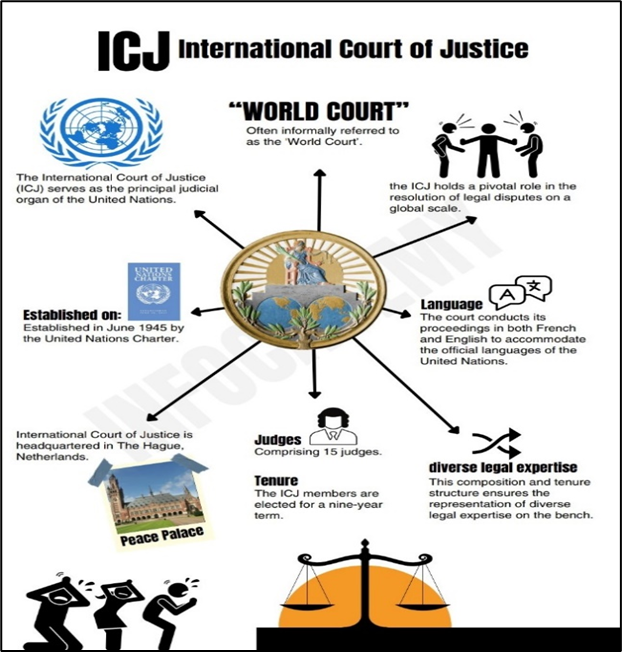
Context: The United Nations General Assembly (UNGA) recently adopted a resolution overwhelmingly backing the landmark advisory opinion of the International Court of Justice (ICJ) on climate change, reinforcing that countries have legal obligations under international law to address the climate crisis and protect the environment.
More on the News
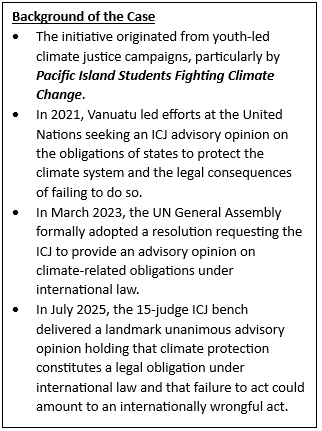
- The UNGA resolution supporting the ICJ advisory opinion was adopted by a vote of 141–8, with 28 countries abstaining, including India.
- Countries voting against the resolution included the United States, Russia, Saudi Arabia, Iran, Israel, Yemen, Liberia and Belarus.
- Moved by Vanuatu, the resolution urged countries to fulfil their international climate obligations and take measures consistent with the Paris Agreement to limit global warming to 1.5°C above pre-industrial levels.
- India abstained on the resolution, emphasising the principle of Common but Differentiated Responsibilities and Respective Capabilities (CBDR-RC) and raising concerns regarding equitable burden-sharing and the developmental priorities of the Global South.
- The resolution endorses the landmark unanimous advisory opinion delivered by the 15-judge ICJ bench, which held that climate protection is a legal obligation under international law and not merely a policy choice.
Key Highlights of the ICJ Advisory Opinion
- Climate Action as a Legal Obligation: The ICJ held that climate action is a legal obligation under international law, and failure to take adequate action could constitute an internationally wrongful act.
- Linkage with Human Rights: The Court recognised the human right to a clean, healthy, and sustainable environment and linked climate obligations with international human rights protections.
- Reaffirmation of CBDR-RC: The ICJ reaffirmed the principle of Common But Differentiated Responsibilities and Respective Capabilities (CBDR-RC) as a foundational principle of the international climate regime.
- Liability and Reparations: The Court observed that states failing to meet environmental obligations could be required to provide reparations, including restitution, compensation, or ecosystem restoration measures.
- Legal Status of Kyoto Protocol: The ICJ clarified that the Kyoto Protocol continues to remain in force and retains the status of international law even after the Paris Agreement.
Significance of the UNGA Resolution and ICJ Opinion
- Strengthening Climate Justice: The ruling strengthens the global climate justice framework by recognising the disproportionate vulnerabilities faced by Small Island Developing States and climate-affected communities.
- Strengthening International Environmental Jurisprudence: The advisory opinion is expected to influence domestic courts, international climate litigation, and the interpretation of states’ environmental obligations worldwide.
- Reinforcing Responsibilities of Developed Countries: By reaffirming CBDR-RC, the ruling reiterates that developed countries bear greater responsibilities due to their historical emissions and superior technological and financial capacities.
- Integrating Climate and Human Rights: The opinion adopts a holistic approach by integrating climate protection, environmental sustainability, and human rights obligations within international law.