

SYLLABUS
GS-1: Urbanization, their problems and their remedies.
GS-2: Issues relating to development and management of Social Sector/Services relating to Human Resources; Important International institutions.
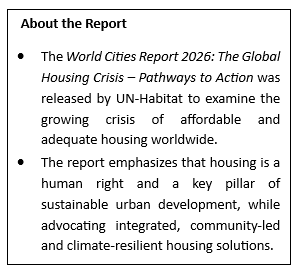
Context: A major new report by UN-Habitat, launched at the World Urban Forum 13 in Baku, highlights that the global housing crisis affecting billions can be addressed through inclusive, rights-based, and climate-resilient housing strategies.
Key Findings of the Report
- Scale of the Global Housing Crisis: Up to 3.4 billion people worldwide lack access to adequate housing.
- More than 1.1 billion people live in informal settlements and slums, the highest level on record.
- Major Drivers of the Crisis: The crisis is shaped by five interconnected challenges: affordability, displacement, informality, sustainability and declining liveability.
- Rapid urbanization, rising land prices, widening inequality, speculative housing markets and climate change are worsening housing shortages globally.
- Housing Affordability Challenges: Around 44% of households globally spend more than 30% of their income on housing.
- Housing shortages increased from 251 million units in 2010 to 288 million units in 2023.
- Rising rents and housing prices are deepening inequality and increasing insecurity of tenure.
- Informal Settlements and Urban Exclusion: Informal settlements increased from 895 million people in 2000 to around 1.13 billion in 2024.
- Forced evictions and slum clearances continue in many countries despite worsening poverty and social exclusion.
- Displacement and Housing Insecurity: By the end of 2024, over 123 million people were forcibly displaced globally due to conflict, violence, persecution and disasters.
- Many displaced populations live in insecure and substandard urban housing conditions.
- Climate Change and Housing: Climate-related hazards could destroy nearly 167 million homes by 2040.
- Buildings account for around 37% of global greenhouse gas emissions, making housing central to climate action.
- Low-income and informal settlements face the greatest climate risks and weakest adaptive capacity.
- Housing as a Human Right: The report highlights that forced evictions, insecure tenure and homelessness remain major human rights concerns.
- It calls for recognition of diverse tenure systems, rental housing, cooperatives and community-led housing approaches.
- Successful Global Examples: Thailand’s Baan Mankong programme is highlighted for community-driven upgrading of informal settlements.
- Brazil’s favela upgrading projects demonstrate the benefits of in-situ development instead of forced eviction.
- Community-led climate-resilient housing initiatives in countries such as Cambodia and the Philippines are presented as successful models.
About the United Nations Human Settlements Programme (UN-Habitat)
- It is the United Nations agency responsible for human settlements and sustainable urban development.
- Established in 1978 after the Habitat I Conference (Vancouver, 1976), it promotes inclusive, safe, resilient and sustainable cities to ensure adequate shelter for all.
- Headquartered in Nairobi, UN-Habitat supports countries through research, policy support, technical assistance and capacity-building on sustainable urbanization.
- India and UN-Habitat: India has been associated with UN-Habitat since its inception and played a major role in establishing the United Nations Centre for Human Settlements in 1976.
- Dr. Arcot Ramachandran served as the first Executive Director of UNCHS from 1978 to 1993, and India hosted the 11th session of UNCHS in 1988 and the first Asia Pacific Ministerial Conference on Housing and Human Settlements in 2006.
- India also served as President of the UN-Habitat Governing Council during 2017–19 and was a member of the Executive Board from 2019 to May 2025.
- India’s Engagement with UN-Habitat and Urban Initiatives: India’s engagement with UN-Habitat aligns with major urban initiatives such as the Smart Cities Mission, AMRUT, HRIDAY, National Urban Livelihoods Mission and the National Rurban Mission.
- These programmes support sustainable urbanization, improved urban infrastructure, livelihood generation and balanced rural-urban development in line with the Sustainable Development Goals and the New Urban Agenda.