SYLLABUS
GS-2: Important International Institutions, agencies and fora – their Structure, Mandate.
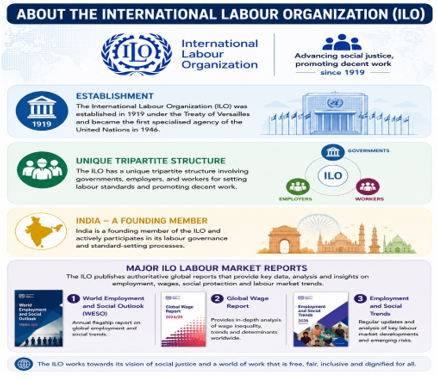
Context: The International Labour Organization (ILO) recently released the Employment and Social Trends: May 2026 Update, warning that the ongoing West Asia/Middle East crisis could significantly disrupt global labour markets and weaken economic growth.
More on the News
• The report is an update under the broader ILO Employment and Social Trends 2026 series, assessing global labour market conditions and emerging risks.
• The ILO warned that prolonged geopolitical instability in West Asia could lead to substantial job losses, declining labour incomes, worsening working conditions, and increased vulnerabilities for migrant workers and remittance-dependent economies.
• The report particularly highlights the global spillover effects of rising oil prices, disruptions in shipping routes such as the Strait of Hormuz, reduced tourism activity, inflationary pressures, and slower investment flows.
Key Findings of the Report
Global Labour Market Risks from the West Asia Crisis:
• Under a severe scenario where oil prices rise by around 50% above their January–February 2026 average:
- Global hours worked could decline by 0.5% in 2026 and 1.1% in 2027, equivalent to nearly 14 million and 38 million full-time jobs respectively.
- Real labour income could decline by 1.1% in 2026 and 3% in 2027, translating into losses of around US$ 1.1 trillion and US$ 3 trillion respectively.
- The global unemployment rate could increase by 0.1 percentage points in 2026 and 0.5 percentage points in 2027, resulting in around 5 million additional unemployed people in 2026 and nearly 20 million in 2027.
Migrant Workers and Remittance Economies Most Vulnerable:
• According to ILO estimates, in Gulf Cooperation Council (GCC) countries, for every 1% decline in employment among nationals, employment among non-nationals (migrant workers) declines by nearly 4% during crisis periods.
• Remittance-dependent developing countries could therefore face significant economic stress through reduced overseas employment opportunities and slower remittance inflows.
Persistent Structural Weaknesses in Global Labour Markets:
• The report noted that global labour markets remain structurally fragile despite relatively stable unemployment levels due to high informality, widening inequalities, weak productivity growth, youth unemployment, and stagnating job quality.
• Around 2.1 billion workers globally continue to remain in informal employment without adequate social protection or labour rights.
Risks to Decent Work and Social Stability:
• The ILO warned that prolonged geopolitical instability and economic shocks could worsen poverty, deepen inequalities, and increase “decent work deficits”, particularly in low-income and developing countries.
Implications for India
• Impact on Energy and Inflation: India’s heavy dependence on imported crude oil makes it vulnerable to rising global energy prices, which could increase inflationary pressures and affect employment-intensive sectors.
• Risks to Overseas Employment and Remittances: India has a large migrant workforce in Gulf countries; any slowdown in regional economies or labour demand could adversely affect employment opportunities and remittance inflows.
• Pressure on Informal and Vulnerable Workers: Higher inflation and economic uncertainty may disproportionately affect India’s large informal workforce, particularly workers engaged in transport, logistics, MSMEs, and construction sectors.
Policy Recommendations by the ILO
• Strengthening Social Protection: Governments should expand social security systems, unemployment support, and labour protections for vulnerable workers.
• Enhancing Labour Market Resilience: Greater investments are needed in skilling, workforce adaptability, and employment diversification to absorb external economic shocks.
• Protecting Migrant Workers: The report emphasised stronger safeguards for migrant workers, fair recruitment systems, and international labour cooperation.
• Coordinated Global Economic Response: The ILO called for coordinated international efforts to stabilise energy markets, reduce geopolitical tensions, and support inclusive economic growth.