SYLLABUS
GS-3: Changes in industrial policy and their effects on industrial growth.
GS-2: Issues relating to development and management of Social Sector/Services relating to Health, Education, Human Resources.
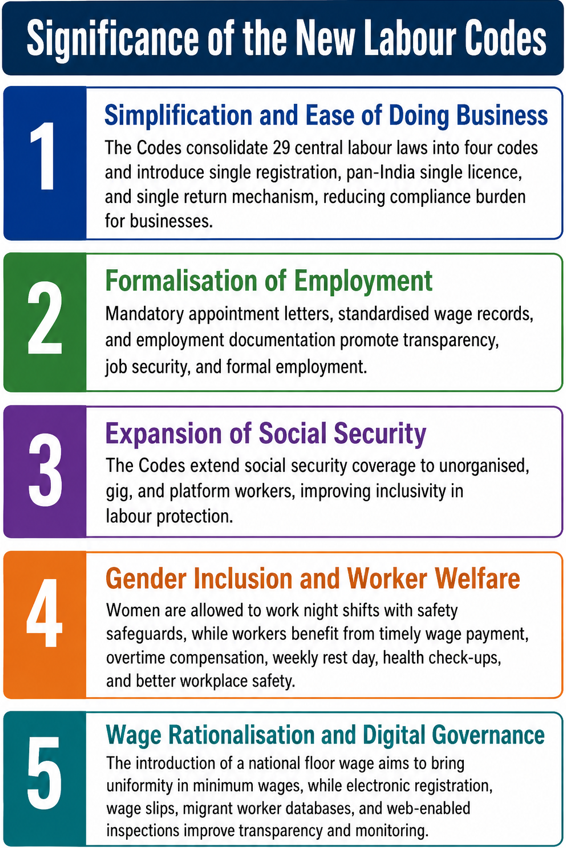
Context: The Central Government notified the final rules under all four Labour Codes through gazette notifications, fully operationalising India’s labour law reforms that consolidate 29 central labour laws into four labour codes.
More on the News
• The four Labour Codes — the Code on Wages, 2019; Code on Social Security, 2020; Industrial Relations Code, 2020; and Occupational Safety, Health and Working Conditions (OSH) Code, 2020 — had already come into force on November 21, 2025, but detailed implementation rules were pending.
• The notified rules complete the legal framework for implementation and will guide states in framing their own rules, as labour is a Concurrent List subject.
Key Features of Rules for All Four Labour Codes
1. Code on Wages, 2019:
• Floor Wage and Minimum Wage: The Centre will fix a national floor wage considering minimum living standards, food, clothing, housing, and other relevant factors.
- States cannot fix minimum wages below the floor wage, while the criteria for the calculation of minimum wages will be separately notified by the Central Government through special or general orders.
• Working Hours: For daily wage workers, normal working hours have been fixed at 8 hours per day, while for other workers, weekly working hours are capped at 48 hours.
- The rules also provide for overtime wages and at least one weekly rest day.
• Wage Administration: Employers must issue wage slips in electronic or physical form, and the rules standardise procedures regarding deductions, fines, advances, damages, and loans.
- A formal nomination mechanism has also been introduced for employees.
• Wider Wage Coverage: The Code introduces a statutory right to minimum wages for all workers through the concept of floor wage.
- It also ensures timely payment of wages.
2. Code on Social Security, 2020:
• Universal Social Security: The rules mandate Aadhaar-linked registration for every unorganised worker above 16 years to access social security benefits.
- The Code also formally recognises gig and platform workers for the first time.
• Gig and Platform Workers: Aggregators must register gig/platform workers on a designated government portal in real time and regularly update exit details.
- o A National Social Security Board will also be created with representation from Parliament, states, workers, employers, SCs, STs, women, and minorities.
• Social Protection Expansion: The Code expands social security coverage beyond the formal sector to include a wider workforce. It also introduces changes in rules related to Employees’ State Insurance (ESI) and EPF mechanisms.
3. Industrial Relations Code, 2020:
• Grievance Redressal: Industrial establishments employing 20 or more workers must establish a Grievance Redressal Committee with equal representation of employers and workers.
- The committee can have a maximum of 10 members, with proportional representation for women workers.
• Trade Union Recognition: A trade union with at least 30% membership in an establishment will be recognised as the sole negotiating union.
• Retrenchment and Layoffs: Establishments employing up to 300 workers no longer require government permission for retrenchment, layoffs, or closure, compared to the earlier threshold of 100 workers.
• Strike Regulations: Workers cannot go on strike without giving notice within 60 days before the strike and observing a mandatory 14-day notice period.
- The definition of strike has also been expanded to include mass casual leave taken by more than 50% workers on a single day.
• Standing Orders: The Code notifies Model Standing Orders regarding worker classification, service conditions, attendance, leave, and discipline or misconduct procedures.
4. Occupational Safety, Health and Working Conditions (OSH) Code, 2020:
• Women Workers and Night Shift: Women are allowed to work beyond 7 PM and before 6 AM with their written consent.
- Employers must provide safe and well-lit workplaces along with transportation facilities for pick-up and drop-off.
• Health and Safety Measures: The rules make appointment letters mandatory for all employees and provide for free annual health check-ups for workers aged 40 years and above.
- The Code also ensures equal pay, work, and opportunities for women across shifts.
• Safety Committees: Factories employing 500 or more workers must constitute safety committees comprising representatives of both employers and workers.
• Migrant Worker Database: Employers are required to electronically furnish data regarding inter-state migrant workers and workplace safety details through designated government portals.