
SYLLABUS
GS-3: Indian Economy and issues relating to planning, mobilisation of resources, growth, development and employment.
Context: The Ministry of Statistics and Programme Implementation (MoSPI) has released the January–March 2026 Quarterly Bulletin of the Periodic Labour Force Survey (PLFS).
More on the News
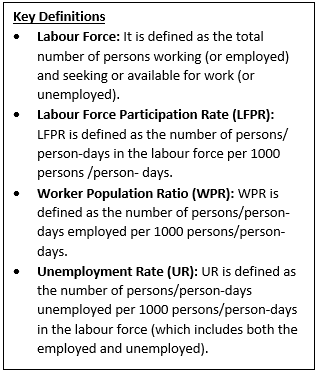
• The PLFS conducted by the National Statistics Office (NSO), MoSPI, is the primary source of data on activity participation and employment-unemployment conditions of the population.
• The PLFS survey methodology has been modified from January, 2025 to provide monthly and quarterly estimates of labour force indicators for both rural and urban India under the Current Weekly Status (CWS) framework.
• Earlier PLFS Quarterly Bulletins released up to December, 2024, presented labour market indicators only for urban areas.
• The Bulletin for April – June, 2025 marked the first in the series to provide estimates for both rural and urban areas and the current Bulletin for January – March, 2026 is the fourth in the series.
Key Highlights of the Periodic Labour Force Survey
Labour Force Participation Rate (LFPR)
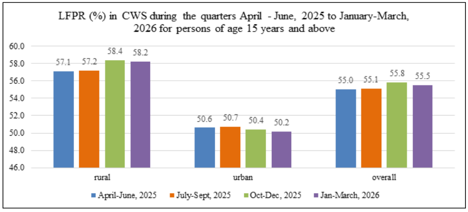
• The overall LFPR for persons aged 15 years and above stood at 55.5% during January–March 2026, compared to 55.8% in the previous quarter (October–December 2025).
• The rural LFPR marginally declined to 58.2% from 58.4% in the previous quarter, while the urban LFPR declined slightly to 50.2% from 50.4%.
• Female LFPR for persons aged 15 years and above remained broadly stable at 34.7% during January–March 2026, compared to 34.9% in the previous quarter.
- Female LFPR in rural areas was estimated at 39.2% as against 39.4% in the preceding quarter, while in urban areas it stood at 25.4% compared to 25.5%.
Worker Population Ratio
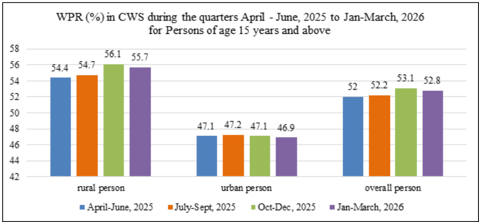
• The overall Worker Population Ratio of age 15 years and above stood at 52.8% in January-March, 2026, compared to 53.1% in October-December, 2025.
• While rural WPR marginally declined to 55.7% in this quarter from 56.1% in the previous quarter, urban WPR maintained its stability at 46.9% in the current quarter compared to 47.1% in the preceding quarter.
Unemployment Rate
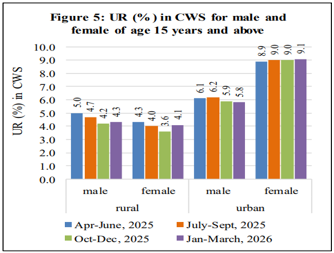
• The overall Unemployment Rate among persons aged 15 years and above increased marginally to 5.0% during the quarter January – March, 2026, from 4.8% during October–December 2025.
• The unemployment rate in urban areas for persons aged 15 years and above declined marginally to 6.6% during January–March 2026 from 6.7% in the previous quarter.
• In contrast, the rural unemployment rate increased slightly to 4.3% from 4.0% during the previous quarter.
Distribution of Workers by Employment Status and Industry
• The share of regular wage/salaried employees in rural areas increased to 15.5% during January–March 2026 from 14.8% in the previous quarter.
• The share of self-employed workers in rural areas declined marginally to 62.5% from 63.2% in October–December 2025.
• In urban areas, the distribution of workers across different employment categories remained broadly stable during the quarter.
• The agriculture sector accounted for 55.8% of rural employment during January–March 2026, marking a decline from 58.5% in the previous quarter.
• The secondary sector, along with mining and quarrying in rural areas, also witnessed a rise from 20.9% in the previous quarter to 22.6% in the current quarter.
• The share of employment in the tertiary sector increased from 20.6% in October–December, 2025 to 21.7% in the current quarter.
Significance of the Report
• Indicator of Labour Market Stability: The broadly stable LFPR and WPR suggest resilience in India’s labour market despite moderating employment indicators during the quarter.
• Shift Towards Formal Employment: The increase in regular wage/salaried employment in rural areas indicates a gradual improvement in the quality and formalisation of employment.
• Importance for Evidence-Based Policymaking: The revised PLFS framework provides high-frequency labour market data for both rural and urban India, enabling better policy formulation in areas such as employment generation, skilling, labour formalisation, and social protection.
SOURCES:
PIB
MOSPI
FinancialExpress