SYLLABUS
GS-2: Government policies and interventions for development in various sectors and issues arising out of their design and implementation.
GS-3: Indian Economy and issues relating to planning, mobilization of resources, growth, development and employment.
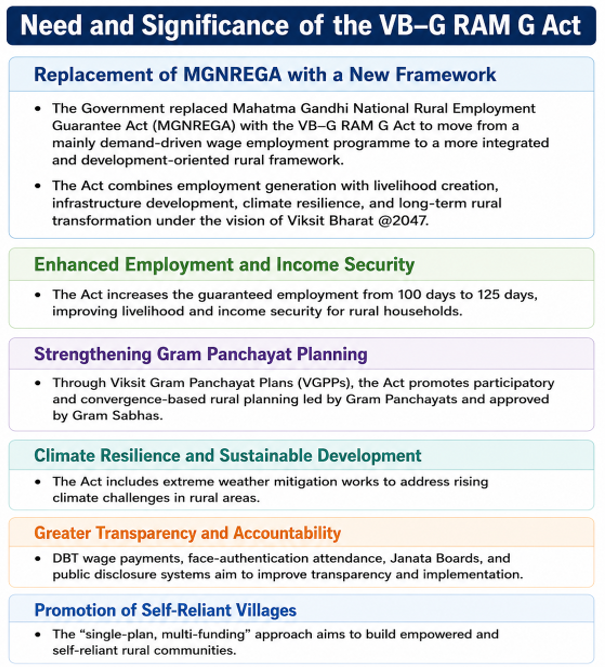
Context: The Union Government has notified the implementation of the VB–G RAM G Act, 2025, which will come into force nationwide from 1 July 2026, replacing the 20-year-old Mahatma Gandhi National Rural Employment Guarantee Act (MGNREGA) framework.
About the VB–G RAM G Act, 2025
- The Viksit Bharat – Guarantee for Rozgar and Ajeevika Mission (Gramin) [VB–G RAM G] Act, 2025 is a new statutory rural employment and livelihood framework aligned with the vision of Viksit Bharat @2047.
- It combines guaranteed wage employment with long-term rural development, livelihood creation, climate resilience, and village-level planning.
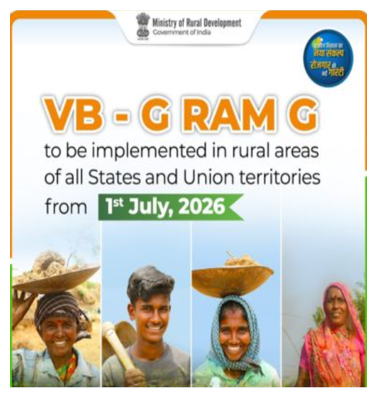
- It will be implemented uniformly across all rural areas of India from 1 July 2026.
- The Act focuses on four major domains:
- Water security works
- Core rural infrastructure
- Livelihood-related infrastructure
- Extreme weather mitigation works
- Financial Allocation: The Union Government has allocated ₹95,692.31 crore for FY 2026–27 — the highest-ever budget estimate for a rural employment programme.
- Fund Sharing Pattern
- 90:10 for North Eastern and Himalayan States
- 60:40 for other States and UTs with legislatures
- 100% Central funding for UTs without legislatures
- Transition from MGNREGA: Existing MGNREGA works will continue seamlessly and be migrated into the new framework.
- Existing e-KYC-verified Job Cards remain valid until new Gramin Rozgar Guarantee Cards are issued.
- Workers cannot be denied employment due to pending e-KYC.
Key Features of the Act
- Enhanced Employment Guarantee: The Act increases the statutory employment guarantee from 100 days to 125 days per financial year.
- Employment must be provided within 15 days of demand, failing which workers are entitled to unemployment allowance.
- Wage Payment and Compensation: Wages will continue through Direct Benefit Transfer (DBT) into bank or post office accounts.
- Payments must be made weekly or within 15 days after closure of the muster roll.
- Workers will receive delay compensation if wages are not paid on time.
- Unemployment Allowance: If employment is not provided within the stipulated period:
- Workers receive at least one-fourth of the wage rate for the first 30 days.
- At least one-half of the wage rate for the remaining period.
- Women-Friendly Provisions: Childcare support will be provided at worksites.
- A woman worker will be appointed to care for children wherever five or more children below five yearsare present.
- Worksite and Labour Provisions: Mandatory facilities include safe drinking water, shade, rest spaces, and first-aid.
- Contractors are prohibited and labour-displacing machinery cannot be used as far as practicable.
- If work is provided beyond 5 km from the village, workers receive an additional 10% wage compensation.
- Attendance and Transparency: Attendance will be captured through a face-authentication-based system with exception mechanisms for connectivity or technical issues.
- “Janata Boards” displaying work details and expenditure must be installed at worksites.
- Weekly disclosure meetings and public digital transparency systems are mandated.
- Viksit Gram Panchayat Plans (VGPPs): All works under the Act must originate from Viksit Gram Panchayat Plans (VGPPs) approved by Gram Sabhas.
- VGPPs are convergence-based local development plans aligned with long-term rural transformation goals.