
SYLLABUS
GS-3: Achievements of Indians in science & technology; indigenization of technology and developing new technology.
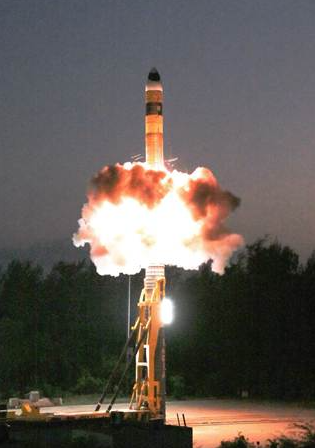
Context: India successfully conducted the flight-trial of an Advanced Agni missile equipped with Multiple Independently Targeted Re-Entry Vehicle (MIRV) capability from Dr APJ Abdul Kalam Island, Odisha.
More on the News
• The Advanced Agni missile was tested with multiple payloads capable of striking different targets spread across a large geographical area in the Indian Ocean Region.
• The missile trajectory and payload impacts were monitored through telemetry and tracking systems operated by multiple ground-based and ship-based stations.
• Flight data confirmed that all mission objectives were successfully achieved during the trial, demonstrating the missile system’s operational reliability and precision.
• The missile system was developed by Defence Research and Development Organisation with support from Indian industries, and the trial was witnessed by senior DRDO scientists and personnel of the Indian Army
About Multiple Independently Targetable Re-entry Vehicle (MIRV) Technology
• MIRV technology enables a single ballistic missile to carry and deliver multiple warheads against different targets independently.
• Unlike traditional ballistic missiles that carry a single warhead, MIRV-equipped missiles can deploy several warheads from one missile system.
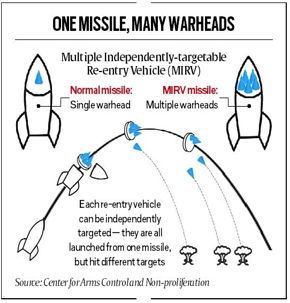
• The warheads are released at different speeds and trajectories during the final phase of flight, allowing them to strike spatially separated targets.
• MIRV Work:
- After the missile completes its powered flight, the missile bus releases multiple re-entry vehicles (RVs) sequentially.
- These re-entry vehicles independently re-enter the atmosphere and move towards separate designated targets.
• The major components of a MIRV system include:
- Missile Bus: Carries the warheads and guidance systems during launch and mid-course flight.
- Re-entry Vehicles (RVs): Individual warheads designed to survive atmospheric re-entry and strike different targets.
• Global Development of MIRV Technology:
- The United States first deployed MIRVed Intercontinental Ballistic Missiles (ICBMs) in 1970, followed by the Soviet Union during the 1970s.
- Countries such as the United States, Russia, China, the United Kingdom, and France possess MIRV capabilities.
- India successfully carried out its first flight-test of a MIRVed Agni-5 missile in March 2024 and further advanced the capability through the successful trial of the Advanced Agni missile.
Significance of MIRV Technology
• MIRV technology significantly enhances the strategic and destructive capability of a missile system by enabling multiple-target engagement through a single launch.
• Compared to Multiple Re-entry Vehicle (MRV) systems, MIRV offers the added advantage of independent targeting capability.
• The development of MIRV systems is technologically complex as it requires large missiles, miniaturised warheads, accurate guidance systems, and sophisticated sequential warhead-release mechanisms.
• MIRV-equipped missiles are also considered effective countermeasures against Ballistic Missile Defence (BMD) systems because multiple warheads are harder to intercept simultaneously.