SYLLABUS
GS-3: Effects of liberalization on the economy, changes in industrial policy and their effects on industrial growth.
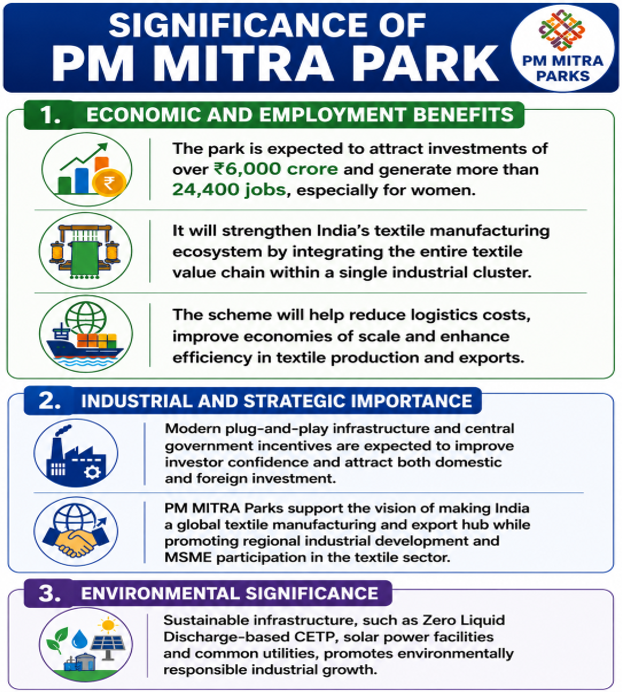
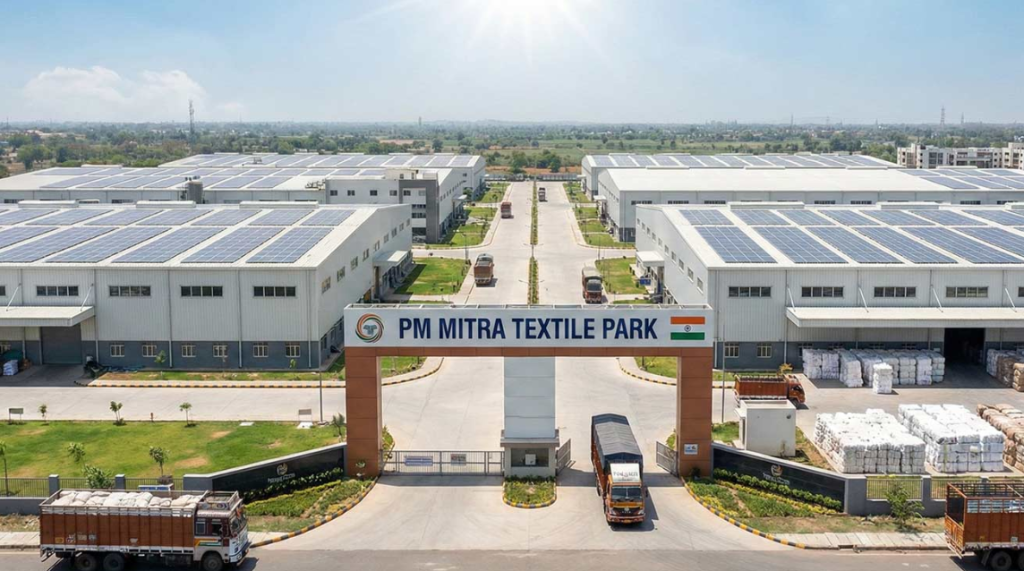
Context: Recently, the Indian Prime Minister inaugurated the PM MITRA Park at Warangal, Telangana, India’s first functional PM MITRA Park developed under the Government’s 5F vision — “Farm to Fibre to Factory to Fashion to Foreign”.
About the Park
• The PM MITRA Park has been established at the Kakatiya Mega Textile Park (KMTP) in Warangal at a total project cost of ₹1,695.54 crore and is spread across 1,327 acres.
• The park is strategically located near the proposed Nagpur–Vijayawada Greenfield Expressway (NH-163G) and close to NH-163, ensuring strong connectivity to railway networks and seaports.
• It has been designed as a world-class textile industrial ecosystem with infrastructure facilities such as internal roads, dedicated power substations, assured water supply, worker dormitories, common boiler facilities, and a 10 MW solar power plant.
• The park also includes a Common Effluent Treatment Plant (CETP) with Zero Liquid Discharge technology to promote sustainable industrial development.
• Around 62% of the park has already been allotted to industries and units established in the park are eligible for Competitive Incentive Support (CIS) and benefits under schemes such as the Production Linked Incentive (PLI) Scheme for textiles.
About the PM MITRA Scheme
• PM MITRA stands for Pradhan Mantri Mega Integrated Textile Region and Apparel Scheme.
• The scheme was notified in October 2021 to strengthen the Indian textile industry through integrated large-scale textile manufacturing ecosystems.
• The scheme operationalises the Government’s 5F vision — Farm to Fibre to Factory to Fashion to Foreign and seeks to integrate the complete textile value chain from spinning, weaving, processing and dyeing to garment manufacturing and exports.
• The scheme aims to attract investments worth around ₹70,000 crore and generate nearly 20 lakh employment opportunities.
• Implementation and Funding: Under the first phase, seven PM MITRA Parks are being developed in Telangana, Tamil Nadu, Karnataka, Maharashtra, Gujarat, Madhya Pradesh and Uttar Pradesh, with each park spread across at least 1,000 acres.
- PM MITRA Parks are being developed under a Public-Private Partnership (PPP) model through Special Purpose Vehicles (SPVs) with 51% equity of State Governments and 49% equity of the Central Government.
- The scheme has a total budgetary outlay of ₹4,445 crore up to 2027-28.
- The Central Government provides Development Capital Support (DCS) for core infrastructure and Competitive Incentive Support (CIS) of ₹300 crore per park for manufacturing units.
• Key Features: The parks provide plug-and-play manufacturing facilities, common infrastructure, warehousing, logistics support, workers’ hostels, skill development centres, and effluent treatment facilities.
- Unlike earlier textile park schemes, PM MITRA focuses on large-scale integrated production, reducing logistics costs by locating the complete textile value chain at a single location.