
SYLLABUS
GS-3: Different Types of Irrigation and Irrigation Systems; Storage, Transport and Marketing of Agricultural Produce and Issues and Related Constraints; E-technology in the aid of farmers.
Context: The Union Government recently highlighted the progress and implementation status of the National Mission for Sustainable Agriculture (NMSA) in the context of promoting climate-resilient and resource-efficient agricultural practices in India.
About National Mission for Sustainable Agriculture (NMSA)
• The Government launched the National Mission for Sustainable Agriculture (NMSA) in 2014-15 under the framework of the National Action Plan on Climate Change.
• The mission was envisaged as a strategic intervention to mitigate the adverse impacts of climate variability on agriculture while ensuring long-term food and livelihood security.
• The Mission focuses on: integrated farming systems, soil and water conservation, efficient water-use management, nutrient management, livelihood diversification, and sustainable agricultural practices.
• From 2018–19, NMSA was operationalised as a sub-scheme under the umbrella programme Green Revolution – Krishonnati Yojana.
• Subsequently, from 2022–23, it was restructured under the umbrella scheme of Pradhan Mantri Rashtriya Krishi Vikas Yojana (PM-RKVY) to improve convergence, administrative efficiency, and outcome-based implementation.
• Through its various components, NMSA supports the United Nations Sustainable Development Goals (SDGs) of 2030, specifically SDG 2 (Zero Hunger), SDG 6 (Clean Water and Sanitation), and SDG 13 (Climate Action).
Key Components of NMSA
• Rainfed Area Development (RAD)
- RAD promotes an area-based “watershed plus” approach through Integrated Farming Systems (IFS).
- It encourages a holistic approach by integrating multi-cropping, rotational, inter- and mixed-cropping systems with allied activities such as horticulture, livestock, and fisheries to enhance farmers’ income and resilience.
- Since 2014-15, ₹2,119.84 crore has been released under Rainfed Area Development, covering 8.50 lakh hectares and benefiting 14.35 lakh farmers through Integrated Farming System.
- The National Rainfed Area Authority (NRAA), established in 2006 under the Ministry of Agriculture & Farmers Welfare, serves as a knowledge partner for the Rainfed Area Development (RAD) component.
• Per Drop More Crop (PDMC)
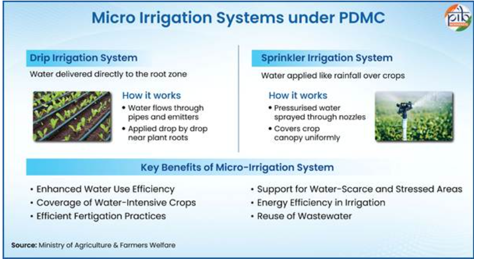
- PDMC primarily focuses on improving efficient use of water at the farm level through micro-irrigation techniques, particularly drip and sprinkler irrigation.
- Implemented since 2015-16, about 109 lakh hectares have been covered under the scheme, with ₹26,325 crore released as central assistance, significantly improving water-use efficiency.
- Furthermore, the Government has set a target of bringing 100 lakh hectares under micro-irrigation over the five-year period from 2025-26 to 2029-30.
• Soil Health Management (SHM)
- SHM promotes location- and crop-specific sustainable soil management practices, including residue management, organic farming, balanced use of macro and micronutrients, soil fertility mapping, and measures to reduce soil erosion and land degradation.
- Implemented under SHM, the Soil Health Card (SHC) Scheme serves as the principal farmer advisory instrument.
- During FY 2025–26, around 97.53 lakh soil samples were collected and 92.87 lakh samples were tested, while cumulatively about 25.79 crore Soil Health Cards had been generated up to February 2026 since its launch in 2015.
Significance of NMSA
• Promoting Climate-resilient Agriculture: NMSA supports adaptation to climate change through diversified farming systems, resource conservation, and sustainable agricultural practices.
• Enhancing Water and Soil Sustainability: The Mission promotes efficient irrigation, soil health management, and balanced nutrient usage to address groundwater depletion and soil degradation.
• Supporting Rainfed Agriculture: By focusing on rainfed and vulnerable regions, NMSA helps improve productivity and livelihood security in areas highly exposed to climatic risks.
• Reducing Input Costs and Environmental Stress: Promotion of organic inputs, integrated farming, and resource-efficient technologies helps reduce dependence on chemical-intensive farming practices.
• Improving Farmers’ Income and Livelihood Diversification: Integrated farming systems involving livestock, fisheries, horticulture, and agroforestry create multiple income streams and reduce vulnerability to crop failure.