
SYLLABUS
GS-3: Major crops cropping patterns in various parts of the country, and marketing of agricultural produce and issues and related constraints; e-technology in the aid of farmers.
Context: The Union Cabinet approved an outlay of ₹5,659.22 crore for the Mission for Cotton Productivity (2026–27 to 2030–31) to address bottlenecks, declining growth, and quality concerns in India’s cotton sector.
About the Mission for Cotton Productivity
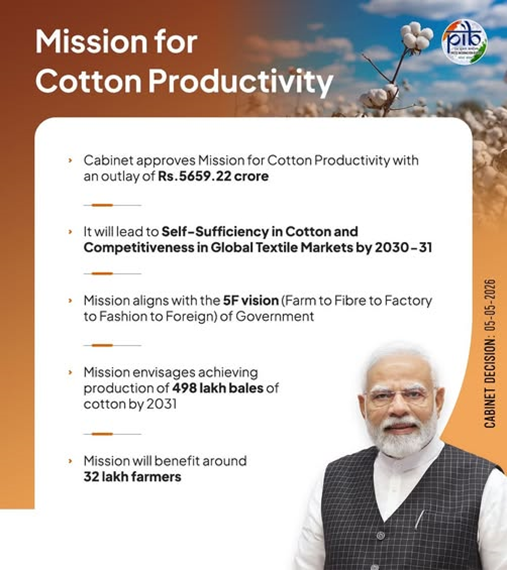
- The Mission aims to enhance cotton productivity, improve cotton quality, strengthen the cotton value chain, and position India as a globally competitive and self-reliant cotton producer.
- It aligns with the Government of India’s 5F vision: Farm → Fibre → Factory → Fashion → Foreign.
- The Mission will be implemented from 2026–27 to 2030–31.
- The total approved financial outlay for the Mission is ₹5,659.22 crore.
- Institutional Framework: The Mission will be jointly implemented by the Ministry of Agriculture and Farmers Welfare and the Ministry of Textiles.
- It will involve 10 ICAR institutes, 1 CSIR institute, 10 AICRP centres on cotton, and State Agricultural Universities (SAUs).
- The initial phase of the Mission will cover 140 districts across 14 States and include 2,000 ginning and processing factories.
- The Mission aims to achieve cotton production of 498 lakh bales (170 kg each) by 2031.
- It also targets an increase in lint productivity from 440 kg per hectare to 755 kg per hectare.
- Around 32 lakh farmers are expected to benefit from the Mission.
Major Focus Areas
- Development of Improved Cotton Seeds: The Mission focuses on developing high-yielding variety (HYV) seeds, climate-resilient seeds, and pest- and disease-resistant cotton varieties.
- It also promotes advanced production and crop protection technologies to improve cotton productivity and resilience.
- Promotion of Modern Cotton Cultivation Technologies: The Mission promotes large-scale adoption of modern cultivation practices such as High Density Planting System (HDPS), Closer Spacing (CS), Integrated Cotton Management, and Extra Long Staple (ELS) cotton cultivation.
- Technology dissemination will be carried out through State Governments, Krishi Vigyan Kendras (KVKs), and State Agricultural Universities (SAUs).
- Quality Improvement and Processing Modernisation: The Mission supports the modernisation of ginning factories and cotton processing units.
- It also promotes best processing practices to ensure least-contaminant cotton supply and improved fibre quality.
- Strengthening Cotton Testing Infrastructure: The Mission aims to establish modern, standardized, and accredited cotton testing facilities.
- These facilities will ensure reliable quality assessment and help India meet global benchmarking standards.
- Branding and Traceability: The Mission promotes Kasturi Cotton Bharat to enhance traceability, certification, and branding of Indian cotton as a premium and sustainable global product.
- It also targets reduction of trash content in cotton to below 2%.
- Digital Integration of Mandis: The Mission seeks to integrate market yards with e-platforms for transparent price discovery, direct market access, and better price realization for farmers.
- Circular Economy and Sustainability: The Mission promotes cotton waste recycling and circular economy practices.
- Its objective is to improve resource efficiency, reduce environmental footprint, and generate additional value.
- Diversification of Natural Fibres: The Mission encourages the promotion of alternative natural fibres such as flax, ramie, sisal, milkweed, bamboo, and banana.
- This supports environmentally sustainable textile production and aligns with evolving global demand patterns.
Significance of the Mission
- Reviving India’s Cotton Economy: The Mission addresses declining productivity, pest-related crop losses, fibre quality concerns, and structural bottlenecks affecting India’s cotton sector.
- Enhancing Farmer Income and Rural Livelihoods: Higher productivity, better quality cotton, and improved market access are expected to increase farmer income and benefit around 32 lakh cotton farmers.
- Strengthening India’s Textile Value Chain: Availability of high-quality and contamination-free cotton will support the domestic textile industry and improve India’s competitiveness in global textile manufacturing.
- Boosting Cotton Exports and Global Branding: Kasturi Cotton Bharat branding and traceability mechanisms will promote Indian cotton as a premium and sustainable product in international markets.
- Promoting Sustainable and Climate-Resilient Agriculture: The Mission supports climate-resilient farming, efficient resource utilisation, recycling practices, and environmentally sustainable fibre diversification.
- Reducing Import Dependence and Supporting Self-Reliance: Higher domestic cotton production and productivity will help meet rising industrial demand and reduce dependence on cotton imports.
- Advancing the Government’s 5F Vision: The Mission strengthens integration across the cotton value chain from Farm → Fibre → Factory → Fashion → Foreign and supports India’s long-term goal of becoming a globally competitive textile hub.
Sources:
PIB
Economic Time
Bussiness standard
The Hindu Business Line
Indian Express