
SYLLABUS
GS-2: Bilateral, regional and global groupings and agreements involving India and/or affecting India’s interests.
GS-3: Effects of liberalization on the economy, changes in industrial policy and their effects on industrial growth.
Context: India and New Zealand have signed a landmark Free Trade Agreement (FTA), aimed at strengthening bilateral economic ties through expanded market access, enhanced services cooperation, and increased investment flows.
More on the News
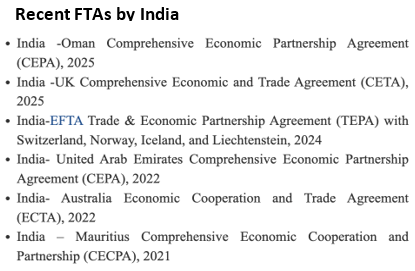
- The India–New Zealand FTA is the seventh FTA concluded by India in the last three and a half years, the latest being with Oman in December 2025.
- The FTA secures duty-free or preferential access across a wide range of sectors for Indian exports to New Zealand, while serving as a gateway to the wider Oceania and Pacific Island markets.
- The FTA will enter into force after the completion of all domestic procedures and ratification in both countries.
India-New Zealand Relations
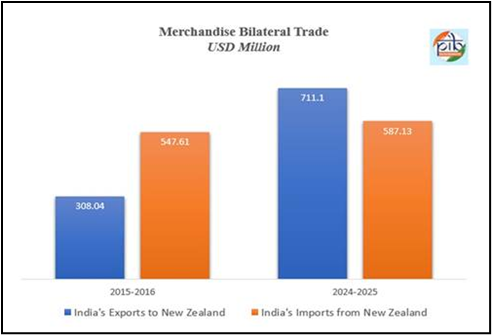
- Merchandise Trade: Grew from USD 873 million in 2023–24 to USD 1.3 billion in 2024–25, registering a 49% growth.
- Merchandise Exports to New Zealand: Rose to USD 711 million in 2024–25, showing a positive trend of 32%.
- Services Trade: India’s services exports to New Zealand grew by 13% in 2024, reaching USD 634 million.
- Major sectors include travel, IT, and business services.
- Size: Currently, New Zealand is India’s second-largest trading partner in the Oceania region, after Australia.
- Human Resources: Around 300,000 persons of Indian origin and NRIs live in New Zealand, making up nearly 5% of its population.
- Trade Balance: India currently has a positive trade balance with NZ.
Key Aspects of the India-New Zealand FTA
- Tariff Elimination: The FTA provides duty-free access for 100% of India’s exports to New Zealand, covering all tariff lines.
- Phased Liberalisation: India has offered tariff liberalization on 70.03% of tariff lines covering 95% of bilateral trade value while keeping 29.97 % tariff lines excluded to protect India’s sensitive sectors.
- The immediate duty elimination is on 30% of tariff lines, while the rest is phased in over 10 years.
- Domestic Safeguards: Several sensitive sectors, including dairy, coffee, onions, sugar, spices, edible oils, rubber, etc., are excluded to protect domestic producers in India.
- Investments: NZ has committed to facilitate USD 20 billion in investment into India over the next 15 years, supporting sectors like manufacturing, industrial infrastructure, services, and innovation.
- Services Liberalisation: New Zealand has provided market access in about 118 service sectors, including IT, education, healthcare, financial services, tourism, and professional services, along with Most-Favoured Nation commitments in 139 sub-sectors.
- Labour Mobility: The FTA enables up to 5,000 Temporary Employment Entry (TEE) visas for Indian professionals at any given time, spanning sectors such as AYUSH, Yoga, IT, engineering, healthcare, education, and construction.
- Work Visas:For the first time with any country, New Zealand has created a dedicated pathway for Student Mobility and Post Study Work Visas with India.
- It removes caps on Indian students, allowing part-time work during studies, and offers Post-study work visas of up to three years for STEM bachelor’s and master’s students and up to four years for doctoral scholars in New Zealand.
- Regulatory Access: New Zealand will accept Good Manufacturing Practice (GMP) and Good Clinical Practice (GCP) inspection reports from comparable regulators in other advanced countries.
- This will reduce duplicative inspections and expedite product approvals, thus facilitating smoother market entry and growth of India’s pharma and medical device exports.
- MSME Growth: It places explicit emphasis on MSME-driven and labour-intensive sectors, including textiles, food processing, and electronics.
- Structured MSME cooperation includes access to trade information, export readiness programs, and linkages with New Zealand’s SME ecosystem.
- Rules of Origin: The FTA establishes a robust Rules of Origin framework to ensure that benefits accrue only to genuine exporters.
- Intellectual Property (IP) Protection: NZ has committed to expanding Geographical Indications (GIs) laws within 18 months, enabling registration of Indian goods beyond wines and spirits.
- Health, Wellness and Traditional Medicine: For the first time in its FTAs, NZ will provide dedicated market access for India’s AYUSH systems alongside Māori health practices, promoting medical value travel, wellness collaboration.
Significance of the Agreement
- Export Competitiveness: The zero-duty access across all product categories will boost competitiveness for sectors such as textiles, engineering goods, leather and a wide range of manufactured items.
- Trade Diversification: The agreement demonstrates India’s continued push to recalibrate its trade architecture through targeted, high-quality bilateral agreements aligned with domestic interests.
- Strategic Significance: It strengthens India’s presence in the Indo-Pacific and offers a gateway to Pacific and advanced markets, enhancing India’s global trade positioning.
- Balanced Liberalisation: It delivers unprecedented duty-free access to the New Zealand market for Indian businesses while safeguarding sensitive domestic sectors.
- Economic Partnership: Beyond goods trade, the agreement promotes employment, facilitates skill mobility, and supports trade- and investment-led growth across multiple sectors. Thus, it gestures towards a more holistic economic partnership.
- Integration into Global Value Chains (GVCs): Trade facilitation and reduced barriers will help Indian firms, especially MSMEs, integrate into global value chains.