
SYLLABUS
GS-2: Statutory, regulatory and various quasi-judicial bodies.
GS-3: Indian Economy and issues relating to planning, mobilization of resources, growth, development and employment.
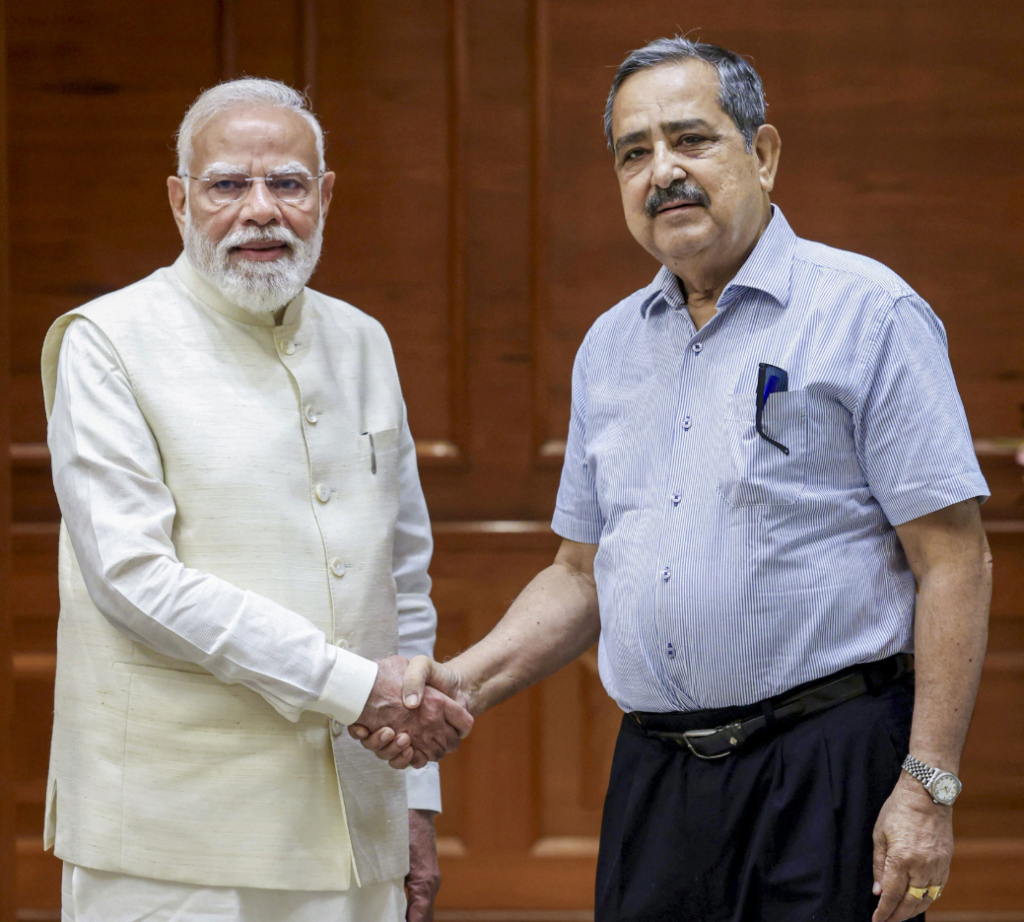
Context: The Government of India has reconstituted NITI Aayog, appointing new leadership and full-time members to strengthen its role in policy-making.
More on the News
• Prime Minister Narendra Modi stated that NITI Aayog has become a vital pillar of India’s policy-making architecture, promoting cooperative federalism, reforms, and ‘Ease of Living’.
• Ashok Kumar Lahiri has been appointed as the Vice Chairman.
• The following have been appointed as Full-Time Members: Rajiv Gauba, K. V. Raju, Gobardhan Das, Abhay Karandikar, and M. Srinivas.
• The Prime Minister extended best wishes to the newly appointed members for a productive and impactful tenure.
About NITI Aayog (National Institution for Transforming India)
• On January 1, 2015, NITI Aayog was established as the successor to the Planning Commission through an executive resolution of the Government of India (Union Cabinet).
• It is a non-constitutional body (not created by the Constitution) and a non-statutory body (not created by an Act of Parliament).
Role and Functions of NITI Aayog
• NITI Aayog serves as the premier policy think tank of the Government of India, providing both directional and policy inputs.
• It is responsible for designing strategic and long-term policies and programmes for national development.
• It also provides technical advice to both the Centre and States.
• The institution marks a significant shift from the Planning Commission era:
- The one-way flow of policy from Centre to States is replaced by a genuine partnership between the Centre and States.
- It adopts a collaborative approach instead of the earlier command-and-control model.
- In line with the spirit of federalism, it follows a bottom-up approach, incorporating inputs from various stakeholders rather than a top-down model.
• NITI Aayog also acts as:
- A platform for cooperative federalism
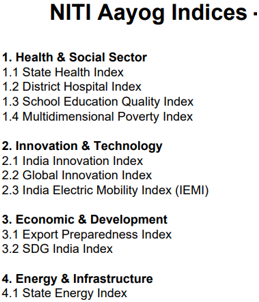
- A promoter of competitive federalism through performance-based indices
- A knowledge and innovation hub supporting evidence-based policymaking
• Composition of NITI Aayog:
- Chairperson: Prime Minister of India.
- Governing Council: Comprises Chief Ministers of all States, Chief Ministers of Union Territories with legislatures and Lt. Governors of other Union Territories.
- Regional Councils: Formed to address specific issues affecting multiple states or regions.
Convened by the Prime Minister
Chaired by the Chairperson of NITI Aayog or their nominee
- Special Invitees: Experts, specialists, and practitioners nominated by the Prime Minister.
- Full-Time Organisational Framework:
Vice-Chairperson: Appointed by the Prime Minister, enjoys Cabinet rank.
Full-Time Members: Hold the rank of Minister of State.
Part-Time Members: From leading universities and research institutions (on rotation).
Ex-Officio Members: Up to four Union Ministers nominated by the Prime Minister.
Chief Executive Officer (CEO): Appointed by the Prime Minister for a fixed tenure.
Secretariat: Provides administrative and technical support.
Sources:
PIB
Decanherald
NITI
NITI