

Cultivation of Gucchi (Morels) in Kashmir
Context: Recently, Sher-e-Kashmir University of Agricultural Sciences and Technology has successfully cultivated Gucchi (Morels) under controlled and open-field conditions for the first time.
About Morels (Morchella / Gucchi / Kangaech)
• Gucchi (Morchella esculenta) is a highly prized wild edible mushroom belonging to the genus Morchella (family Morchellaceae).
• It is one of the most expensive mushrooms in the world.
• It is locally known as Gucchi in Jammu & Kashmir and Kangaech.
• It grows naturally in high-altitude forest ecosystems.
• Climatic Conditions for Growth: It grows in cold, moist environments at high altitudes (2500–3500 m) on humus-rich soils. Fruiting generally occurs after rainfall or snowmelt, mainly from March–June (or winter in warmer regions).
• Habitat and Distribution: It is mainly found in the North-Western Himalayas, especially Jammu & Kashmir, Himachal Pradesh, and Uttarakhand.
- It grows in Chir Pine, Oak, and mixed conifer forests under specific ecological conditions.
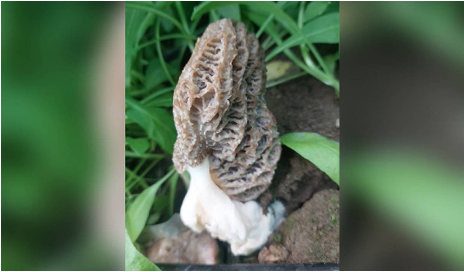
• Appearance and Biological Features: The mushroom develops from underground mycelium and produces a visible fruiting body (ascocarp) above the soil.
- It appears in clusters and is easy to identify at genus level but difficult at species level.
• Economic and Nutritional Value:
- Morels are among the most expensive mushrooms in the world.
- They are highly demanded in international gourmet markets.
- They are rich in proteins, vitamins, and antioxidants.
- They are also known for their distinct flavour and medicinal properties.
Significance of the Breakthrough
• The innovation enables commercial cultivation of a wild species.
• It provides new income opportunities for farmers and rural youth.
• It promotes diversification into high-value agriculture.
• It supports export-oriented bioeconomy development in J&K.
• It reduces ecological pressure on fragile Himalayan ecosystems.
Caribou Survival Threatened by Declining Lichen in the Arctic
Context: A study by researchers at the State University of New York College of Environmental Science and Forestry highlights that declining lichen availability may threaten the winter survival of caribou in the Arctic.
About Caribou (Reindeer)
• Caribou, scientifically known as Rangifer tarandus, belong to the deer family (Cervidae).
• The terms “Caribou” (used in North America) and “Reindeer” (used in Eurasia and for domesticated populations) refer to the same species.
• Key Biological Features:
- Both male and female caribou grow antlers, which is a unique feature among deer species.
- Females typically give birth to one calf each year under natural conditions.
- The newborn calf can stand within minutes and begins walking within a day of birth.
- Caribou have large hooves that help them walk on snow and also swim efficiently.
- Their hooves undergo seasonal changes, becoming soft in summer for better grip and hard in winter for ice traction.
- The hollow underside of their hooves helps them dig through snow to reach food.
• Diet and Ecological Role:
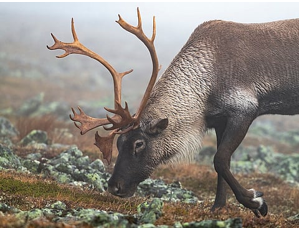
- Lichens, often called “reindeer moss,” form the primary winter diet of caribou.
- They are among the few animals capable of digesting lichens effectively.
- Caribou play an important ecological role by regulating tundra vegetation.
- They also contribute to nutrient cycling in Arctic ecosystems.
• Habitat and Distribution: Caribou are found across Greenland, Scandinavia, Russia, Alaska, and Canada. They inhabit Arctic tundra regions as well as boreal forest ecosystems.
- Caribou are of two types—highly migratory tundra caribou with large herds and less-migratory woodland caribou living in forests.
• Conservation Status: Listed as Vulnerable on the IUCN Red List
• Major Threats: Include climate change, habitat disturbance, hunting, and predation by wolves, bears, and lynx.
First Edition of the Indian Navy’s Biannual Commanders’ Conference 2026
Context: The first edition of the Indian Navy’s biannual Commanders’ Conference 2026 will be held from 14–16 April 2026 at Nausena Bhawan, New Delhi.
About the Commanders’ Conference
• It is an apex-level forum of the Indian Navy for reviewing operational posture, capability development, and strategic alignment with national security objectives.
• Objective: To ensure the Indian Navy remains a combat-ready, technology-driven force and emerges as a ‘Preferred Security Partner’ in the Indian Ocean Region (IOR) and Indo-Pacific.
• The conference gains importance due to swift naval deployments to safeguard India’s energy security amid the ongoing West Asia conflict and the presence of Multi-National Forces (MNFs) in the Indian Ocean Region.
• It also assumes significance in reaffirming operational doctrine, inter-services coordination, and technology-driven responses in the aftermath of ‘Op Sindoor’.
• Core Areas of Deliberation:
- Reviewing current geo-strategic challenges and the evolving maritime security environment.
- The Conference emphasises operational readiness, combat capability, blue-water expansion, training, human resource management, logistics, maintenance, and deployment of uncrewed systems.
- It also prioritises the implementation of Artificial Intelligence and data-driven technologies to enhance naval operational efficiency.
• Strategic Orientation:
- Assessment of preparedness in line with the Indian Maritime Doctrine (IMD).
- Strengthening international cooperation and maritime partnerships.
- Advancing India’s vision of MAHASAGAR.
- Promoting indigenisation and innovation in defence.
Jallianwala Bagh massacre
Context: On the 107th martyrdom day of the 1919 Jallianwala Bagh massacre at Jallianwala Bagh, the nation pays homage to the innocent victims whose sacrifice became a turning point in India’s freedom struggle.
The Jallianwala Bagh Massacre (April 13, 1919)
• The Jallianwala Bagh Massacre occurred in Amritsar, Punjab, on April 13, 1919.
• It was a tragic culmination of the tensions stirred by the Rowlatt Act.
- The Rowlatt Act, officially known as the Anarchical and Revolutionary Crimes Act of 1919, was a law passed by the British government in India to suppress dissent and revolutionary activities.
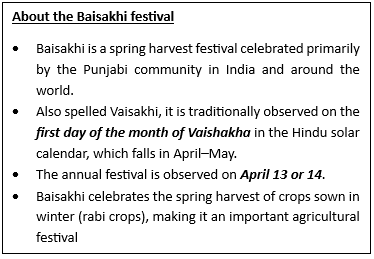
• A large crowd of about 20,000 people had gathered at Jallianwala Bagh to celebrate Baisakhi, a religious festival, and to protest the arrest of local leaders Saifuddin Kitchlew and Dr Satyapal.
• The crowd was unaware of the martial law orders, including a ban on public gatherings.
• Brigadier-General Reginald Dyer, in charge of enforcing martial law, arrived at the scene with his troops, surrounded the gathering, and opened fire without warning.
• Official British records claimed 379 dead and over 1,100 wounded, while Indian sources and other estimates suggest much higher casualties.
• It marked a decisive turning point in India’s freedom struggle, destroying faith in British rule and pushing Mahatma Gandhi toward mass mobilisation through the Non-Cooperation Movement (1920–22).
• Rabindranath Tagore renounced his knighthood in protest, while revolutionary sentiment also deepened—later influencing figures like Udham Singh, who assassinated Michael O’Dwyer in 1940.
• The British-appointed Hunter Commission censured Dyer and forced his resignation, though reactions in Britain were divided, with some praising him.
Significance
• Marked a decisive shift from moderate politics to mass nationalism
• Strengthened Gandhi’s leadership in the freedom struggle
• Exposed the brutal nature of colonial rule
• Became a symbol of sacrifice and resistance in India’s independence movement