
SYLABUS
GS 2:Government Policies and Interventions for Development in various sectors and Issues arising out of their Design and Implementation; Issues Relating to Development and Management of Social Sector/Services relating to Health, Education, Human Resources.
Context: The menstrual leave debate in India has gained prominence following the Supreme Court observations in petitions seeking a national policy for paid leave during menstruation for women employees and students.
Key Highlights of the Supreme Court’s Observations
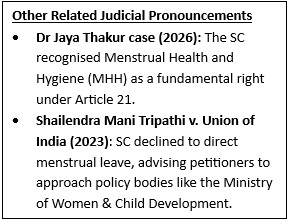
- Terming it a “double-edged sword”, the Supreme Court refused to direct a compulsory nationwide menstrual leave law, triggering wider discourse on gender equality vs workplace equity.
- It cautioned that:
- Mandatory leave may discourage employers from hiring women, affecting labour market participation.
- It could reinforce gender stereotypes, portraying women as less capable.
- The Court favoured voluntary company/State policies over uniform law, and directed the government to consult stakeholders.
About Menstrual Leave and Current Status in India
- Menstrual leave refers to leave granted to women during their menstrual cycle to manage physical discomfort, such as dysmenorrhea(severe pain) or conditions like endometriosis.
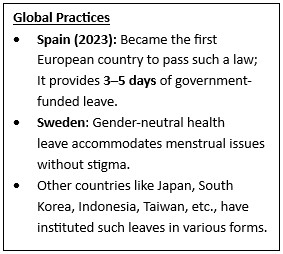
- At present, India does not have a central law mandating menstrual leave, leaving the matter to organizational discretion and state-level experimentation.
- However, some state governments like Bihar (offers 2 days/month to govt employees) and Kerala (provides it for female students) have taken initiatives in this regard.
- Several Private Member’s Bills have been introduced in Parliament to institutionalize menstrual leave and improve menstrual hygiene, but none of them has become law.
Arguments in Favour of Menstrual Leave
- Health and Medical Necessity: Menstrual leave is justified on the grounds that many women experience significant physical discomfort, and providing leave upholds their right to health, dignity, and humane working conditions.
- Enhancement of Workplace Productivity: Allowing women to rest during periods of acute discomfort helps reduce presenteeism and enables them to return with greater efficiency, thereby supporting sustained workplace productivity.
- Promotion of Substantive Equality: Such provisions align with the principle of substantive equality by recognizing biological differences and ensuring that women are not disadvantaged in workplaces due to natural physiological processes.
- Breaking Social Taboos: Institutionalizing menstrual leave contributes to normalizing menstruation, thereby reducing long-standing taboos and fostering a more inclusive and empathetic work culture.
- Alignment with Global and Rights-Based Frameworks: The adoption of menstrual leave policies resonates with international commitments such as the Convention on the Elimination of All Forms of Discrimination Against Women (CEDAW), reinforcing efforts toward gender equity and women’s socio-economic empowerment.
Arguments Against Menstrual Leave
- Risk of Employment Discrimination: Critics caution that mandating menstrual leave may discourage employers from hiring women due to perceived additional costs and operational constraints, potentially reducing women’s participation in the workforce.
- Reinforcement of Gender Stereotypes: There is concern that such policies may reinforce stereotypes portraying women as less capable or less reliable, thereby affecting their professional image and long-term career prospects.
- Operational and Administrative Challenges: Employers often highlight that predictable monthly leave can disrupt workflow and workforce planning, particularly in sectors requiring continuous presence or tight coordination.
- Concerns of Benevolent Sexism: Some argue that menstrual leave, though well-intentioned, may fall into the category of benevolent sexism by treating women as needing special protection, which could inadvertently perpetuate inequality.
- Preference for Gender-Neutral Alternatives: An alternative perspective suggests that strengthening gender-neutral sick leave policies and flexible work arrangements would address health concerns without singling out women or reinforcing gender distinctions.
Way Forward
- Adoption of Flexible and Optional Policies: A balanced approach would involve encouraging organizations to adopt flexible and voluntary menstrual leave policies, allowing employees to exercise choice while maintaining organizational efficiency.
- Integration with Broader Health Frameworks: Incorporating menstrual leave within broader health or wellness leave policies can help reduce stigma and ensure that it is treated as a legitimate health concern rather than a gender-specific exception.
- Promoting Awareness and Sensitization: There is a need for sustained awareness campaigns and workplace sensitization initiatives to address taboos surrounding menstruation and create a more supportive and informed environment.
- Strengthening Basic Infrastructure: Ensuring access to proper sanitation facilities and affordable menstrual hygiene products is essential to address the broader challenges associated with menstrual health.
- Evidence-Based Policymaking and Consultation: Policymaking in this domain should be guided by empirical evidence and shaped through stakeholder consultation to strike a balance between gender equity and labour market realities.