
SYLLABUS
GS-2: Issues relating to development and management of Social Sector/Services relating to Health; Effect of policies and politics of developed and developing countries on India’s interests
GS-3: Inclusive growth and issues arising from it.
Context: Recently, the UN Inter-agency Group for Child Mortality Estimation (UN IGME) has released a report titled- Levels and Trends in Child Mortality, highlighting trends in under-five mortality, neonatal mortality, and child survival globally.
About the Report
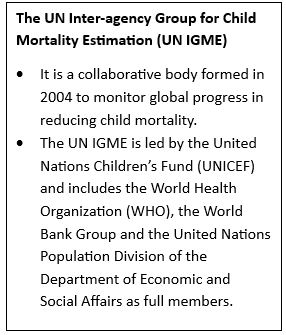
- The report is jointly prepared by the UNICEF, World Health Organisation (WHO), World Bank and United Nations Population Division.
- The objective of this report is to provide reliable and comparable global estimates of child mortality; to monitor progress towards Sustainable Development Goal 3; and to identify trends, inequalities, and policy gaps related to child survival.
- It covers 1990-2024 data, emphasising preventable deaths from prematurity, infections, and complications.
- India’s statistics underscore the impact of national health initiatives, establishing the country as a global exemplar amidst SDG efforts.
Key Findings of the Report:
- Overall Child Mortality Trends
- Global under-five mortality dropped from 93 to 37 deaths per 1,000 live births between 1990 and 2024.
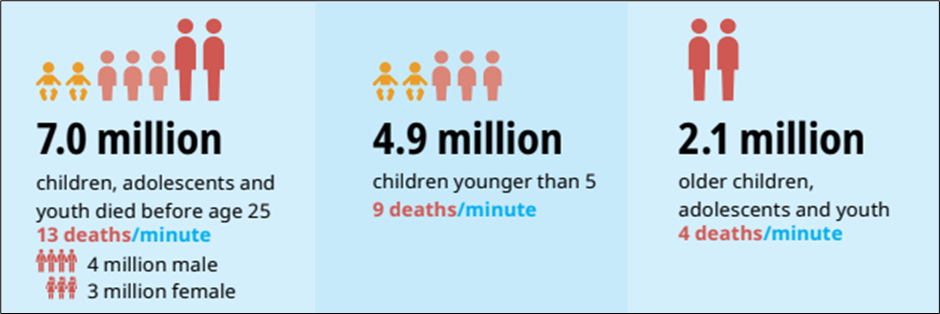
- Around 4.9 million children under age five died in 2024, mostly by preventable causes.
- Neonatal mortality fell 59% in the same period, yet accounts for 47% of under-five deaths globally.
- Death Insights:
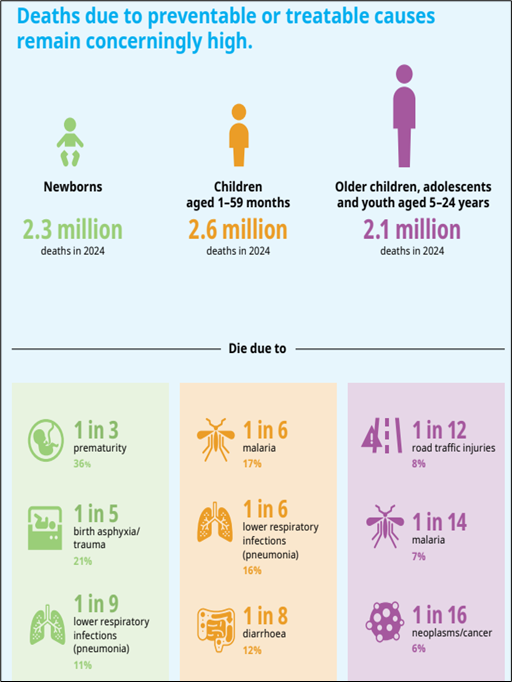
- Most deaths were caused by preterm birth complications, pneumonia, malaria, and birth-related complications.
- Nearly half of deaths occur in the neonatal period (first 28 days).
- These deaths are largely preventable through low-cost interventions like vaccines, nutrition, and basic healthcare.
- Severe acute malnutrition (SAM) directly caused over 100,000 deaths among 1-59-month-olds (5% of cases), with indirect effects amplifying vulnerability.
- Severe acute malnutrition (SAM) is a life-threatening condition defined by very low weight-for-height (<-3 SD), a mid-upper arm circumference (MUAC) <115 mm, or nutritional oedema.
- Regional Disparities
- Sub-Saharan Africa and Southern Asia bear over 80% of under-five deaths, with fragility/conflict areas.
- South Asia reduced under-five mortality by 76% since 1990 and 68% since 2000, with rates dropping from 92 to 32 per 1,000 live births (2000-2024).
- Emerging Challenges
- Climate change, conflicts and fragile states, economic instability, and a decline in global health funding (27% drop in 2025) result in the risk of stagnation or reversal of gains
India’s Performance and Achievements
- Mortality Rate Reductions
- India slashed under-five mortality by 79% since 1990 to 27 per 1,000 live births in 2024, and by 70% since 2000.
- Neonatal mortality has declined 70% since 1990 to 18 per 1,000 and 61% since 2000, averting millions of deaths.
- Interventions Driving Gains
- Key factors include expanded immunisation, institutional deliveries, Special Newborn Care Units (SNCUs), and Tele-SNCU innovations.
- These efforts reduced deaths from pneumonia, diarrhoea, malaria, and birth complications, contributing to South Asia’s under-five rate falling from 92 to 32 per 1,000 live births (2000-2024).
- India stands out as a global exemplar in the report for accelerating child mortality reductions, significantly contributing to South Asia’s progress amid global slowdowns.
- A 70% decline was observed in the Neonatal Mortality Rate (NMR)—dropping from 57 per 1,000 live births in 1990 to 17 in 2024; the Infant Mortality Rate reached 23.3 per 1,000. Improvements in neonatal care have been particularly impressive.
Key Recommendations of the Report
- Investment in Primary Healthcare Systems and maternal and newborn care.
- Scaling up preventive interventions like universal immunisation, nutrition programmes and access to clean water and sanitation.
- Special focus should be placed on the first 28 days of neonatal life, and preterm and low-birth-weight babies.
- Ensuring sustainable financing can lead to an increase in domestic public health spending.
- Data and monitoring systems to strengthen real-time health data tracking.
India’s Initiatives for Women’s Nutrition & Preventing Child Mortality
- POSHAN Abhiyaan: It is a flagship nutrition mission for a malnutrition-free India, targeting women, children, and adolescents. It has been strengthened through ‘Mission Saksham Anganwadi’ and ‘POSHAN 2.0’.
- Anaemia Mukt Bharat Abhiyan: Launched in 2018, the initiative aims to reduce anaemia prevalence through targeted interventions. It focuses on iron supplementation, regular screening, and awareness to accelerate the decline in anaemia levels.
- Mission Shakti: It is an umbrella scheme aimed at ensuring women’s safety, security, and empowerment through its two components—Sambal and Samarthya. It integrates services like One Stop Centres, PMMVY, and childcare support to indirectly improve maternal health and child outcomes.
- Integrated Child Development Services: Provides nutrition, preschool education, immunisation, and health services to children under six and mothers. It is delivered through Anganwadi centres, which form the backbone of early childhood care in India.