
SYLLABUS
GS 2: Government policies and interventions; Structure, organisation and functioning of the Judiciary; Issues relating to development and management of social sector/services relating to public welfare; Statutory, regulatory and quasi-judicial bodies.
GS 3: Implicit under economic reforms & governance; Issues in sectors of the Indian economy.
Context: Recently, the India Justice Report (IJR) released the Consumer Justice Report 2026, intending to assess the capacity of redressal commissions in India.
About the Report
- It is the first of its kind report mainly relied on data from public platforms, websites of redressal commissions, Right to Information (RTI) replies, and Parliament responses collected between 2020 and 2024.
- Objective: To comprehensively examine the institutional capacity of India’s consumer dispute redressal commissions at the state and district levels under the Consumer Protection Act, 2019.
- In a first-time assessment, the IJR collated data on 28.57 lakh cases filed between 1st January 2010 and 31st August 2024 at the national, state and district consumer commissions from the CONFONET dashboard (now e-Jagriti).
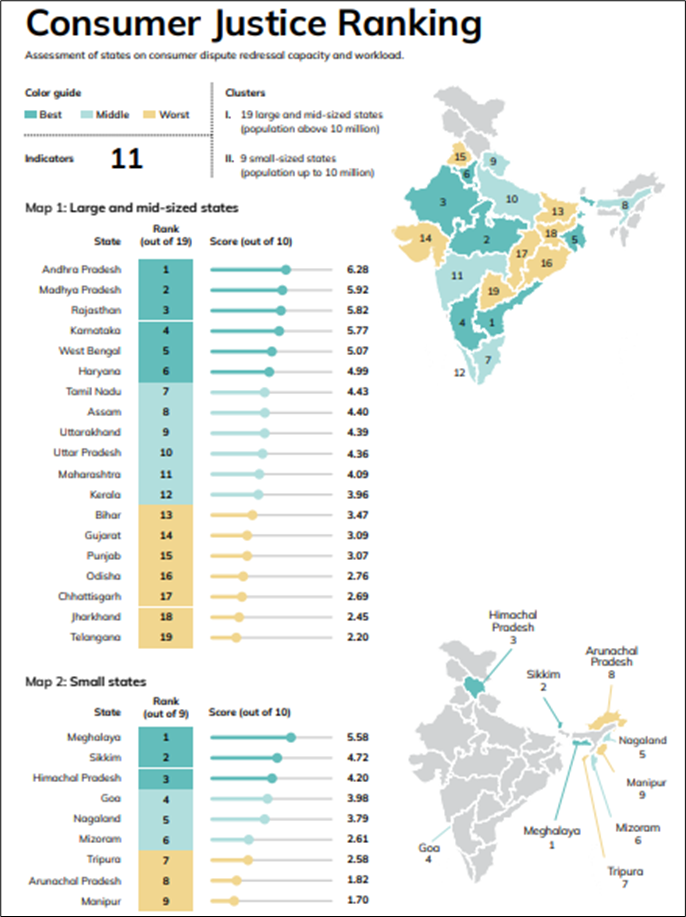
- Provides ranking of the states on 11 indicators across five themes: Budgets, Infrastructure, Human Resources, Workload and Diversity (Gender)
- Each indicator was scored on a range of 1 to 10 points, where states with lowest performance received a minimum score of 1 and highest performing states received 10 points.
- Highlights the gap between law and implementation, which will be useful for governance reforms, judicial efficiency and consumer protection.
Key Findings of the Report
- Pendency of Cases
- Between 2020 and 2024, the pendency of cases rose to 21%, accounting for a total of 5.15 lakh cases.
- 35% of pending cases had remained unresolved for more than three years.
- Indicates that new cases are outpacing disposals, leading to backlog accumulation
- Delay in Case Disposal
- Average disposal time for a case is 600–650 days (2 years) despite the legal mandate of 3–5 months.
- Severe Human Resource Shortage
- The report highlights that more than 50% of seats for presidents are vacant in State Consumer Dispute Redressal Commissions.
- Large vacancy of members and supporting staff, leading to frequent adjournments and reduced hearings.
- Representation of Women
- Despite a legal mandate under the Consumer Protection Act, 2019, the share of women among presidents and members in SCDRCs declined from an average of 35% in 2021 to 29% in 2025.
- Weak Use of Mediation (ADR Failure)
- Only 134 cases referred to mediation nationwide
- Despite legal provisions, ADR mechanisms remain underutilised, increasing the burden on courts.
- State Rankings:
- Andhra Pradesh leads among 19 large/mid-sized states with 93% case clearance (2020-2024), followed by Madhya Pradesh, Rajasthan, Karnataka, and West Bengal.
- Telangana was last in the ranking.
Recommended Reforms
- Immediate Vacancy Filling: Prioritise appointments via unified recruitment to cut pendency.
- Boost ADR/Mediation: Scale Lok Adalats and mediation cells to meet statutory timelines, reducing hearing repeats.
- Infrastructure and Diversity: Mandate compliance with women’s quota, invest in district forums, and leverage RTI/parliamentary oversight for transparency.
- Federal Coordination: Central guidelines for state capacity-building, tying budgets to performance metrics for SDG 16 alignment
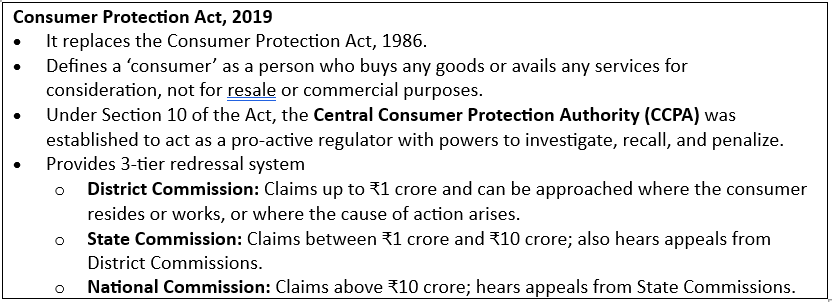
Recent Judgment: Recently, the Supreme Court has invoked Article 142 to ensure that consumer grievances in smaller States and Union Territories are not left without remedy due to the non-functioning of State Consumer Disputes Redressal Commissions.