SYLLABUS
GS-2: Government policies and interventions for developmentGS-3: Major crops – cropping patterns in various parts of the country; Issues related to direct and indirect farm subsidies and minimum support prices; Technology missions in agriculture.
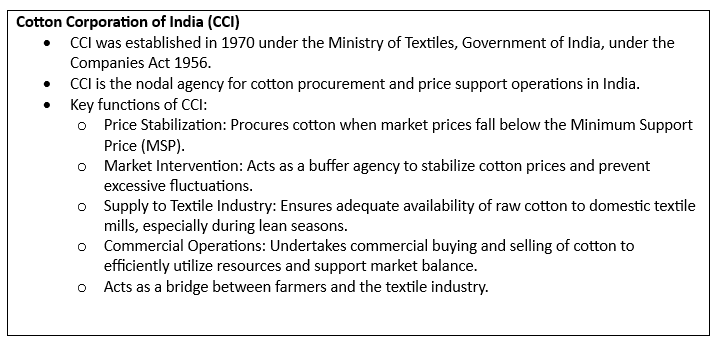
Context: Recently, the Cabinet Committee on Economic Affairs (CCEA) has approved Minimum Support Price (MSP) funding of Rs. 1,718.56 crore to the Cotton Corporation of India (CCI) for the cotton season 2023–24.
More on the News
- The funding aims to provide direct price support to cotton farmers across the country, enhancing the economic security of cotton-growing communities.
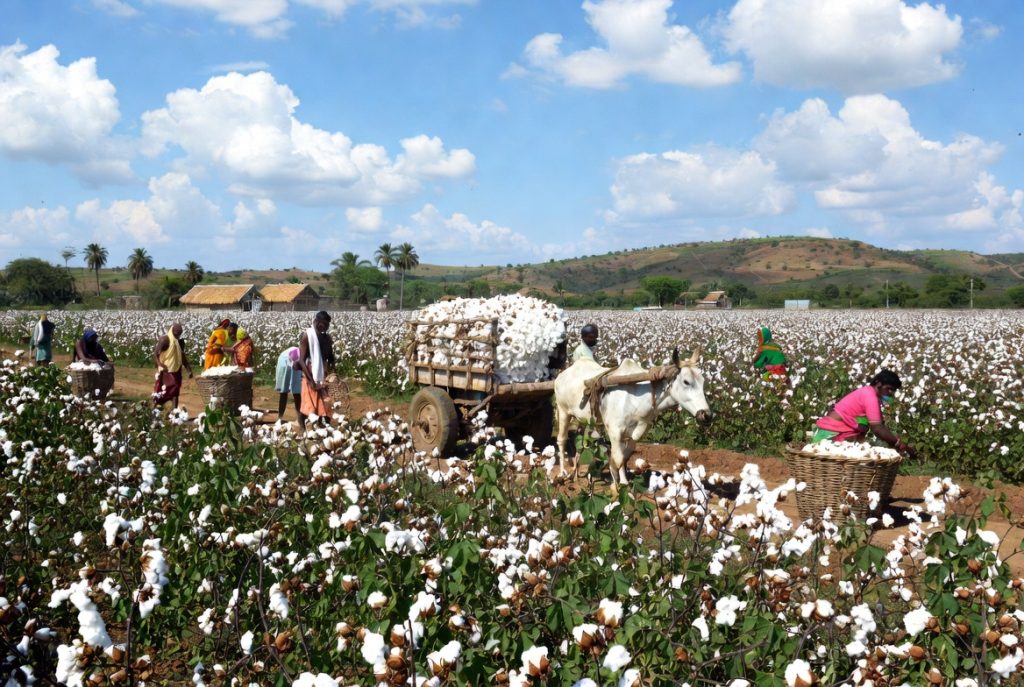
- Cotton sustains the livelihoods of approximately 60 lakh farmers and supports 400–500 lakh people engaged in allied activities, including processing, trade, and textiles.
- During the 2023-24 cotton season, India contributed approximately 25% to global cotton production, cultivating an area of 114.47 lakh hectares.
- The Government of India fixes the MSP for seed cotton (kapas) based on the recommendations of the Commission for Agricultural Costs and Prices (CACP).
Aspects of Cotton Cultivation in India
- Agro-Climatic Conditions
- Crop type: Cotton is primarily a Kharif crop, with its sowing season starting in early April-May in northern India and during the monsoon season in the southern zone.
- Temperature: Ideally between 21°C to 30°C.
- Requires a long frost-free period (180–200 days)
- Rainfall: 50–100 cm (Extremely vulnerable to waterlogging, making proper drainage crucial)
- Soil: Can be grown in various soil types, including well-drained alluvial soils in the north, variable-depth black clayey soils in the central region, and mixed black and red soils in the south.
- Major Cotton-Producing States
- India is the only country which grows all four species of cotton, G. Arboreum (Asiatic cotton), G. Herbaceum (Asiatic cotton), G. Barbadense (Egyptian cotton) and G. Hirsutum (American Upland cotton).
- In India, the majority of cotton production comes from 9 major cotton-growing states
- Northern Zone – Punjab, Haryana and Rajasthan.
- Central Zone – Gujarat, Maharashtra and Madhya Pradesh.
- Southern Zone – Telangana, Andhra Pradesh and Karnataka.
- India ranks second globally in both cotton production and consumption, accounting for about 20% of world production and approximately 21.4% of global cotton consumption during the 2024–25 cotton season.
- Export: One of the largest exporters of cotton with an estimated export of 18 lakh bales (0.31 million metric tons), i.e. 3.23% of world export.
- Bt Cotton:
- Genetically modified version of cotton which expresses Cry proteins (like Cry1Ac and Cry2Ab) from Bt bacteria, targeting lepidopteran pests such as bollworms.
- Now covers about 95% of India’s cotton area.
Significance of Cotton Cultivation
- Multipurpose Crop (Triple Output): It is a highly versatile crop that yields three major products, e.g., lint fibre, cottonseed and by-products/waste.
- Backbone of Textile Sector: Cotton occupies a central position in India’s textile industry, contributing roughly two-thirds of the total fibre consumption.
- Role in Livestock and Feed Industry: Cottonseed by-products, particularly cottonseed cake, are crucial for the feed industry.
- Nutrient-Rich Animal Feed: The residual cottonseed cake (about 80–85% of the seed after oil extraction) is rich in protein and widely used as feed for cattle and poultry.
Challenges to the Cotton Sector in India
- Climate Variability: Erratic rainfall, recurrent droughts, floods, declining soil fertility, and inadequate irrigation facilities adversely affect productivity. Rising temperatures and changing rainfall patterns pose long-term threats to sustainable cotton production.
- Low Productivity: A significant proportion of farmers continue to rely on conventional farming methods, resulting in low yields and inferior fibre quality.
- Technological Gap: Limited access to modern technologies, quality seeds, and effective weed management further exacerbates productivity, particularly for small and marginal farmers.
- Pest Incidence: Cotton crops are increasingly vulnerable to pests such as the Pink Bollworm (PBW) and various fungal infections. The declining effectiveness of GM cotton varieties has compounded the problem.
- Price Volatility: Farmers’ limited access to organised markets tends to sell produce below the Minimum Support Price (MSP). Also, fluctuations in global cotton prices, along with trade barriers, further impact income stability and export competitiveness.
Government Initiatives to Support the Cotton Industry
- Mission for Cotton Productivity: Mission by the Department of Agricultural Research and Education (DARE) and the Ministry of Textiles (announced in Budget 2025-26) provides scientific and tech-driven support for higher yields.
- NFSM Cotton Development Programme: Part of the National Food Security Mission, which promotes demos and high-density planting in 15 major cotton-growing states to increase productivity and output.
- Kasturi Cotton Bharat: Traceability and branding program led by the Ministry of Textiles and CCI.
- PM MITRA Parks: Creates 7 integrated textile parks to boost investment, infrastructure, and global competitiveness, including cotton processing.
- Bale Identification and Traceability System (BITS): Blockchain-based initiative by the Cotton Corporation of India (CCI) to enhance transparency in cotton supply chains.
- Cott-Ally App: Enables better outreach and service delivery to farmers.