
SYLLABUS
GS-3: Indian Economy and issues relating to planning, mobilization of resources, growth, development and employment; Changes in Industrial Policy and their Effects on Industrial Growth.
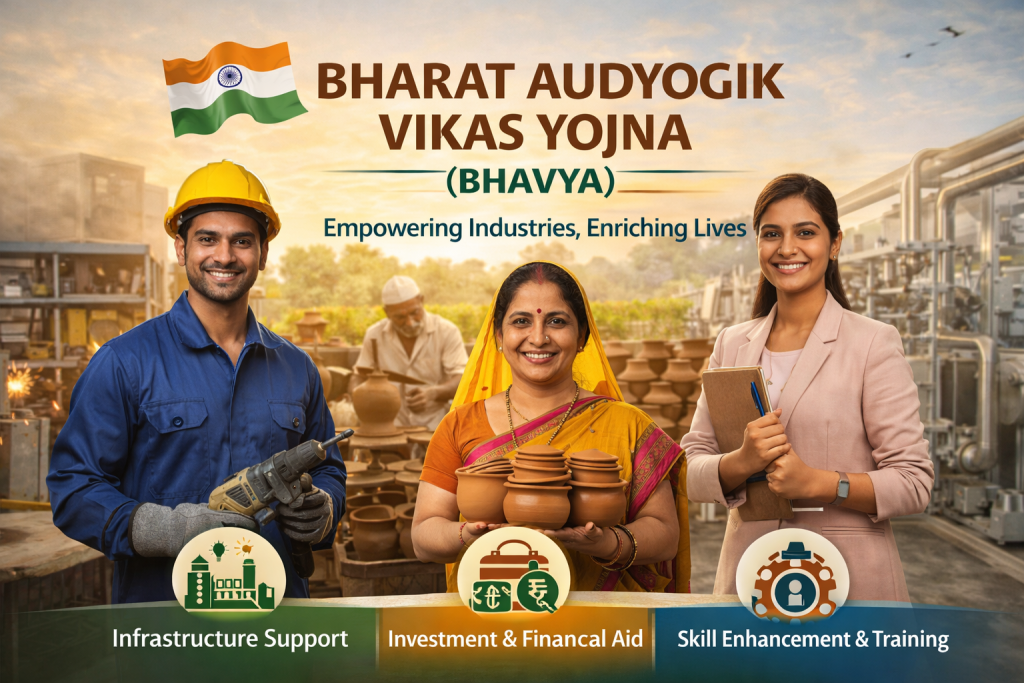
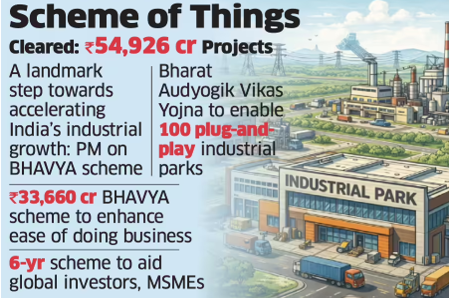
Context: The Union Cabinet has approved the ₹33,660 crore Bharat Audyogik Vikas Yojna (BHAVYA) to develop 100 plug-and-play industrial parks across India to boost manufacturing, investment, and employment.
About the BHAVYA Scheme
• BHAVYA is a flagship industrial infrastructure scheme aimed at developing 100 plug-and-play industrial parks to create world-class, future-ready manufacturing ecosystems across India.
• The scheme will be implemented over a six-year period starting from 2026–27, with around 50 parks to be developed in the first phase.
• It builds upon the success of industrial smart cities under the National Industrial Corridor Development Programme (NICDP) and represents a next-generation expansion of the industrial corridor model.
• Institutional Framework:
- Nodal Ministry: Department for Promotion of Industry and Internal Trade (DPIIT)
- Implementing Agency: National Industrial Corridor Development Corporation (NICDC)
- Implementation through partnership with State Governments and private sector
- Mandatory creation of a Special Purpose Vehicle (SPV) with planning and single-window clearance powers
• Key Features of the Scheme:
- The scheme provides for the development of industrial parks ranging from 100 to 1,000 acres, with a minimum size of 100 acres (relaxed to 25 acres for hilly and Northeastern regions).
- It ensures flexibility to accommodate regional constraints while maintaining scale.
- Central assistance is provided up to ₹1 crore per acre to support the creation of high-quality industrial infrastructure.
- The scheme supports core infrastructure such as internal roads, underground utilities, drainage systems, treatment facilities, and ICT systems.
- It also includes value-added infrastructure like factory sheds, testing labs, and warehousing, along with social infrastructure such as worker housing and amenities.
- Up to 25% of the project cost is provided for external infrastructure, ensuring seamless connectivity to highways, railways, and ports. This enhances logistics efficiency and reduces transportation costs.
• Governance & Selection Mechanism: Projects will be selected through a challenge mode, ensuring only high-quality, reform-oriented, and investment-ready proposals. The scheme promotes competitive federalism by encouraging states to compete on ease of doing business and reforms.
• Ease of Doing Business & Plug-and-Play Model: The scheme provides pre-approved land, ready infrastructure, and integrated services to industries. Single-window clearances and streamlined approvals enable industries to move quickly from intent to production.
• Future-Ready & Sustainable Design: The scheme is aligned with PM GatiShakti to ensure multimodal connectivity and last-mile access. It promotes green energy use, efficient resource management, and underground utility corridors for a “no-dig” environment.
• Sectoral Scope & Beneficiaries: The scheme is sector-agnostic and open to a wide range of industries. It primarily benefits MSMEs, startups, manufacturing units, and global investors, while also supporting workers, logistics providers, service sectors, and local communities.
Significance of the Scheme
• Boost to Manufacturing & Growth: BHAVYA unlocks India’s manufacturing potential and strengthens its emergence as a global hub in line with Atmanirbhar Bharat and Viksit Bharat.
• Large-scale Employment Generation: The scheme is expected to generate around 15 lakh direct jobs along with significant indirect employment in logistics and services.
• Investment Attraction: It reduces entry barriers through ready infrastructure, thereby attracting domestic and global investments and enhancing investor confidence.
• Strengthening Supply Chains: BHAVYA promotes cluster-based industrial development, enabling co-location of industries and reducing logistics costs.
• Regional Industrialisation & Inclusivity: The scheme ensures balanced industrial growth across all States and UTs, with special focus on hilly and Northeastern regions.
• Ease of Doing Business Reforms: It simplifies regulatory processes and encourages state-level reforms, fostering competitive federalism.
• Infrastructure & Logistics Efficiency: Integration with PM GatiShakti enhances connectivity, improving efficiency, reliability, and productivity.
• Sustainable Industrial Development: The scheme promotes green energy use and sustainable practices for efficient and uninterrupted industrial operations.