
SYLLABUS
GS-3: Indian Economy and issues relating to Planning, Mobilization of Resources, Growth, Development and Employment.
Context: In the backdrop of rising geopolitical tensions in West Asia, coupled with a surge in global crude oil prices, the Union Government has proposed the creation of an Economic Stabilisation Fund (ESF) to enhance India’s resilience against external economic shocks.
More on the News
- The Finance Minister Nirmala Sitharaman announced the proposal while presenting the Second Supplementary Demand for Grants in Parliament.
- Under the second supplementary demands, the government has sought Parliament’s approval for ₹57,381 crore as an initial allocation towards the ESF.
- The total corpus of the ESF is proposed at around ₹1 lakh crore, with the balance to be mobilised through savings and inter‑account transfers from other ministries and departments.
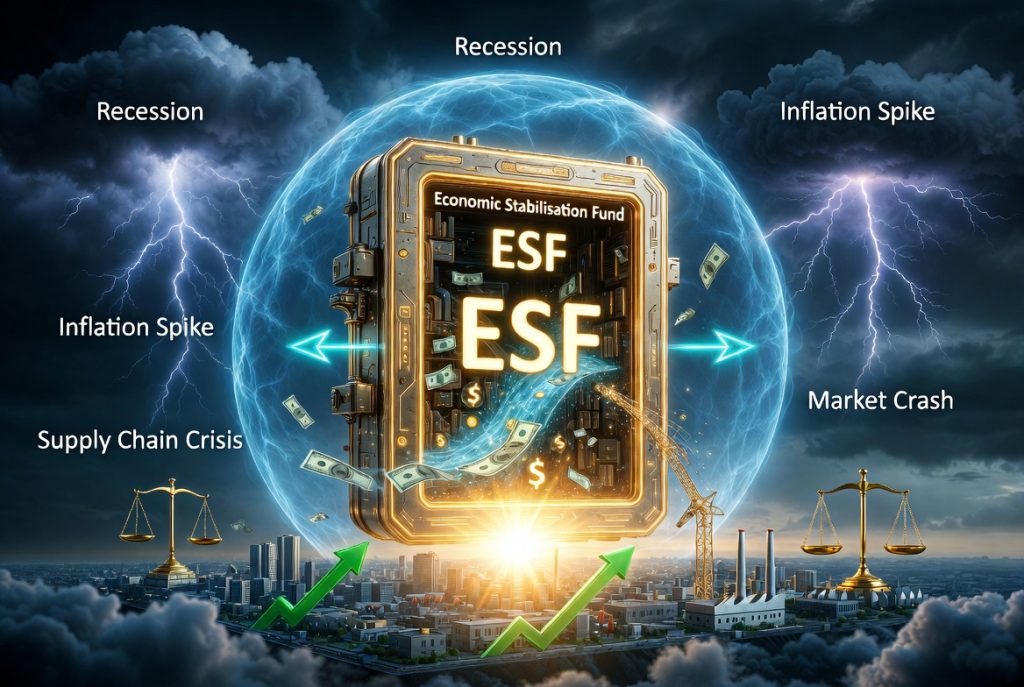
- The Fund will help manage the economic impact of global crises, supply disruptions, and sector-specific shocks.
- The government has emphasized that the additional expenditure will remain within the fiscal deficit target of 4.4% of GDP.
About the Fund
- Nature: The Economic Stabilisation Fund is a proposed dedicated fund acting as a fiscal buffer parked within the Union government’s accounts to be tapped during periods of external or domestic macroeconomic stress.
- Size and funding: Target corpus of about ₹1 lakh crore; around ₹57,381 crore is being provided via the second supplementary grants, with the remainder to come from re‑prioritisation/savings across grants.
- Purpose: To provide fiscal headroom to address global headwinds—especially oil‑price spikes, West Asia‑related disruptions, and other exogenous shocks without abrupt expenditure cuts elsewhere.
- Use: Envisaged as a flexible instrument that can support targeted relief, sectoral support, or cushioning of budgetary pressures when shocks have sizeable fiscal or growth implications.
Need / Significance
- Macroeconomic Stability: Provides a buffer against external shocks, helping maintain stable growth and inflation levels.
- Energy and Import Risk Management: Shields the economy from volatility in crude oil prices, which significantly impacts India’s trade deficit.
- Counter-cyclical Fiscal Policy: Enables the government to increase spending during downturns without abrupt fiscal stress.
- Supply Chain Resilience: Helps mitigate disruptions arising from geopolitical conflicts, pandemics, or global trade shocks.
- Investor Confidence: Demonstrates fiscal prudence and preparedness, thereby strengthening confidence in India’s economic management.
- Policy Flexibility: Reduces dependence on ad-hoc measures, ensuring a structured and timely response mechanism.