
SYLLABUS
GS-3: Science and Technology- developments and their applications and effects in everyday life, and Achievements of Indians in science & technology; indigenization of technology and developing new technology.
Context: A recent study published in Communications Earth & Environment suggests that Earth’s magnetic field reversals may last far longer than previously assumed.
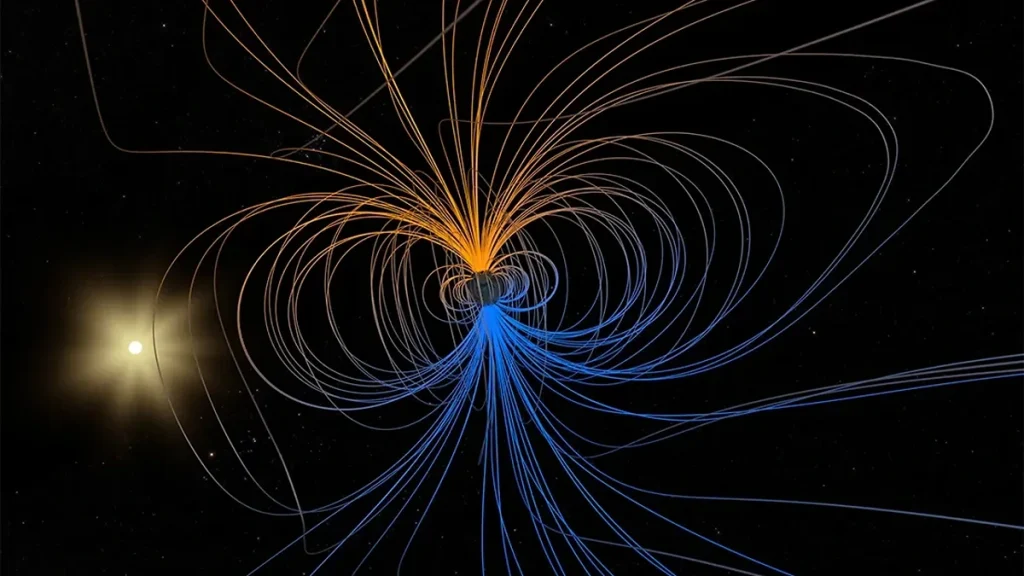
About the Earth’s Magnetic Field and Geomagnetic Reversals
- Earth’s magnetic field helps in navigation and forms the magnetosphere, protecting the planet from harmful solar wind and cosmic radiation.
- The field is generated through the geodynamo process, caused by the movement of molten iron and nickel in Earth’s outer core (~2,200 km thick).
- Over geological time, the magnetic north and south poles periodically reverse, a phenomenon known as geomagnetic reversal.
- Evidence of past reversals is preserved in rocks and marine sediments, where magnetic minerals (such as magnetite crystals) align with the Earth’s magnetic field when deposited.
- Scientists estimate that around 540 geomagnetic reversals have occurred over the past 170 million years.
- Earlier studies suggested that reversals generally occur over 2,000–12,000 years, with about 10,000 years considered the typical duration.
Findings of the New Study
- An international team of researchers from Japan, France, and the United States, led by Yuhji Yamamoto (Kochi University) and Peter Lippert (University of Utah), analyzed deep-sea sediment cores from the North Atlantic near Newfoundland, Canada.
- These sediments were collected during the Integrated Ocean Drilling Program expedition (2012).
- The researchers examined sediment layers from the Eocene epoch (~40 million years ago) using:
- X-ray scanning
- Magnetic measurements
- Astronomical tuning of sediment layers
- Their analysis identified two unusually long geomagnetic reversals:
- One lasting about 18,000 years
- Another lasting around 70,000 years
- The longer reversal showed complex behaviour, including precursor phases and multiple rebounds, where the magnetic field temporarily shifted direction before stabilizing.
- Numerical simulations of the Earth’s core suggested such long reversals are rare but natural outcomes of geodynamo dynamics, potentially lasting up to 130,000 years.
Implications for Earth and Future Research
- During geomagnetic reversals, the magnetic field weakens significantly, reducing Earth’s protection from solar and cosmic radiation.
- Prolonged reversals could therefore lead to:
- Higher radiation exposure
- Increased genetic mutations
- Possible atmospheric erosion
- Disruption of animal navigation, since many species rely on Earth’s magnetic field.
- Such conditions may have influenced ancient ecosystems and evolutionary processes.
- The Eocene period, when these long reversals occurred, also had higher global temperatures and CO₂ levels, making it a useful climate analogue for future warming scenarios.
- Scientists note that Earth’s magnetic field strength has declined by about 5% per century in recent measurements, while the magnetic North Pole continues to drift toward Siberia, raising questions about whether a future reversal could eventually occur.
- Future research will analyze lava sequences in Iceland and geomagnetic excursions preserved in sediment records better to understand the causes and duration of magnetic reversals.