

SYLLABUS
GS-3: Achievements of Indians in science & technology; indigenisation of technology and developing new technology. Awareness in the fields of IT, Space, Computers, robotics, Nano-technology, and bio-technology.
Context: Recently, the Indian Institute of Science (IISc) launched a moonshot project to develop brain co-processors that combine neuromorphic hardware and AI algorithms to enhance or restore brain function.
More on the News
- The project is funded by the Pratiksha Trust, founded by Senapathy Kris Gopalakrishnan and Sudha Gopalakrishnan.
- The project is described as a moonshot because it targets a highly ambitious and transformative scientific goal similar to large-scale technological missions.
- The initiative seeks to achieve a breakthrough in neuroscience by integrating neural recording, artificial intelligence and closed-loop brain stimulation into a single therapeutic system.
Key Highlights of the Project
- The main objective of the project is to develop both implantable and non-invasive brain co-processors that can decode brain activity from neural recordings.
- The system will process this information using AI algorithms and send signals back to the brain through neural stimulation or neurofeedback.
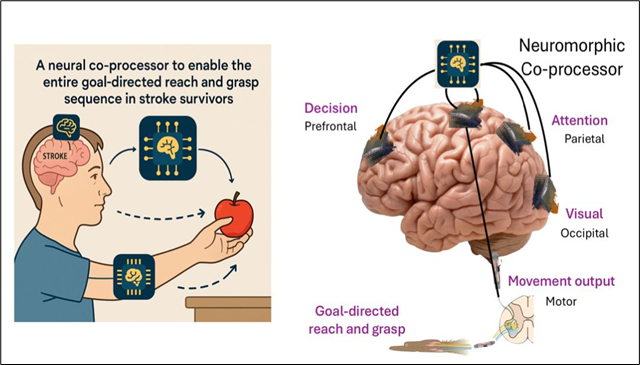
- The technology is primarily designed to assist in the cognitive rehabilitation of stroke survivors by restoring functions such as goal-directed reaching and grasping movements.
- The project will build an AI-powered closed-loop device that connects to different parts of the brain and helps restore smooth and coordinated movement.
- The initiative also aims to develop indigenous implants, hardware and AI systems that can function within India’s clinical infrastructure, including low-resource healthcare settings.
- The project will create India-specific databases of neural recordings, such as stereo EEG and ECoG (Electrocorticography) and will develop open-source AI tools and datasets as digital public goods.
- The first phase focuses on developing a non-invasive neural co-processor that provides sensorimotor feedback for stroke patients while groundwork for implantable devices continues simultaneously.
- The second phase aims to develop a minimally invasive embedded co-processor that can restore sensorimotor coordination in patients suffering from chronic neurological deficits following middle cerebral artery stroke.
Understanding Brain Co-processors and Why They Are Important
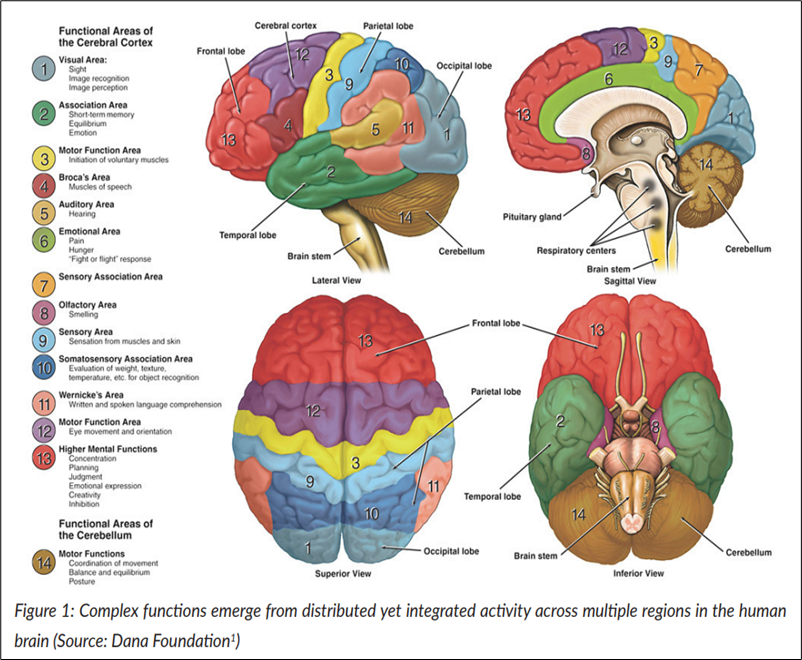
- Understanding Brain Functions
- The human brain controls a wide range of behaviours, ranging from simple reflex actions to complex reasoning.
- These behaviours arise from coordinated interactions among large-scale neural networks across different regions of the brain.
- Complex functions emerge from integrated activity across multiple brain regions rather than from a single isolated area.
- Disruption to brain networks due to stroke, neurodegenerative diseases, traumatic brain injury or developmental conditions can lead to severe functional impairments.
- Role of Brain–Computer Interfaces (BCI)
- Significant advances have been made in the development of Brain–Computer Interfaces (BCIs) that directly interact with neural signals to restore or enhance brain function.
- BCIs have demonstrated capabilities such as decoding motor intent to control computer cursors or robotic arms for paralysed individuals. Some BCI technologies also include retinal prostheses that help restore basic vision in people with blindness.
- Limitations of Conventional BCI Approaches
- Most existing BCI systems follow a one-region–one-function approach, which targets a specific brain circuit for a narrow task.
- This approach does not fully account for the distributed and interconnected nature of brain functions.
- Even simple actions such as reaching and grasping involve coordination between multiple brain regions.
- Concept of Brain Co-processors
- Brain co-processors are advanced neurotechnology systems designed to interact directly with the human brain to enhance or restore neural functions.
- These devices analyse brain signals captured from neural recordings and process them using artificial intelligence algorithms.
- The processed information is then sent back to the brain through neural stimulation or neurofeedback to influence brain activity.
- Brain co-processors operate as closed-loop systems, which means they continuously read brain signals, analyse them and provide real-time corrective feedback.
- The technology can be developed as implantable devices placed inside the body or as non-invasive systems that operate externally.
- Importance of Brain Co-processors
- Brain co-processors aim to restore or enhance natural brain functions in real-life situations rather than focusing only on technical performance metrics.
- The technology can help address complex neurological deficits that require coordination among multiple brain regions.
- Development of brain co-processors requires advances in artificial intelligence, materials science, microelectronics and neuroscience.
- The approach also reflects a deeper understanding of how the brain processes information and adapts through feedback-driven learning mechanisms.