

Mascots for Census 2027 Unveiled
Context: Recently, the Union Home Minister unveiled two mascots named Pragati and Vikas and soft-launched four digital platforms for the upcoming Census 2027 in New Delhi.
More on the News
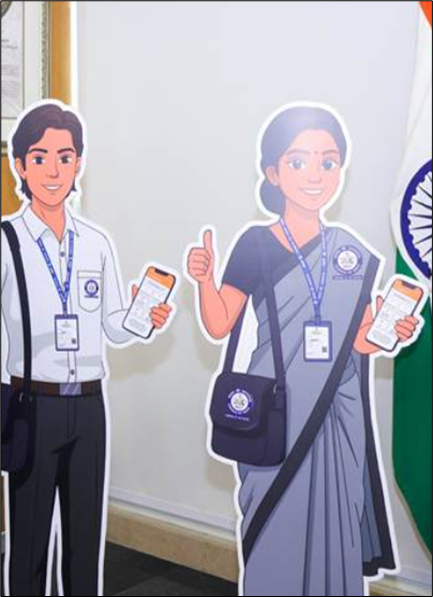
- The mascots Pragati and Vikas represent a female and male census enumerator, respectively.
- The mascots symbolise the equal participation of women and men in nation-building.
- The mascots will help spread awareness and information related to Census 2027 in a citizen-friendly and relatable manner.
- The Centre for Development of Advanced Computing (C-DAC) has developed advanced digital platforms to facilitate enumeration operations across the country.
Four Digital Tools for Census 2027
- Houselisting Block Creator (HLBC) Web Application: The application allows charge officers to create houselisting blocks digitally using satellite imagery and ensures standardised geographic coverage across the country.
- HLO Mobile Application: The application enables enumerators to collect houselisting data through a secure, offline mobile platform and transmit the data directly to central servers.
- Self-Enumeration (SE) Portal: The portal allows households to submit their information online before the field survey and generates a unique Self-Enumeration ID which is later verified by the enumerator.
- Census Management and Monitoring System (CMMS) Portal: The portal functions as a central platform to plan, manage and monitor census operations while allowing officials to track enumeration progress in real time.
About Census 2027
- The Central Government notified its intent to conduct Census 2027 through a Gazette Notification on 16th June 2025, formally commencing the Census process.
- Census-2027 is the world’s largest census exercise and will be conducted in 2 phases.
- Phase 1: Houselisting and Housing Census (HLO) – data on housing conditions and household amenities will be collected. It will be held between 1st April 2026 and 30th September 2026.
- Phase 2: Population Enumeration (PE) – it will record demographic, social, and economic particulars of every person in the country. It will be conducted in February 2027 across India.
- Census 2027 will be the first census in India conducted completely through digital tools and the first to provide a self-enumeration option for citizens.
- The census will also include caste-related questions during the population enumeration phase.
Raisina Dialogue 2026
Context:
Recently, the prime minister of India inaugurated the 11th edition of the Raisina Dialogue in New Delhi.
About the Raisina Dialogue 2026
- The Raisina Dialogue is India’s flagship conference on geopolitics and geo-economics, held annually in New Delhi since 2016.
- It is organised by the Observer Research Foundation (ORF) in partnership with the Ministry of External Affairs.
- It has emerged as India’s equivalent of major global strategic forums such as the Munich Security Conference and Shangri-La Dialogue, strengthening India’s role in shaping global governance discussions.
- The theme of the 2026 dialogue is “Saṁskāra – Assertion, Accommodation, Advancement”.
- The inaugural edition of the Raisina Science Diplomacy Initiative was also organised as part of the dialogue to discuss science diplomacy and governance of emerging technologies.
- The dialogue provides a platform where global policymakers, strategic experts and thought leaders discuss major international challenges.
- Over the course of three days, decision makers and thought leaders of the world will engage each other across conversations in various formats, over six thematic pillars:
- Contested Frontiers: Power, Polarity, and Periphery
- Repairing the Commons: New Groups, New Guardians, New Avenues
- White Whale: The Pursuit of Agenda 2030
- The Eleventh Hour: Climate, Conflict, and the Cost of Delay
- Tomorrowland: Towards a Tech-topia
- Trade in the Time of Tariffs: Recovery, Resilience, Reinvention
Raisina Science Diplomacy Initiative
- The Raisina Science Diplomacy Initiative was launched at Bharat Mandapam in New Delhi during the dialogue.
- The initiative was jointly organised by the Office of the Principal Scientific Adviser to the Government of India and the Observer Research Foundation.
- The initiative aims to provide a global platform to discuss the role of science and technology in international cooperation and policymaking.
- The platform is envisioned as an annual forum for dialogue on science diplomacy and technological governance.
8th Janaushadhi Diwas
Context:
The 8th Janaushadhi Diwas was celebrated on 7th March nationwide to promote affordable generic medicines and highlight the achievements of the Pradhan Mantri Bhartiya Janaushadhi Pariyojana (PMBJP).
More on the News
- The celebration marked the conclusion of the week-long Janaushadhi Saptah 2026, organised by the Pharmaceuticals and Medical Devices Bureau of India (PMBI) under the Department of Pharmaceuticals.
- The government reaffirmed its goal to expand the current network of over 18,000 Janaushadhi Kendras to 25,000 Kendras by 31 March 2027.
About Janaushadhi Diwas
- The Janaushadhi Diwas is observed to promote awareness about affordable and quality generic medicines in India.
- The first Janaushadhi Diwas was celebrated on 7 March 2019 to highlight the importance of accessible healthcare through generic medicines.
- The observance is linked with the Pradhan Mantri Bhartiya Janaushadhi Pariyojana, which aims to provide medicines at affordable prices to the public.
About Pradhan Mantri Bhartiya Janaushadhi Pariyojana (PMBJP)
- The programme was originally launched in 2008 as the Jan Aushadhi Scheme under the Ministry of Chemicals and Fertilisers. Later, in 2015, it was revamped as Pradhan Mantri Bhartiya Janaushadhi Pariyojana (PMBJP).
- The scheme operates through dedicated outlets known as Pradhan Mantri Bhartiya Janaushadhi Kendras, which provide quality generic medicines at significantly lower prices.
- The Scheme is implemented by a society registered under the Societies Registration Act, viz., Pharmaceuticals and Medical Devices Bureau of India (PMBI).
- Objectives of the scheme are:
- To make available quality medicines, consumables and surgical items at affordable prices for all and reduce out of pocket expenditure of consumers/patients.
- To popularize generic medicines among the masses and dispel the prevalent notion that low-priced generic medicines are of inferior quality or are less effective.
- To ensure easy availability of the menstrual health services to all women across India.
- To generate employment by engaging individual entrepreneurs in the opening of Jan Aushadhi Kendra.
International Women’s Day 2026
Context:
International Women’s Day is observed globally on 8 March each year to recognise women’s achievements and to promote gender equality and women’s rights.
More on the News
- The United Nations observed International Women’s Day 2026 on 8 March with the theme “Rights. Justice. Action. For ALL Women and Girls”.
- The theme emphasises the need to remove discriminatory laws and harmful social practices that weaken the rights of women and girls.
- The observance calls for stronger legal protections and collective global action to achieve gender equality.
About International Women’s Day
- International Women’s Day is celebrated annually on 8 March across the world.
- The observance also serves as a platform to strengthen global efforts for gender equality and women’s rights.
Historical Background of the Day
- The origin of International Women’s Day lies in labour movements in North America and Europe during the early twentieth century.
- Women workers organised protests demanding better working conditions, equal pay and voting rights.
- In 1917, women in Russia organised a strike demanding bread and peace during the First World War.
- The protest began on 23 February in the Julian calendar, which corresponds to 8 March in the Gregorian calendar.
- The United Nations General Assembly officially recognised International Women’s Day in 1977.
Gravity Bombs
Context:
Recently, the U.S. Secretary of Defence announced that the United States military will shift to 500-pound, 1000-pound and 2000-pound precision gravity bombs in the ongoing conflict with Iran.
About Gravity Bombs
- Gravity bombs are unpowered aerial bombs that fall toward the target due to gravity after being released from an aircraft.
- The trajectory of the bomb depends on gravity, aerodynamics and the speed and altitude of the aircraft.
- Modern gravity bombs are often fitted with guidance kits, which improve accuracy.
- Many gravity bombs are fitted with Joint Direct Attack Munition kits that convert unguided bombs into precision-guided weapons.
- The kits include GPS navigation systems and steerable fins, which guide the bomb to a specific target.
- This technology allows the bomb to strike precise coordinates even from a considerable distance.
- The US arsenal also includes nuclear gravity bombs, such as the B61 and B83 series. The difference between these and conventional bombs lies in yield, cost, and authorisation.
Types of Gravity Bombs
- The United States primarily uses the Mark 80 series of conventional gravity bombs.
- The 500-pound Mark 82 bomb is used against light targets such as vehicles, radar systems and exposed troop positions.
- The 1000-pound Mark 83 bomb is used to destroy reinforced structures and military installations.
- The 2000-pound Mark 84 bomb functions as a bunker buster capable of destroying underground facilities and heavily fortified structures.
9th International Santal Conference
Context:
The President of India, Droupadi Murmu, attended the 9th International Santal Conference held in Darjeeling, West Bengal on March 7, 2026.
More on the News
- The President highlighted the historic contributions of tribal leaders in India’s struggle against exploitation and colonial rule.
- She recalled the early anti-colonial struggles led by Tilka Majhi (late 18th century) and later by Sido–Kanhu, Chand–Bhairav, and Phoolo–Jhano during the Santal Hul of 1855 as foundational moments of Adivasi resistance.
About the International Santal Conference
- The International Santal Conference, organised by the International Santal Council, is a global cultural gathering of Santal scholars, artists, community leaders, and researchers.
- The Conference provides a platform to discuss tribal identity, linguistic preservation, cultural heritage, and socio-economic development of the Santal people.
- It serves as an important forum to strengthen unity among Santals living in India and other South Asian countries such as Bangladesh and Nepal.
About Santal Community and Santal Language
- The Santal (Santhal) community is one of the largest Scheduled Tribes in India, mainly concentrated in Jharkhand, West Bengal, Odisha, Bihar and Assam.
- Santals belong to the Austroasiatic linguistic family and traditionally follow a strong cultural tradition of folk music, dance, and nature-centric beliefs.
- The Santali language was included in the Eighth Schedule of the Constitution by the 92nd Constitutional Amendment Act, 2003, recognising it as one of India’s official languages.
- The language is written in the Ol Chiki script, invented by Pandit Raghunath Murmu in 1925, which played a crucial role in preserving Santal literature and identity.
Kalarippayattu
Context:
Recently, the Leader of the Opposition in the Lok Sabha, Rahul Gandhi, tried his hand at Kalaripayattu, the traditional martial art of Kerala.
About Kalaripayattu
- Kalaripayattu is a traditional martial art of Kerala, regarded as one of the oldest martial systems of the world, aimed at integrated training of mind and body through physical discipline, breath control, and meditative focus.
- The term “Kalari” refers to the training arena or gymnasium, while “Payattu” means practice or combat training in Malayalam.
- Mythological sources credit the warrior-sage Parashurama with founding this martial tradition in Kerala.
- Training is systematised into four stages:
- Maippayattu – body conditioning and physical preparation through exercises and flexibility training.
- Kolthari – practice with wooden weapons such as sticks and staffs.
- Angathari – training with metal weapons like swords and daggers.
- Verumkai – advanced bare-hand combat techniques, focusing on pressure points and body anatomy.
- The main ethnic styles of Kalarippayattu found in the three regions of northern Kerala (Malabar) are: 1) Vattenthirippu Style, 2) Arappukkai Style, 3) Pillathangi Style.