
SYLLABUS
GS-3: Environment Conservation
GS-2: Agreements involving India and/or affecting India’s interests.
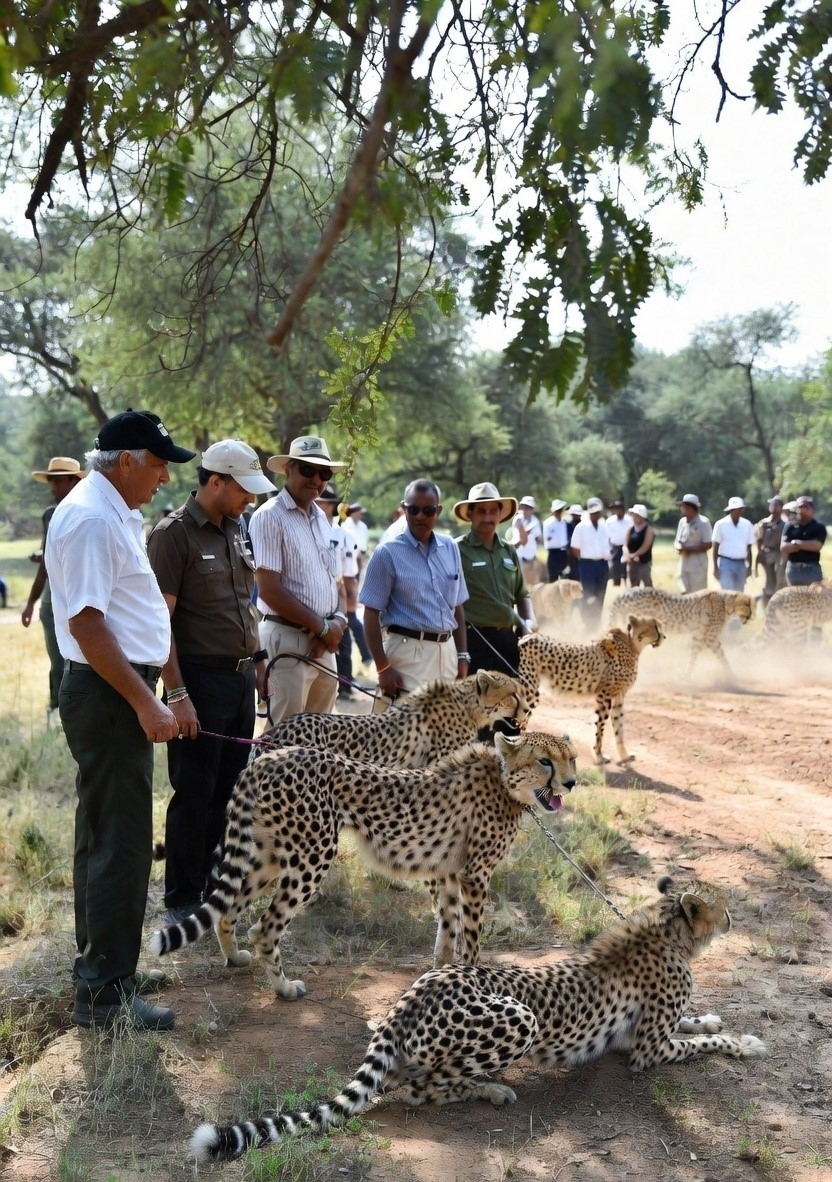
Context: Recently, the Union Minister for Environment, Forest and Climate Change, released nine cheetahs received from Botswana into quarantine enclosures at Kuno National Park in Madhya Pradesh as part of India’s cheetah reintroduction programme.
More on the News
- With the arrival of the six female and three male cheetahs, the total cheetah population in India has increased to 48, which includes 28 India-born cubs and 20 adult cheetahs translocated from African countries under Project Cheetah.
- This marks the third batch of cheetahs brought from an African nation under the translocation programme, following the first batch of eight cheetahs from Namibia in September 2022 and another 12 cheetahs from South Africa in February 2023.
- The initiative represents the world’s first intercontinental translocation of cheetahs aimed at restoring the species in the wild.
- The transfer is part of a government-to-government agreement designed to establish a genetically diverse and free-ranging cheetah population in India over the next decade.
Why was Kuno National Park chosen for the Cheetah Reintroduction?
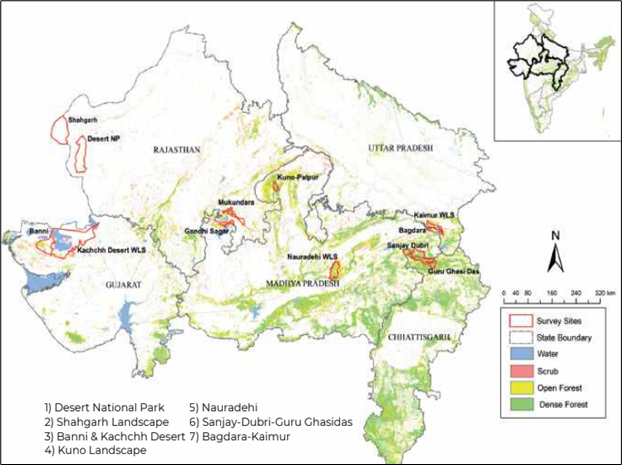
- Kuno National Park, located in Madhya Pradesh, received the highest rating among surveyed sites, making it the most suitable location for the cheetah reintroduction programme in India.
- The park offers a vast and contiguous landscape within the Sheopur–Shivpuri Forest region, covering about 6,800 sq km, which provides sufficient space for the movement and expansion of cheetah populations.
- Its habitat conditions are highly conducive for cheetahs, with suitable terrain and adequate prey resources necessary for sustaining the species in the wild.
- The park falls under the Northern Tropical Dry Deciduous Forest category as per the forest classification of H. G. Champion and S. K. Seth (1968), which supports a favourable ecological environment for cheetahs.
- As of March 2026, Gandhi Sagar Wildlife Sanctuary in Madhya Pradesh has become the second habitat for cheetahs in India after their initial reintroduction at Kuno National Park, and the sanctuary currently hosts three cheetahs.
About Cheetah
- The cheetah (Acinonyx jubatus) is the fastest land animal and Africa’s most threatened big cat.
- It can accelerate to over 110 km/h (about 70 mph) in just over three seconds and can cover strides of up to seven metres.
- The name “Cheetah” originates from the Sanskrit word “Chitra”, meaning “the spotted one”.
- Cheetahs play an important ecological role and are considered keystone species and apex predators in savanna and grassland ecosystems.
- International Cheetah Day is observed annually on December 4 to raise awareness about the conservation of the species.
- Physical Characteristics:
- Male cheetahs are slightly larger than females and have somewhat bigger heads, though the differences are subtle compared to other big cats.
- They possess a slim body, narrow waist, and deep chest adapted for high-speed running.
- Long legs and a uniquely slender frame distinguish the cheetah from other cats.
- The cheetah is the only member of its genus, Acinonyx.
- Global Distribution:
- The largest existing cheetah population occurs across a six-country landscape spanning Namibia, Botswana, South Africa, Angola, Mozambique, and Zambia.
- Namibia holds the largest number of cheetahs in the world and is often referred to as the “Cheetah Capital of the World.”
- Conservation Status:
- The cheetah (Acinonyx jubatus) is listed as Vulnerable on the IUCN Red List.
- The species is included in Appendix I of the Convention on International Trade in Endangered Species (CITES), which provides the highest level of protection in international trade.
- The Asiatic cheetah (Acinonyx jubatus venaticus), once widespread across India and the Middle East, is now Critically Endangered, surviving only in the central deserts of Iran and was declared extinct in India in 1952.
The Saga of Cheetah Reintroduction in India
- Formal efforts to reintroduce cheetahs in India began in the 1970s, when discussions were initiated with Iran for the relocation of the Asiatic cheetah, followed later by negotiations with Kenya.
- In 2009, India proposed introducing cheetahs from Africa, a proposal that required clarification from the Hon. Supreme Court of India. In 2020, the Court permitted the import of a limited number of cheetahs for an experimental reintroduction programme.
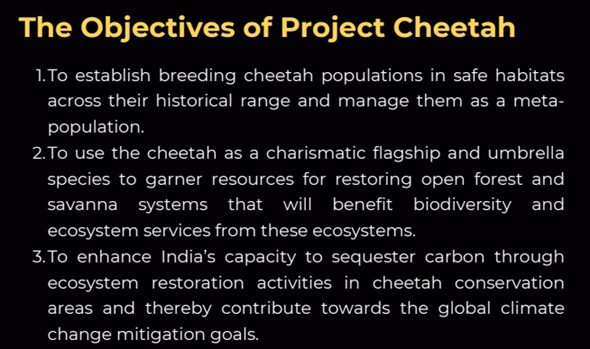
- Following these directions, Project Cheetah was officially launched in 2022 under the supervision of the National Tiger Conservation Authority (NTCA), with the Cheetah Reintroduction Programme forming its central component.
- The National Tiger Conservation Authority (NTCA) is a statutory body in India under the Ministry of Environment, Forests and Climate Change, established in 2006 to strengthen tiger conservation.
- After a Memorandum of Understanding was signed between India and Namibia to promote wildlife conservation, the first batch of eight cheetahs (five females and three males) was translocated to Kuno National Park in Madhya Pradesh on September 17, 2022.
- The second batch of 12 African cheetahs (seven males and five females) arrived from South Africa at Kuno National Park in February 2023, further strengthening the reintroduction programme.
Source:
PIB
Indian Express