
SYLLABUS
GS-2: Bilateral, regional and global groupings and agreements involving India and/or affecting India’s interests.
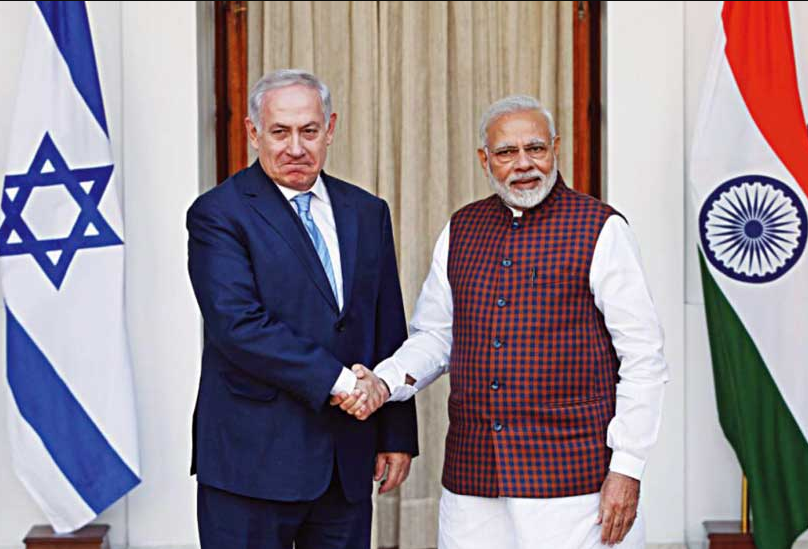
Context: Recently, at the invitation of Israeli Prime Minister Benjamin Netanyahu, Indian Prime Minister Narendra Modi paid a State Visit to Israel, accompanied by a high-level delegation.
More on the News
- The visit built upon the historic exchanges of 2017 (PM Modi’s visit to Israel) and 2018 (PM Netanyahu’s visit to India), which marked a turning point in bilateral ties.
- Both leaders reviewed substantial progress across defence, technology, agriculture, water, cybersecurity, health, trade, education, and people-to-people cooperation.
- The Strategic Partnership was formally elevated to a “Special Strategic Partnership for Peace, Innovation & Prosperity.”
- The visit positioned India–Israel ties as innovation-driven, future-focused, and institutionally anchored, aligning with India’s vision of Atmanirbhar and Viksit Bharat 2047.
Key Highlights of the Visit
- Elevation of Strategic Partnership: Prime Minister Narendra Modi and Prime Minister Benjamin Netanyahu elevated bilateral ties to a “Special Strategic Partnership for Peace, Innovation & Prosperity,”committing to deeper collaboration across advanced technologies, defence, and institutional frameworks spanning government, business, and people-to-people engagement.
- Defence & Security: Welcomed implementation of the November 2025 MoU on Defence Cooperation.
- Agreed on a forward-looking roadmap to expand defence collaboration in scope and scale.
- Strong condemnation of terrorism in all forms, including specific attacks in Israel (Oct 7, 2023) and India (2025 incidents).
- Reaffirmed commitment to regional peace and discussed US President Donald Trump’s “Comprehensive Plan to End the Gaza Conflict.”
- Technology, AI, Research & Space Cooperation: The leaders launched a new Critical & Emerging Technologies (CET) initiative led by the National Security Advisors, focusing on AI, cybersecurity, semiconductors, quantum computing, biotechnology, and defence technologies.
- They strengthened AI and research collaboration through the signing of MoUs on Artificial Intelligence (including AI in education), enhanced support for the India–Israel Industrial R&D and Innovation Fund (I4F), and increased Joint Research Calls funding to USD 1.5 million each.
- Elevated the Joint Commission on Science & Technology to the ministerial level, and agreed to explore Tech Gateway and Horizon Scanning mechanisms.
- They also expanded space cooperation between the Israel Space Agency and the Indian Space Research Organisation, encouraging deeper industry partnerships and joint ventures in the space sector.
- Cybersecurity: The leaders agreed on a multi-year cybersecurity roadmap, welcomed the inaugural India-Israel Cyber Policy Dialogue (March 2025), and signed a Letter of Intent to establish an India-Israel Centre of Excellence in Cybersecurity in India to strengthen capacity building, AI-security integration, and joint cyber exercises.
- Trade, Investment, Financial Cooperation & Connectivity: The leaders welcomed the Bilateral Investment Agreement, advanced FTA negotiations, and launched the India–Israel Financial Dialogue to deepen economic engagement.
- Both sides agreed to link UPI with Israel’s payment system through an MoU between NPCI International and MASAV, and strengthen financial resilience through joint cyber cooperation and simulations.
- Agriculture, Water & Environment: Expansion of cooperation in desalination, wastewater reuse, river cleaning (including Ganga), and water utility reforms.
- Progress review of 35 operational and 8 upcoming Centres of Excellence in Agriculture across India.
- Over 1 million Indian farmers trained.
- MoU establishing India–Israel Innovation Centre for Agriculture (IINCA).
- 20 Joint Fellowships at Israel’s Volcani Agricultural Research Organization.
- Education & Academic Cooperation: Both leaders strengthened education ties through MoUs, including one between Nalanda University and the Hebrew University of Jerusalem.
- Agreed to establish the annual India–Israel Academic Cooperation Forum (I2I Forum), and expanded collaboration in AI-enabled education, research exchanges, and academic partnerships.
- Labour & Mobility: Acknowledging the contribution of Indian workers in Israel, the leaders agreed to facilitate the arrival of up to 50,000 additional Indian workers over five years.
- Parliamentary & Cultural Cooperation: The leaders welcomed the establishment of the India-Israel Parliamentary Friendship Group and adopted a Cultural Exchange Programme (2026–2029) to deepen cooperation in cinema, sports, and creative industries, strengthening people-to-people ties.
- Regional & Global Connectivity: Reaffirming commitment to multilateral frameworks such as I2U2 and the India–Middle East–Europe Economic Corridor (IMEC), the leaders expressed intent to advance regional connectivity, economic integration, and Israel’s role within these emerging strategic initiatives.
India and Israel Bilateral Relations
| Political Relations: | India recognized Israel on 17 September 1950, while full diplomatic relations were established in 1992 with the opening of embassies.Bilateral ties are warm, forward-looking, and currently defined as a Strategic Partnership (since 2017).Institutional dialogues include Foreign Service Consultations, Consular Dialogue, Cyber Policy Dialogue, and Export Control Dialogue.Both countries cooperate in plurilateral groupings such as I2U2 (India–Israel–UAE–USA). |
| Economic & Commercial Relations: | Economic ties have grown rapidly since diplomatic relations began in 1992.Bilateral trade stood at US$ 3.75 billion in FY 2024–25.India is Israel’s second-largest Asian trading partner in merchandise.Trade composition includes diamonds, petroleum products, chemicals, electronics, and medical equipment.Indian ODI in Israel totals about US$ 443 million (including Haifa Port acquisition).Israeli FDI in India stands at US$ 334.26 million.Ongoing negotiations include a proposed India–Israel Free Trade Agreement. |
| Defence Relations: | Defence cooperation includes naval port calls, air force exercises, and institutional dialogues.Indian Navy ships have visited Haifa, and the IAF participated in Blue Flag exercises (2021).First defence minister-level interaction took place in 2023.The 17th Joint Working Group on Defence Cooperation was held in Tel Aviv (Nov 2025). |
| Science, Technology & Innovation: | S&T cooperation governed by a 1993 bilateral agreement and Joint Committee.Joint research initiatives include AI applications in climate change and agriculture (2023).Industrial R&D collaboration includes the India–Israel Initiative for Industrial R&D (2005).India–Israel Industrial R&D and Innovation Fund (I4F) renewed for 2023–27. |
| Diaspora: | Over 42,000 Indians reside in Israel, mainly caregivers, workers, professionals, and students.Around 1,000 Indian students pursue higher education, mostly in STEM. |
| Evacuation Operations: | Operation Ajay (Oct 2023) evacuated over 1,300 Indians via special flights.Operation Sindhu (June 2025) evacuated about 818 Indians via Jordan and Egypt during the Israel–Iran conflict. |