
SYLLABUS
GS Paper 2: Issues Relating to Development and Management of Social Sector/Services relating to Health, Education, Human Resources.
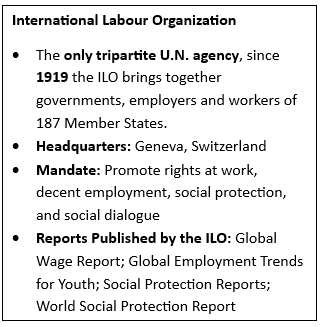
Context: A recent report released by the International Labour Organization (ILO), “Universal Social Protection in Changing Labour Markets: Protecting Workers in All Types of Employment” highlights the urgent need to strengthen social protection systems in response to changing labour market realities, including informalisation, gig work, and non-standard employment.
About Social Protection
- Social protection (social security) refers to policies and programmes aimed at reducing and preventing poverty and vulnerability across the life cycle.
- It includes nine key areas: child and family benefits, maternity protection, unemployment support, employment injury benefits, sickness benefits, health protection, old-age benefits, disability benefits, and survivors’ benefits.
Need for Strengthened Social Protection
- Shift from Reduction to Prevention: Systems must evolve from merely reducing poverty to preventing vulnerability, ensuring support before individuals fall into risk.
- Adapting to Changing Labour Markets: With the rise of temporary, part-time, self-employed, and informal work, social protection must ensure universal access to adequate and comprehensive benefits.
- Expanding Coverage and Inclusion: Extending social insurance to workers in agriculture, domestic work, micro- and small enterprises, and complex employment arrangements improves income security, fairness, and inclusion.
- Build Resilience to Crises: Robust social protection systems enhance stability amid climate change, technological disruptions, and demographic shifts (E.g. Pradhan Mantri Fasal Bima Yojana).
- Reduce Gender Inequalities: Gender-responsive social protection measures help correct labour market disparities (E.g. Pradhan Mantri Matru Vandana Yojana).
Role of Social Insurance
- Enables risk-sharing and redistribution across men and women, higher- and lower-income groups, and workers with continuous or interrupted careers
- Helps mitigate gender inequalities in labour markets
- Remains a stable financing source, contributing 18.8% of total taxation and 5.7% of GDP globally (2019).
- Accounts for over 27% of total taxation in Europe and Central Asia, and remains significant in Africa, Asia and the Pacific despite relatively lower shares.
- Continues to play a key role even with challenges in extending coverage to the informal economy.
Key Concern
- The report underscores that existing social protection systems are insufficient to address the realities of modern labour markets, characterised by informal employment, gig work, and diverse employment arrangements.
- Without reform, large sections of workers remain exposed to social and economic risks.
Major Recommendations
- Expanding Coverage: The report calls for universalisation of social protection by extending coverage to all workers, including those in temporary, part-time, self-employment, and informal sectors.
- Improving Adequacy and Comprehensiveness:Beyond coverage, the report stresses the need to ensure adequate and comprehensive benefits.
- Social protection should move beyond minimal and reactive support to a life-cycle approach, covering individuals across different stages such as childhood, employment transitions, unemployment, illness, disability, and old age.
- Ensuring Sustainable Financing: The report highlights the importance of sustainable and equitable financing mechanisms.
- Key sources include social security contributions and progressive taxation, supplemented by public subsidies for workers with limited capacity to contribute.
- For countries with weak fiscal capacity, international cooperation and solidarity are crucial to strengthen social protection systems.
Significance
- Facilitating Labour Market Transitions: Robust social protection systems help workers adapt to changes such as technological shifts and evolving employment patterns.
- Promoting Formalisation: By extending coverage, the system encourages movement from informal to formal employment, improving economic efficiency.
- Strengthening Resilience: In the face of climate change, demographic changes, and technological disruption, strong social protection systems enhance resilience of both workers and economies.
- Enhancing Social Cohesion: Comprehensive protection reduces inequalities and supports inclusive growth, reinforcing social stability.
Conclusion
The International Labour Organization underscores that universal, inclusive, and adaptive social protection systems are essential for safeguarding workers across all forms of employment. Strengthening these systems will promote social justice, economic stability, and sustainable development in a rapidly evolving world of work.
Source
Down to Earth
Lio Org
PIB