
SYLLABUS
GS-3: Infrastructure: Energy; Conservation, environmental pollution and degradation.
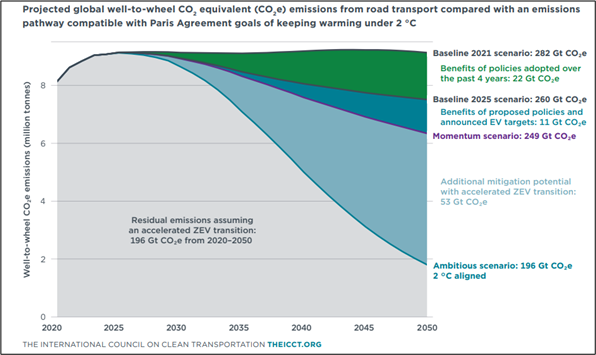
Context: Recently, a global assessment published by the International Council on Clean Transportation (ICCT) highlights that full implementation of India’s national and state-level electric vehicle (EV) targets could reduce road transport CO2 equivalent emissions by nearly 50% by 2050.
More on the News
- The findings are part of the fourth edition of Vision 2050, ICCT’s annual assessment of the global transition to zero-emission vehicles.
- The study models the impact of current and proposed policies on vehicle sales, energy use, and emissions through 2050.
- It further highlights that such reductions would support India’s net zero target for 2070 and reduce dependence on fossil fuel imports.
- ICCT researchers stress that India’s EV transition is both a climate and economic opportunity: strong domestic manufacturing plus robust policies can strengthen value chains, create jobs and improve air quality.
Key Findings of the Study
- Emissions and Energy Use: Achieving India’s current national and State EV targets could cut road-transport CO2-equivalent emissions by half by 2050, and similarly halve liquid fuel demand.
- This would significantly bend the transport emissions curve while allowing continued growth in mobility demand, aligning transport development with Paris Agreement-compatible pathways.
- Domestic Manufacturing Strength: Nearly 80% of EVs sold in India are manufactured domestically, putting India in a group with the EU and Japan, where EV demand is largely met by local production rather than imports.
- This localisation gives India a strategic advantage: the EV push can reduce import dependence, support industrial policy goals, and embed more value addition within the country
- Heavy-Duty Vehicles as the Next Frontier:
- While current EV uptake is concentrated in two- and three-wheelers and passenger vehicles, ICCT identifies heavy-duty freight vehicles as a major next-phase climate opportunity.
- India is among the few emerging economies exploring long-term zero-emission pathways for trucks and HDVs, so electrifying freight can drive large, additional emissions cuts beyond the gains from light vehicles.
- Policy as the Primary Driver: The report projects that India’s EV adoption will steepen sharply after 2030, as proposed fuel-efficiency standards, zero-emission vehicle (ZEV) targets, and State EV policies bite, especially across two- and three-wheelers, passenger cars and eventually heavy-duty freight.
- India as a Global Decarbonisation Hotspot: Given the size of its vehicle market and its rising energy demand, India represents one of the largest single-country opportunities for transport emissions reduction worldwide.
India’s Policy Developments Driving Emission Trends
- National-Level Initiatives:
- The Bureau of Energy Efficiency issued proposed fuel efficiency norms for light commercial vehicles (LCVs) and medium- and heavy-duty vehicles (MHDVs) in July 2025 to curb emissions from freight and commercial transport.
- A 100% Zero-Emission Vehicle (ZEV) sales target for heavy-duty vehicles (HDVs) by 2050 has been proposed under the Bharat Zero Emission Trucking Policy Advisory (2024), released by the Office of the Principal Scientific Adviser to the Government of India, aiming to decarbonise the trucking sector.
- Sub-National Initiatives:
- Delhi Government – Delhi EV Policy 2.0 (Proposed March 2025): Targets 95% of new vehicle registrations to be battery electric vehicles (BEVs), strong hybrids, and plug-in hybrid electric vehicles (PHEVs) by 2027.
- Government of Andhra Pradesh: It aims to register 230,000 EVs by 2029 as part of its state EV roadmap.
- Government of Madhya Pradesh: The state has set sales share targets for two- and three-wheelers, passenger cars, and buses to be achieved by 2030.