
SYLLABUS
GS-3: Infrastructure: Energy, Ports, Roads, Airports, Railways etc.
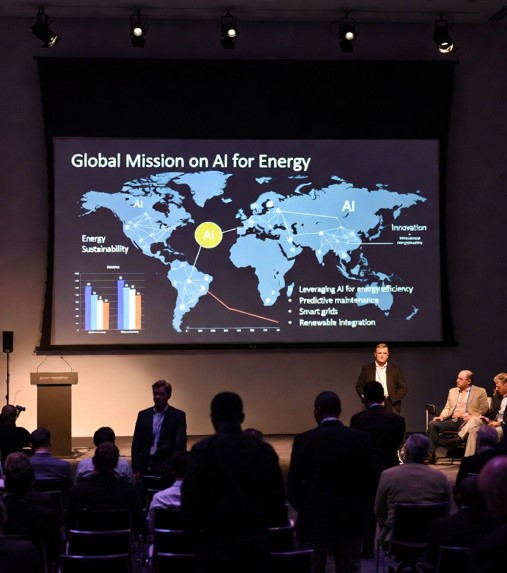
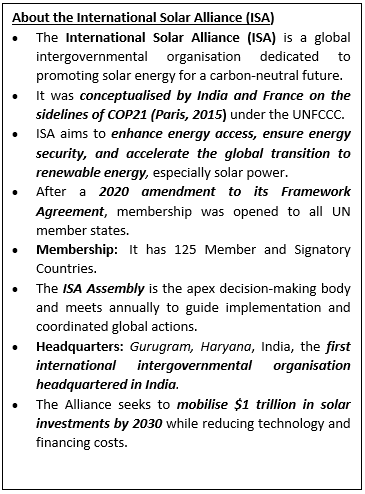
Context: Recently, the International Solar Alliance (ISA) has launched a Global Mission on AI for Energy to accelerate the adoption of Artificial Intelligence in clean energy systems across its 120+ member countries.
More on the News
• The announcement was made at the India AI Impact Summit 2026 in New Delhi.
• The session was titled “Global Mission on AI for Energy – Scaling through Citizen-Centric India Energy Stack.”
• The mission aims to unite governments, industry, financial institutions, and multilateral organisations to scale AI-enabled clean energy systems.
• A report titled Smarter and Citizen-Centric Power for Shared Prosperity: Unleashing the Potential of Digitally and AI-Enabled Power Systems was released.
• The report emphasizes that AI and clean energy reinforce each other, affordable clean power drives digital growth, while AI enables efficient renewable deployment.
Core Objectives of the Mission
• Smart Grid Transformation: Building intelligent, bidirectional grids capable of integrating distributed renewable energy.
• Digital Leapfrogging: Helping developing countries bypass legacy infrastructure using AI-enabled energy systems.
• Citizen-Centric Energy Systems: Placing consumers at the centre via interoperable digital platforms.
• System-Level Transformation: Aligning policy frameworks, data infrastructure, technical capacity, and finance beyond pilot projects.
• Decentralised Energy Scaling: Supporting distributed solar and prosumer ecosystems using AI-driven forecasting and optimisation.
Key Themes Highlighted at the Summit
• AI as the Engine of Energy Transition: AI can enhance load forecasting, predictive maintenance, grid optimisation, and renewable integration.
- Enables real-time management of distributed energy assets, especially in developing economies with uneven electricity access.
- Digitisation and AI are increasingly seen as essential enablers of scalable and equitable energy transition.
• From Energy Transition to Grid Transition: Rapid expansion of distributed renewables is shifting focus from capacity addition to grid integration.
- Requires stronger transmission infrastructure, modernised distribution networks, and real-time monitoring with digital optimisation.
• India as a Digital Energy Model: India’s digital public infrastructure in the power sector was showcased as a scalable template.
- Interoperable platforms linking consumers, utilities, vendors, and financiers enable inclusive service delivery.
- States such as Delhi, Rajasthan, and Andhra Pradesh are advancing smart metering and digital grid systems.
• India’s Solar Journey: India’s solar capacity has grown from less than 3 GW in 2014 to over 141 GW, making it one of the fastest-growing solar markets globally.
- Major initiatives include PM-KUSUM, which promotes solar pumps enabling farmers to become energy producers, and PM Surya Ghar: Muft Bijli Yojana, which supports rooftop solar for 1 crore households to create a nationwide prosumer ecosystem.
- These programmes are democratising solar energy and strengthening distributed energy systems.
India’s Clean Energy Momentum
• India aims to achieve 500 GW non-fossil fuel capacity by 2030, aligned with COP-26 commitments.
• The country achieved 50% installed capacity from non-fossil sources in June 2025, five years ahead of its NDC target.
• Non-fossil capacity reached 262.74 GW (51.5%) in November 2025, out of a total installed capacity of 509.64 GW.
• Renewable additions in 2025 have been record-breaking, with 44.51 GW added (till November), nearly double the previous year.
• Total renewable installed capacity reached 253.96 GW in November 2025, marking strong year-on-year growth.
• Solar as the Main Growth Driver:
- Solar capacity crossed 100 GW in January 2025 and reached 132.85 GW by November 2025.
- Solar additions (34.98 GW) significantly exceeded the previous year’s pace.
- Wind capacity also expanded, reaching 53.99 GW by November 2025.
• Global Standing: According to IRENA RE Statistics 2025, India ranks:
- 3rd in solar capacity globally
- 4th in wind capacity
- 4th in total renewable capacity
Innovations Showcased by ISA
• One Solar App (BSES Rajdhani Power Ltd.): A unified platform for rooftop solar registration, net-metering transparency, and performance tracking.
• Digital Twin Solutions for DISCOMs: Virtual replicas of electricity networks enabling simulation, predictive maintenance, and renewable integration planning.
• GIS-Based Distribution Modernisation: Geospatial mapping initiatives (e.g., Andhra Pradesh) for asset optimisation, outage management, and infrastructure planning.
Significance of the Global Mission
• The mission places AI at the core of decentralised clean energy expansion.
• The initiative supports developing countries in digitally leapfrogging legacy energy systems.
• The mission aligns climate goals with economic development objectives.
• The framework ensures that AI-enabled clean energy systems remain inclusive and citizen-centric.
• The initiative reinforces India’s leadership in digital public infrastructure and renewable energy transformation.