
SYLLABUS
GS-3: Awareness in the fields of IT, Space, Computers, robotics, Nano-technology, bio-technology and issues relating to intellectual property rights.
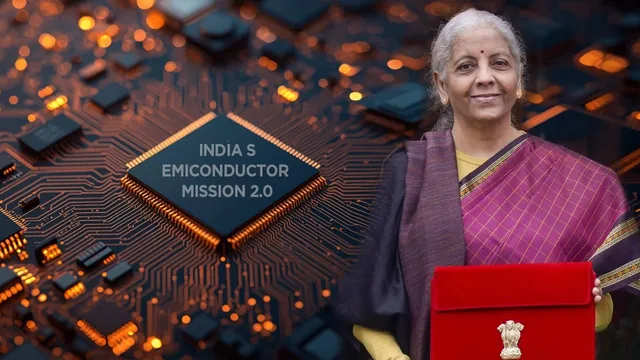
Context: In the Union Budget 2026–27, the Union Finance Minister announced the launch of India Semiconductor Mission 2.0, aiming to boost the country’s semiconductor ecosystem.
India Semiconductor Mission (ISM) 2.0
• The mission builds on ISM 1.0 to expand India’s semiconductor capabilities across the value chain.
- A provision of ₹1,000 crore has been made for ISM 2.0 in FY 2026–27.
• ISM 2.0 will focus on designing and manufacturing semiconductor equipment in India, manufacturing of materials used in semiconductor production, and creation of a large design ecosystem.
• It focuses on developing full-stack Indian intellectual property in chip design and manufacturing, and fortifying semiconductor supply chains to reduce import dependence.
• It will focus on industry-led research and training centres to develop technology and a skilled workforce.
Key Objectives of ISM 2.0
• Equipment & Materials: For the first time, India is incentivising the domestic manufacturing of specialised semiconductor machinery and raw materials.
• Full-Stack Indian IP: A major push to move beyond assembly by developing homegrown chip designs and intellectual property. It marks a shift from “fab centric” support to a whole of ecosystem approach.
• Research & Training: Establishment of industry-led research and training centres to create a specialised workforce and foster indigenous technology.
• Supply Chain Resilience: Strengthening domestic supply chains to reduce the heavy reliance on imported components.
About ISM 1.0
• The India Semiconductor Mission (ISM) 1.0 was launched in December 2021 with a financial outlay of ₹76,000 crore ($10 billion) to reduce India’s reliance on imported semiconductor chips and establish a robust, self-reliant electronics manufacturing ecosystem within the country.
• It is operated as an independent business division under the Digital India Corporation, and it serves as the nodal agency for implementing the Semicon India Programme.
• A total of 10 semiconductor and display projects (Micron, Tata, etc.) with ~₹1.60 lakh crore investment have been approved across six states, mainly targeting fabs and ATMP/OSAT.
Components under ISM 1.0
• Semiconductor Fabs: Offers 50% fiscal support on a pari-passu basis for setting up silicon semiconductor wafer fabrication plants.
• Display Fabs: Provides 50% fiscal support for establishing large-scale display manufacturing facilities (e.g., TFT LCD/AMOLED).
• Compound Semiconductors & ATMP: Extends 50% capital expenditure support for setting up Compound Semiconductors, Silicon Photonics, Sensors, and OSAT (Outsourced Semiconductor Assembly and Test) units.
• Design Linked Incentive (DLI): Provides up to 50% financial support for eligible expenditure (capped at ₹15 crore per application) and deployment-linked incentives of 4%–6% on net sales turnover over five years.