

India Submits Meghalaya’s Living Root Bridges for UNESCO World Heritage Status
Context: Recently, India submitted the nomination dossier of Meghalaya’s living root bridges, titled “Jingkieng Jri / Lyu Chrai Cultural Landscape”, to UNESCO in Paris for consideration under the World Heritage list (2026-27 cycle).
More on the News
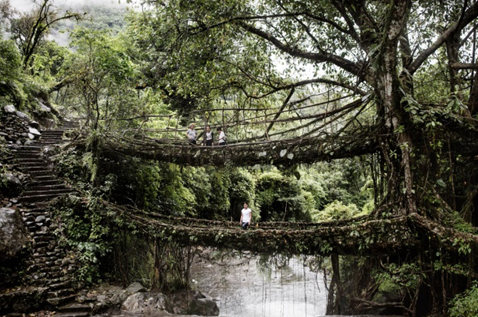
- The nomination covers a living cultural landscape spanning the Khasi and Jaintia Hills, sustained over centuries by the indigenous Khasi and Jaintia communities.
- It reflects a deep interrelationship between people, nature, and belief systems, manifested through traditional land management practices, community governance, and sustainable ecological stewardship.
- The cultural practices embody the indigenous philosophy of coexistence with nature and reverence for Mei Ramew, or Mother Earth.
About Living Root Bridges
- Living root bridges are grown, not built, by training the aerial roots of Ficus elastica (rubber fig trees) across streams and gorges.
- Young roots are guided using hollowed Areca catechu (betel nut) trunks, which provide protection and directional support during growth.
- Developed primarily by the Khasi and Jaintia tribes, the bridges take several decades to mature and can last hundreds of years with community care.
- Mature bridges can span tens of metres and are capable of supporting several dozen people simultaneously.
- Due to the absence of a written script until the 19th century CE, their exact age is unknown; however, oral traditions suggest some bridges may be over 500 years old.
Nipah Virus
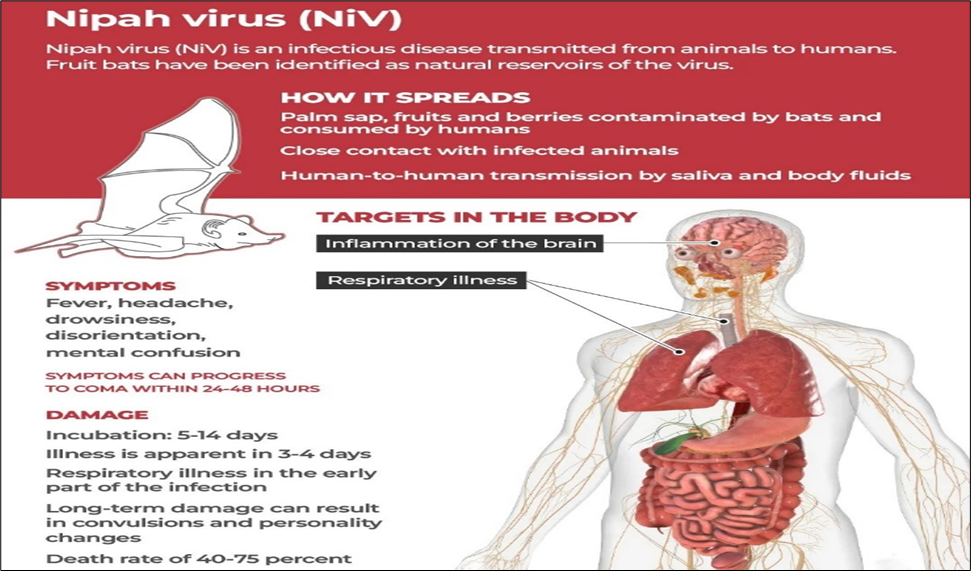
Context: Recently, after India reported two Nipah virus cases since December 2025, the World Health Organization stated that the public health risk remains moderate at the sub-national level and low at the national, regional, and global levels.
More on the News
- The two healthcare workers at a private hospital in Barasat (West Bengal) were confirmed positive.
- This is the third Nipah (Caused by Henipavirus nipahense) outbreak in West Bengal, after 2001 (Siliguri) and 2007 (Nadia).
- India notified WHO on 26 January 2026.
- Confirmation done by the National Institute of Virology, Pune on 13 January 2026, using RT-PCR and ELISA tests.
- RT-PCR (Reverse Transcription Polymerase Chain Reaction) is a sensitive laboratory technique that converts RNA into complementary DNA (cDNA) using reverse transcriptase, which is then amplified via PCR to detect and quantify RNA.
- Enzyme-Linked Immunosorbent Assay (ELISA) is a “gold standard” laboratory technique used to detect and quantify substances like proteins, antibodies, and hormones.
Power Gap Index
Context: The Economic Survey 2025–26 cites the Power Gap Index for the first time to highlight that India has not fully converted its capabilities into regional strategic influence.
More on the News
- The Survey based on findings of the Asia Power Index published by the Australia-based Lowy Institute.
- India’s Power Gap score 2025 is reported at minus 4.0, which is the lowest in Asia except Russia and North Korea.
- The Survey noted a narrow window to convert global uncertainty into strategic opportunity.
About the Power Gap Index
- It measures the gap between expected power (resources) and actual influence.
- Built on eight dimensions covering economic, military, resilience, future resources, diplomacy, defence networks, economic relationships, and culture.
- A positive score indicates that a country converts resources into influence effectively.
- A negative score indicates underperformance despite having significant capabilities.
India’s Position in the Asia Power Index
- Rank: 3rd among 27 countries and territories.
- Scored: 40 / 100.
- Entered the major power category for the first time.
- The United States and China ranked first and second.
USA to Return Bronze Sculptures to India
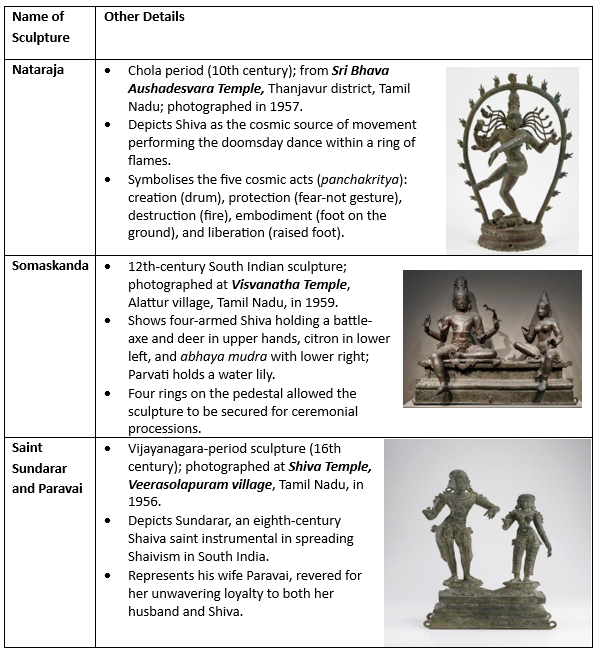
Context: The Smithsonian’s National Museum of Asian Art, United States, has decided to return the sculptures of Nataraja, Somaskanda, and Saint Sundarar with Paravai to the Government of India after confirming that they were illegally removed from temple settings in Tamil Nadu.
More on the News
- The decision is regarded as a major milestone in the international recovery of India’s stolen cultural heritage.
- It also serves as a validation of the Mutual Legal Assistance Treaty (MLAT)-based recovery strategy pursued by the Tamil Nadu Idol Wing–CID.
- Relevant documents and MLAT- related materials were submitted to the museum in 2022.
- In 2023, the French Institute of Pondicherry’s photo archives established that the sculptures had been photographed in functioning temples between 1956 and 1959.
- These findings were subsequently reviewed and affirmed by the Archaeological Survey of India, which confirmed that the removals violated Indian law.
- Key Features of sculptures
About the Mutual Legal Assistance Treaties (MLATs)
- MLA is a formal mechanism that enables countries to cooperate in criminal investigations and prosecutions, especially when evidence or proceeds of crime are located abroad.
- Such cooperation is generally governed by bilateral treaties or agreements between countries.
- MLATs are increasingly used in cases involving heritage crimes, financial offences, and transnational investigations.
Results of Best Marching Contingents & Best Tableaux (Republic Day Parade 2026)
Context: The results of the Republic Day Parade 2026 for Best Marching Contingents and Best Tableaux from States/Union Territories, and Central Ministries/Departments have been officially announced.
More on the News
- The three panels of judges constituted for assessing the performance of the contingents and tableaux have chosen the following:
- Best Marching Contingent (three Services): Indian Navy
- Best Marching Contingent (CAPFs/ Auxiliary Forces): Delhi Police
Best tableaux (States/UTs):
- Maharashtra- Ganeshotsav: A Symbol of Aatmanirbharta.
- Jammu & Kashmir– Handicrafts and Folk Dances of Jammu & Kashmir.
- Kerala– Water Metro & 100% Digital Literacy: Aatmanirbhar Kerala for Aatmanirbhar Bharat.
Best tableau- Central Ministries/Departments
- Ministry of Culture– Vande Mataram:The Soul Cry of a Nation.
Special Prize
- Central Public Works Department- Vande Mataram: Commemoration of 150 Years.
- Dance Group- Vande Mataram: The Eternal Resonance of India.
Popular Choice Awards (MyGov Poll)
- Best Marching Contingent (three Services): Assam Regiment
- Best Marching Contingent (CAPFs/other auxiliary Forces): Central Reserve Police Force (CRPF)
- Top three tableau (States/UTs):
1. Gujarat (Mantra of Swadeshi – Self-Reliance – Freedom: Vande Mataram)
2. Uttar Pradesh (Culture of Bundelkhand)
3. Rajasthan (Golden Touch of the Desert: Bikaner Gold Art (Usta Art)) - Best tableau from Central Ministries/Departments– Dept. of School Education & Literacy (National Education Policy 2020: Rocketing Indian School Education on the Path to Viksit Bharat)
FDI inflows in India Surged 73%: UNCTAD Report
Context: Foreign Direct Investment (FDI) inflows to India surged by 73% to USD 47 billion in 2025, driven by large investments in services (finance, IT, and R&D) and manufacturing, supported by policies aimed at integrating the country into global supply chains, according to the Global Investment Trends Monitor released by the United Nations Conference on Trade and Development (UNCTAD).
More on the News
- The sharp rise in India’s FDI inflows was led by strong investments in services and manufacturing sectors.
- Globally foreign direct investment also increased substantially in 2025.
- Data centres emerged as a major drive of FDI trends, highlighting India’s growing appeal for global capital.
- India ranked among the top 10 major recipients of data centre investments in 2025.
- Foreign investment in data centres remained concentrated in few countries, with France (1st), the United States (2nd) and the Republic of Korea (3rd) leading.
- Emerging markets such as Brazil (4th), India (7th), and Malaysia (9th) also attracted major projects.
Key Highlights of the Report
- The Global FDI reached an estimated USD 1.6 trillion in 2025, marking a 14 per cent increase.
- A significant share of this rise came from major global financial centres and investment hubs, which together added over USD 140 billion.
- The United Kingdom, Luxembourg, Switzerland, and Ireland accounted for the bulk of these conduit flows.
- FDI flows to North America remained broadly stable; the US recorded a 2% increase in inflows.
- Cross-border M&A activity declined by 22% to USD 132 billion, though it rose sharply in semiconductors and telecommunications.
- International project finance increased by 7% to USD 218 billion, despite a 5% decline in the number of projects.
- Project finance activity increased in Syria, the Philippines, Viet Nam, and Uzbekistan, but declined in Egypt and India.
- Data centres drove FDI growth, with USD 125 billion in greenfield announcements and USD 30 billion in international project finance.
- Total greenfield investment in data centres exceeded USD 270 billion, accounting for more than one-fifth of all global investment projects.
- A greenfield investment is a form of FDI in which a foreign company establishes new operational facilities from scratch in the host country.
- The rising importance of proprietary infrastructure reflects growing competition in artificial intelligence (AI) technologies.
About UNCTAD
- It is a permanent intergovernmental body established by the United Nations General Assembly, established in 1964, and serves as the UN’s leading institution on trade and development issues.
- It supports developing countries through economic and trade analysis, consensus-building, and technical assistance to promote inclusive and sustainable development.
- Headquarters: Geneva, Switzerland.